



Table of Contents
- ABA for Managing Transitions
- Why Transitions Are So Challenging for Children with Autism
- How ABA Therapy Helps Manage Difficult Transitions
- Visual Tools ABA Therapists Use to Ease Routine Changes
- Applying ABA Transition Strategies at Home and in School
- The Role of Positive Reinforcement in Building Flexibility
- Building a Brighter Future with ABA for Transitions
ABA for Managing Transitions
ABA for managing transitions is an evidence-based approach that helps children with autism navigate daily shifts, like moving from a favorite activity to mealtime, leaving the house, or adjusting to a new routine, by breaking each change into small, predictable steps and reinforcing calm, flexible responses. For many children, these transitions can trigger anxiety or resistance because the loss of a preferred activity or an unexpected change feels overwhelming.
BCBAs work closely with parents during parent training as part of teaching them how to implement these strategies in their homes. This will help ensure that the child uses these methods throughout the different settings they find themselves in. In order to accomplish this goal, we use task analysis to map out each step, and we incorporate Functional Communication Training to teach a reliable way to express needs. With plenty of practice, families can succeed with ABA in order to make daily transitions easier on everyone involved. So where does this process begin? Well, we have to first explore why transitioning might be difficult for a child who has ASD.
Key Takeaways
- We find that while lots of parents look at ABA therapy when the everyday transitions seem impossible to make, others begin to realize they need help in understanding what is happening inside them.
- Specific visual tools are a key part of how ABA therapists help children manage difficult transitions.
- ABA strategies can also aid children to better predict and handle the change that happens throughout the day, lowering anxiety and developing self-reliance.
- One of the core ideas behind Applied Behavior Analysis is called positive reinforcement: when you offer some sort of positive consequence right away when your child engages in a desirable behavior.
- We can apply the same sort of reinforcement to teach kids how to manage transition periods in their day by breaking those routines up into small, teachable parts.
Why Transitions Are So Challenging for Children with Autism
We find that while lots of parents look at ABA therapy when the everyday transitions seem impossible to make, others begin to realize they need help in understanding what is happening inside them. It’s hard work mentally to transition from one activity or situation to another, and when our kids are used to knowing exactly what will happen next, they may become overwhelmed if something happens that makes them realize things won’t be exactly as expected. That feeling of confusion causes anxiety, stress, frustration.
In addition to the mental strain, sensory sensitivities make transitioning difficult because they turn what should be a simple step into a physical challenge for children. Transitioning from the quiet playroom to the bright and noisy school room makes many children resistant about moving on out of their comfortable place. It’s not stubbornness — it’s a protective reaction to over-stimulation.
The process goes on, and in this case, the communication part is key here too. The fact that Brighter Care ABA’s Guide to Teaching Functional Skills shows how even something as simple as washing hands is taught in chunks makes clear how complex some tasks can be for a child. But when a child is asked to switch their attention, such as leaving play time to move onto cleaning up, the same clear, incremental steps aren’t present. It leaves kids wondering "what comes next." And when a child can’t articulate how frustrated they may be about switching to another activity, the result becomes confusion and frustration.
Unpredictability breeds anxiety for many children. When faced with changes, they may cry, refuse, withdraw, because their internal alarm system indicating there might be danger has become too overwhelming. This is not willfulness; this is what happens in their minds when things seem unreliable or dangerous.
These layers, including cognitive rigidity, sensory sensitivities, communication barriers, and increased anxiety, add up to make transitions seem like major developmental hurdles rather than simple obstinacy. Once we get past these obstacles in understanding how a child can be helped through a therapeutic program that provides some structure, teaches her ways to communicate, and breaks things down step by step, we begin to appreciate why such models fit so naturally with a child’s needs. If a child functions at his very best when the world feels as though everything is predictable, then a structured, individualized therapy plan won’t merely remove the barriers to transitions but help build her sense of independence and confidence throughout the day.
Transitions are often difficult and frightening for autistic children because they don’t occur in a predictable manner. Functional skills such as communication, following a routine, paying attention, etc., provide the building blocks on which we build our ability to tolerate changes. At Brighter Care ABA, we begin the process with a baseline assessment utilizing the Vineland Adaptive Behavior Scales or other measures to determine what areas are problematic in relation to making transitions easier. This data enables us to target those skill deficits that interfere with a child being able to transition appropriately, including a child who has trouble understanding directions given verbally or cannot handle change in their daily routine.
We then apply several evidence-based strategies to build those missing skills. Task analysis breaks a transition down into small, teachable steps: for example, rather than expecting a child to clean up toys and move to a new activity all at once, we practice each part—putting away one toy, then walking to the next area, then starting the new task—with reinforcement at every stage. Functional Communication Training (FCT) teaches children to express needs like “I need more time” or “I don’t want to stop” using words, signs, or pictures, which reduces the frustration that often triggers meltdowns. We count on our parents to reinforce these skills outside of therapy sessions, and our parent training provides specific guidance for practicing at home and in the community.
When we work in a child’s home, we can incorporate these techniques directly into daily routines. For example, a child who practices transitioning between activities like getting ready in the mornings and moving from playtime to dinner learns to generalize the skills across real situations. We get information about each client through a baseline assessment, which guides our treatment plan and ensures that goals are measurable and adjusted as progress occurs. One technique that helps children learn better is visual support: it gives them a picture of what to look forward to, thus decreasing their anxieties and building confidence to face change on a regular basis.
Visual Tools ABA Therapists Use to Ease Routine Changes
Specific visual tools are a key part of how ABA therapists help children manage difficult transitions. Among these, photographic activity schedules stand out as a powerful, evidence-based method for building independence. A photographic activity schedule uses a series of pictures or photographs that depict each step of a routine, such as getting ready for school or completing a chore. The child learns to follow the visual cues, moving from one picture to the next, without needing an adult to prompt each step. This approach, highlighted by the Association for Behavior Analysis International (ABAI), allows individuals with autism to sequence their own behaviors during free-choice situations and reduces reliance on constant adult-provided prompts. Dr. Thomas S. Higbee’s research demonstrates how these schedules promote autonomy, giving children a clear, predictable roadmap. The schedules can be easily adapted to resemble tools used by typically developing peers—such as daily planners, to-do lists, or digital checklists—making them a natural and flexible support across home, school, and community settings.
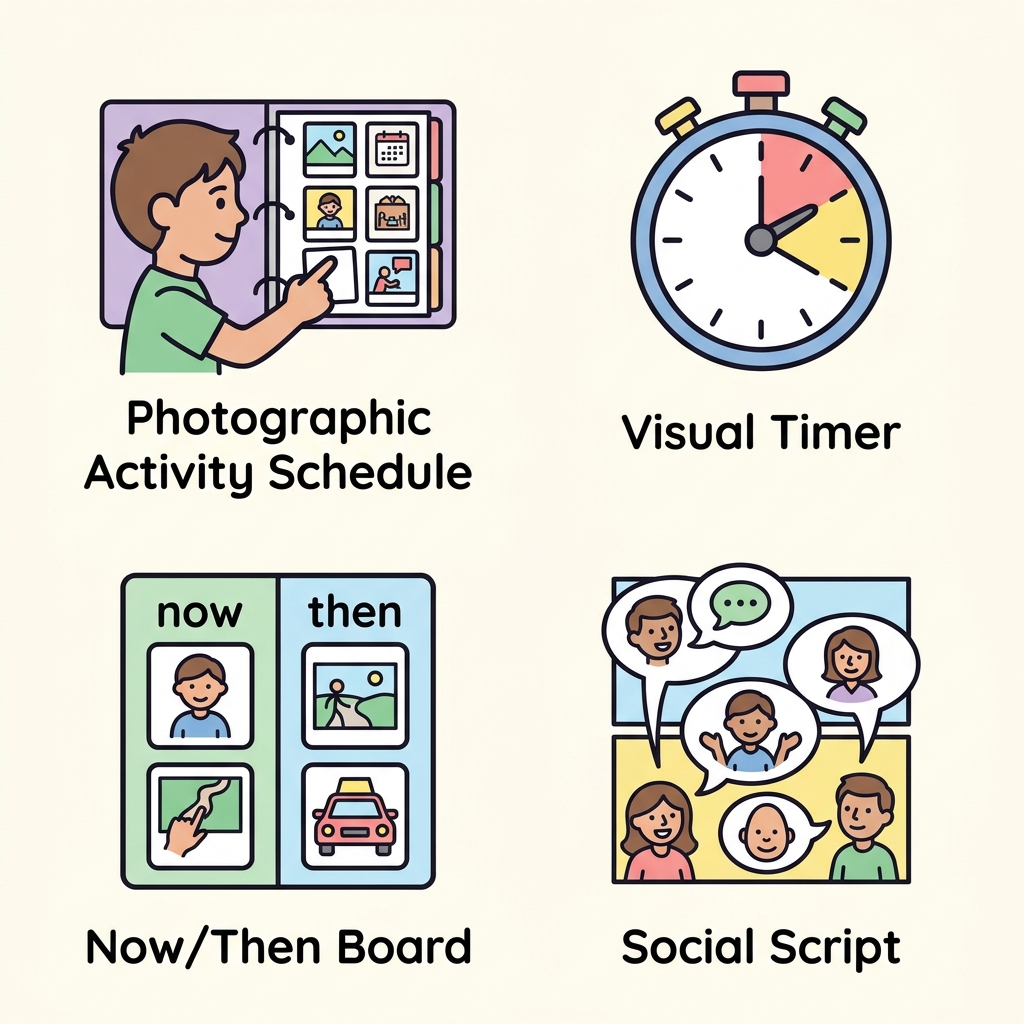
Social scripts can be integrated into activity schedules to improve social interaction outcomes during transitions. Over time, the therapist fades the written prompt, covering parts then removing it entirely, a process called script fading, until the child initiates the interaction independently. ABAI’s resources highlight that this method fosters communicative spontaneity while still providing the schedule’s predictable structure. By embedding social opportunities into the schedule, therapists help children generalize these skills across different people and settings.
Using photography and script fading, behavior analysts are able to show their clients what they need to be doing throughout the day, which will help them become more autonomous as well as handle transitions without feeling anxious. When a client needs fewer prompts from his teacher or mother, he has learned how the various pieces go together. Any parent or educator could employ this same strategy at home or in the classroom if they understood the nature of how the photo boards worked. When we incorporate our knowledge about visual supports, we can make the transition easier for the child, helping him to gain independence even when he isn’t having therapy sessions.
Applying ABA Transition Strategies at Home and in School
ABA strategies can also aid children to better predict and handle the change that happens throughout the day, lowering anxiety and developing self-reliance. To accomplish this, we embed strategies such as task analysis and Natural Environment Teaching in our typical tasks to help children transition smoothly from one activity to another at home and school.
At Home
Families can embed ABA transition strategies in normal tasks and events each day to build predictability and comfort.
- Use Natural Environment Teaching (NET). Brighter Care ABA emphasizes that practicing transition skills during real-life routines like meals, playtime, and dressing helps children generalize what they learn.
- Break the transition into small parts. Task analysis—dividing a complex activity into a sequence of manageable steps—makes expectations clear. Instead of saying “get ready for bed,” we can list: put toys in the bin, walk to the bathroom, pick up the toothbrush.
- Involve siblings. We coach siblings to model transitions calmly and to offer gentle reminders.
- Pair transitions with a predictable positive. Offering a brief preferred activity or praise after a smooth shift—like a sticker—creates motivation.
At School
Classroom transitions can be difficult for some kids, but using ABA strategies in our classrooms will make it easier for them to transition from one activity to another without too much difficulty. Teachers and support staff can take these strategies into their classrooms.
- Create a predictable signal. Whether it’s a chime, a hand signal, or a picture card shown before a switch, a clear prompt prepares the child for the upcoming change.
- Teach a functional communication request. Functional Communication Training (FCT) gives children a reliable way to express needs during transitions. Instead of crying or refusing, a child might hand over a “help” card or say “more time” to request a brief extension.
- Apply task analysis to classroom routines. Breaking a locker change, a shift from circle time to desk work, or a fire drill into clear, simple steps and practicing them repeatedly builds confidence.
- Align school and home plans. When the same language and steps are used in both settings, children experience less confusion and gain skills faster.
Then, as soon as transition practices become regular, children learn to anticipate change as a manageable aspect of each day, making it much more likely they will respond positively when flexibility becomes expected.
The Role of Positive Reinforcement in Building Flexibility
One of the core ideas behind Applied Behavior Analysis is called positive reinforcement: when you offer some sort of positive consequence right away when your child engages in a desirable behavior. This method can help kids be more flexible, particularly as they switch from doing one thing to another activity, going from their house to school, or even just changing locations within the home. When a kid learns that trying something new or shifting focus brings on something good, his resistance decreases and he starts cooperating better.
For instance, if a Board Certified Behavior Analyst (BCBA) were to design a transition plan for a child, she would ensure that there was a reinforcement system in place which catered specifically to his preferences. This could involve giving the child their favourite toy, or praising them verbally, or letting him have time spent doing what he likes most, according to that guidance when teaching functional skills. The BCBA may also break down transitioning between activities into many small chunks and reinforce the child at different points during this process. Thus, this helps children learn that changing activities can be a positive experience rather than a source of stress.
Consider a transition as when children go home from the playground. Instead of requesting that they leave immediately upon giving them a single command, the transition could be done in bits: first, pausing play to acknowledge the transition cue, then picking up a toy, then walking to the exit. Each small step is immediately followed by reinforcement—a cheerful "great job!" or a moment with a tablet—to strengthen the association. This approach, where complex behaviours are broken into simple sequences with each step reinforced, builds toward mastery and reduces frustration.
Consistency is what makes reinforcement truly effective: when parents and therapists use the same reinforcement strategies across settings—at home, in therapy sessions, and at school—the child learns that flexibility is expected and rewarding everywhere. Training for the family is critical, as noted above. The parents then become equipped to provide consistent responses throughout each part of the child’s life. By reinforcing small transition successes throughout the day, families help skills generalize beyond formal sessions, creating lasting behavioral change.
This step-by-step procedure helps lay the groundwork for long-term success with transitions. Building a foundation of trust and predictability through positive experiences paves the way for broader skill development that contributes to a brighter future with ABA therapy.
FAQ
How can ABA therapy help my child manage difficult transitions between activities?
ABA therapy helps children manage difficult transitions by breaking each change into small, predictable steps and reinforcing calm responses. Therapists use task analysis to map out the sequence and Functional Communication Training to teach children to express needs, reducing frustration when activities shift.
What visual tools do ABA therapists use to help children with autism handle changes in routine?
ABA therapists use photographic activity schedules, visual timers, now/then boards, and social scripts. Photographic schedules show pictures of each step in a routine so the child can follow along without needing adult prompts, building independence and predictability during changes.
Why are transitions often so challenging for children on the autism spectrum?
Transitions are often challenging because children on the autism spectrum may experience cognitive rigidity, sensory sensitivities, communication barriers, and heightened anxiety when routines shift unexpectedly. The lack of predictability can feel overwhelming, making even small changes seem like developmental hurdles.
Can ABA strategies for managing transitions be used at home and in school?
Yes, ABA strategies can be used at home and in school. At home, families embed Natural Environment Teaching and task analysis into daily routines, and involve siblings. At school, teachers use predictable signals, Functional Communication Training, and task analysis for classroom shifts, aligning language with home plans.
How does positive reinforcement help improve a child’s flexibility during daily transitions?
Positive reinforcement improves flexibility by immediately rewarding desirable behaviors during transition steps, which reduces resistance and teaches children that shifting focus brings a positive outcome. A BCBA designs a system of favorite items or praise given at each small step of the transition.
Building a Brighter Future with ABA for Transitions
We can apply the same sort of reinforcement to teach kids how to manage transition periods in their day by breaking those routines up into small, teachable parts. With our approach to ABA for managing transitions, these lessons continue until they become new habits rather than just one-off successes.
The guide for Functional Skills talks about Task Analysis and Parent Coaching, plus other things such as the Vineland Adaptive Behavior Scales and how they help set up the plan in order to meet your kids’ specific requirements. If you can bring these reinforcement strategies into the daily life situations, your kid will feel confident while making transitions from home to school to the community.
Results may differ according to each case, thus please consult your doctor in order to be diagnosed or get treated accordingly. By visiting our website, you agree to comply with our privacy policy.
Now that you’re ready for action, we have kind, caring BCBAs and RBTs on our team available to help answer any queries you may have. Give them a call on (833) 400-3970 or visit our Richmond team at 3900 Westerre Parkway.
Begin Your Child’s Transition Journey
Now that you’ve learned how ABA therapy can help your child manage transitions, the next step is to explore personalized support. We offer individualized home-based therapy programs designed to build flexibility and independence in children with autism. Our BCBAs use evidence-based strategies like task analysis and positive reinforcement, as described in this guide, to make daily transitions smoother. We work closely with families in Illinois and Virginia to implement these techniques in real-life settings. Fill out our digital intake form to see if your child qualifies for services. Reach out today and take the first step toward a brighter future for your child.
Begin Your Child’s Transition Journey
