

Table of Contents
- The Role of ABA in Daily Living
- What Are Functional Skills in ABA?
- Key Benefits of ABA for Functional Independence
- How In-Home ABA Builds Functional Skills
- Best Practices for Parents and Caregivers
- Building Lifelong Independence with ABA
The Role of ABA in Daily Living
Beyond foundational learning, ABA therapy services play a pivotal role in helping children with autism develop the practical life skills needed for greater independence at home. By focusing on ABA therapy functional skills, we design interventions that turn everyday routines — like getting dressed, eating a meal, or washing hands — into structured, teachable moments. Our Board Certified Behavior Analysts (BCBAs) create a personalized plan that targets each child’s specific challenges, ensuring that progress is measurable and meaningful.
In our experience, therapy is most effective when it takes place in the child’s natural home environment. This approach allows the skills practiced during one-on-one sessions with Registered Behavior Technicians (RBTs) to generalize into real-world habits. We also prioritize parent training, equipping caregivers with prompting and reinforcement strategies they can use throughout the day to consistently support skill development.
Some of the foundational daily living skills our programs address include:
- Getting dressed independently in the morning
- Transitioning smoothly between activities
- Requesting help appropriately when needed
With these skills in place, families can focus on building even greater confidence and celebrating their child’s growing sense of autonomy.
What Are Functional Skills in ABA?
We define functional skills as the practical, everyday abilities a child needs to communicate, care for themselves, and participate in daily routines. In applied behavior analysis, the leading Behavior Analysis professional organization emphasizes that these skills are essential for building independence. Our approach focuses on developing these foundational abilities through individualized, compassionate support.
Functional skills in ABA therapy for daily living
The development of these skills helps children navigate their world with greater confidence and reduces reliance on constant caregiver support. By focusing on what matters most for each family, we help children learn skills that are immediately useful in their homes and communities.
What Are Daily Living Skills?
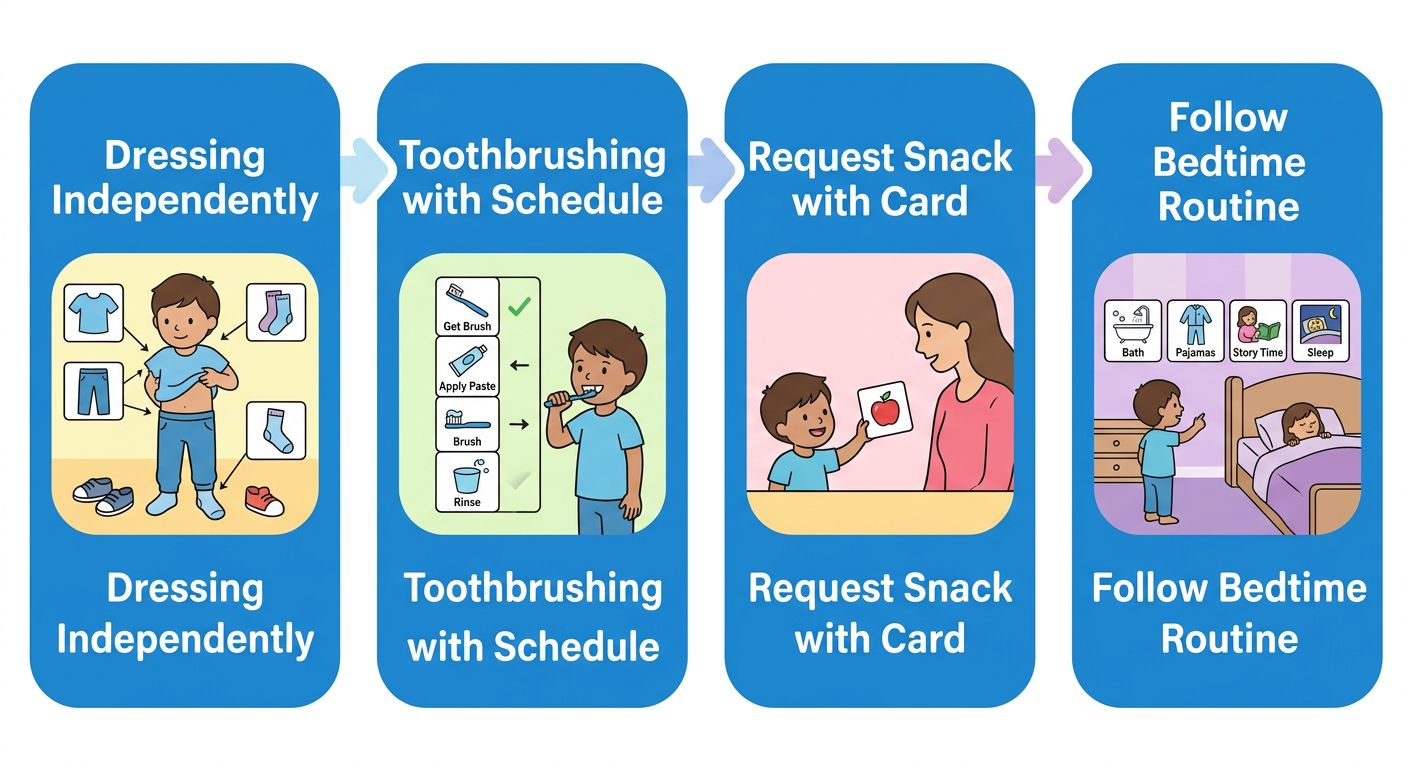
Daily living skills are the self-care routines that allow a child to manage their personal needs. These include dressing, toothbrushing, feeding, and toileting. Mastering these tasks reduces reliance on caregivers and builds the self-esteem that comes from being able to do things for oneself.
Our team works with families to break each task into small, teachable steps. A child who learns to dress independently, for example, gains a sense of accomplishment that extends to other areas of learning. These skills form the bedrock of a more autonomous and fulfilling daily life.
Functional Communication Training (FCT) in Action
Functional communication training teaches children a reliable way to express their wants and needs. Instead of frustration, a child learns that communication gets results. For instance, requesting a snack by pointing or saying “more” replaces the need to cry or reach for an item that is out of sight.
Beyond requesting, we also teach protesting appropriately, such as saying “stop” instead of having a tantrum, and social initiations like saying “hi” to a peer. FCT gives children a powerful, positive voice. By replacing challenging behavior with effective communication, we can reduce frustration and increase meaningful interaction with family and friends.
How a BCBA Assesses Adaptive Behavior
A Board Certified Behavior Analyst (BCBA) begins by understanding a child’s current strengths and needs through a comprehensive adaptive behavior assessment. We often use standardized tools like the Vineland Adaptive Behavior Scales or the ABLLS-R, which are validated for measuring skills in communication, daily living, and socialization.
Direct observation in the child’s natural environment and detailed caregiver interviews are also critical. This combination helps us establish a clear baseline and set meaningful goals. By using these proven tools and listening closely to families, we create a roadmap for building practical skills that can reduce challenging behaviors and increase independence over time.
Key Benefits of ABA for Functional Independence
Now let’s explore the key areas where ABA therapy helps children gain real, lasting independence. When we talk about ABA therapy functional skills, we mean the real-world abilities that help children manage daily life, from morning routines to community safety. For many families, ABA therapy for autism has become a cornerstone of building meaningful independence, and research from the National Center for Biotechnology Information (NCBI) confirms these strategies are effective.
Self-Care and Personal Routines
Self-care skills like handwashing and dressing are essential for independence. Our Board Certified Behavior Analysts (BCBAs) use task analysis to break down each routine into simple, teachable steps. For example, handwashing becomes: turn on the water, wet hands, apply soap, scrub for 20 seconds, rinse, and dry. After each completed step, our registered behavior technicians (RBTs) provide immediate positive reinforcement, such as verbal praise or a preferred toy. A similar approach works for toothbrushing or getting dressed: we break each task into manageable parts, celebrating small successes along the way. Because we work in the home, parents observe and learn these techniques, so skills transfer seamlessly to daily life.
Toilet Training and ABA
Toilet training is a major developmental milestone. We begin by identifying readiness signs, like staying dry for two hours or showing curiosity about the bathroom. Then our BCBAs create a personalized plan with a consistent schedule—practicing sits every 30 to 60 minutes. When a child successfully voids, they receive enthusiastic praise and a highly valued reward; attempted sits bring a smaller reinforcer. This differential reinforcement helps them connect the natural outcome to a big positive. Data collected by our RBTs guides ongoing adjustments, ensuring the plan evolves with the child’s growth. Many children achieve daytime dryness within weeks, and parent training ensures success continues outside sessions. Combined with visual cues and patience, this method turns a challenging routine into a confidence-building experience.
Community Independence and Safety
Community skills like crossing the street and navigating stores are crucial for inclusion. Our therapists practice in real-world settings, such as a local park or grocery store. For instance, we teach a child to wait for the walking symbol, then look left, right, and left again before crossing. Immediate reinforcement for safety checks ensures the behavior sticks. We also practice following store rules, waiting in line, and requesting help. These rehearsals help children generalize skills beyond the home, building their confidence in public spaces. Families continue the practice, and with our support, children truly Succeed with ABA, developing the functional abilities needed for greater independence. These community skills build a foundation for even greater independence at home and in school. As with all therapeutic interventions, results vary by individual, and families should consult with a qualified healthcare professional for diagnosis or treatment guidance.
How In-Home ABA Builds Functional Skills
True progress happens when therapy becomes a natural part of your child’s day. Our approach to aba therapy functional skills centers on this belief: meaningful growth comes from practicing real-world abilities in the places where life actually unfolds. We embed skill-building into the rhythms your family already knows, guided by precise goals and a commitment to consistency across every setting your child experiences. You’re not on your own as we navigate this journey together.
Embedding Therapy into Everyday Routines
We deliver therapy during the moments that already fill your schedule—not in a separate, clinical bubble. During mealtime, a therapist might target requesting, waiting, and utensil use, transforming the dinner table into a classroom for communication and patience. At bedtime, the focus shifts to independence: your child practices toothbrushing, getting into pajamas, and following a visual schedule, turning an evening routine into a confidence-building ritual. Play becomes a vehicle for sharing and turn-taking, all within the safety of your living room.
Because practice happens in your home therapy environment, skills generalize more readily to other parts of life. According to Brighter Care ABA, this family-centered model ensures that personal care mastery and emotional regulation develop where they matter most. And we celebrate every small victory right alongside you.
Goal Setting and Data-Driven Adjustments
Every skill we teach ties to a measurable objective so you can see the path forward. Our BCBAs begin by establishing a clear baseline, then set concrete targets: for example, we may aim to increase independent toilet initiations from two to five per week or reduce aggressive outbursts from five to one per day. These numbers give us a shared language for progress.
We track each step using both naturalistic observation and trial-by-trial data during home sessions. When a strategy isn’t producing the expected gain, we adjust immediately—refining prompts, altering reinforcement, or reshaping the goal itself. Brighter Care ABA emphasizes that this data-driven loop keeps every session purposeful and responsive to your child’s unique trajectory. Every child progresses at their own pace, and our job is to ensure the targets always match their current needs. We keep the path visible and encouraging for both you and your child.
School Support and Cross-Setting Consistency
Growth at home gains even more power when it carries into the classroom. We actively support your child’s school experience by aligning therapy goals with classroom expectations. Our BCBAs attend IEP meetings and share behavior intervention plans directly with teachers, so the strategies that work at your kitchen table also work during morning circle. If your child works on asking for a break at home, we help the teacher use the same signal at school—creating a seamless bridge between settings.
To stay current, we keep our methods aligned with the latest findings in the biomedical research database. Brighter Care ABA’s collaborative approach means educators become partners in your child’s success, reinforcing practical development across the entire day. A bright future is waiting for your child, and we’re here to help build it—one routine, one breakthrough, and one school day at a time.
Best Practices for Parents and Caregivers
Beyond the clinic, parents play a vital role in helping children build lasting skills. You’re not on your own — we partner with families every step of the way. Here are best practices to bring ABA strategies into your daily routines and empower your child to Succeed with ABA.
Reinforcing Daily Living Skills Between Sessions
Reinforcing daily living skills is a key part of ABA therapy functional skills that helps children generalize what they learn in our therapy sessions to the home environment. A consistent approach between formal sessions and everyday life makes a significant difference in building independence. For example, during hand-washing routines, we encourage parents to place a simple visual sequence by the sink showing each step — turn on water, pump soap, scrub, rinse, and dry. This visual cue reduces the need for repeated verbal prompts and fosters self-initiation. When dressing, offering your child two appropriate outfit choices transforms the task into an opportunity to practice decision-making and communication. Embedding these small, structured moments into your day strengthens functional life skills and builds your child’s confidence across natural settings.
The Role of Parent Training
Our structured parent training programs at Brighter Care ABA empower caregivers with practical techniques drawn directly from applied behavior analysis. We offer dedicated 1:1 coaching sessions with a Board Certified Behavior Analyst where you learn to use positive reinforcement effectively and implement antecedent strategies to prevent challenging behaviors before they arise. Our BCBAs stay current with BACB certification updates to provide the highest quality guidance rooted in the latest professional standards. Through these sessions, you gain access to a library of video models that demonstrate how to prompt, reinforce, and shape skills during common routines like mealtimes and play. This training transforms everyday interactions into intentional teaching moments and gives you the tools to support your child’s progress with confidence and consistency.
Making ABA Part of Your Daily Life
Integrating ABA principles into your family’s rhythm doesn’t require a complete overhaul — small, intentional adjustments make a meaningful impact. We recommend creating a visual schedule that highlights three to five key daily routines, such as morning preparation, after-school activities, and bedtime. Displaying this sequence in a central spot gives your child a predictable structure that reduces anxiety and increases cooperation. Use natural opportunities throughout the day to reinforce skills: during snack time, prompt your child to request specific foods using words or pictures, and at bath time, practice sequencing by narrating each step, such as first wash, then rinse, and finally dry. Regular collaboration with your BCBA ensures the strategies you use at home align with current therapy goals, maintaining consistency across environments and accelerating your child’s progress toward greater daily functional skills.
For more personalized support, we encourage you to reach out to our team. We are here to help you build a home environment where your child feels supported, capable, and ready to take on new challenges.
Building Lifelong Independence with ABA
A Bright Future is Waiting for Your Child—one where small, consistent steps toward independence become significant, lasting milestones. Our approach to aba therapy functional skills emphasizes the practical, everyday abilities that allow your child to thrive at home, in school, and within the community.
Through the dedicated work of our 1:1 therapy model with Registered Behavior Technicians (RBTs), we teach essential life skills in the environments where they matter most. This includes mastering daily routines like dressing, eating, and personal hygiene, as well as building communication techniques to express needs clearly. The development of core ABA skills for social interaction, such as taking turns with peers or greeting adults, is equally vital. Complex tasks are broken into small, teachable steps and reinforced with positive encouragement, transforming a challenge into a celebrated achievement. Your child learning to request a favorite snack or independently put on their shoes becomes a powerful moment of growth.
Building these skills for independence is a gradual process guided by our Board Certified Behavior Analysts (BCBAs) and supported by attentive parent training. We partner with your family every step of the way, which is why we are the trusted autism therapy provider for families in your area. Together, we lay the foundation for a future filled with confidence and capability.
Resources
- Discover Brighter Care ABA Therapy Services for Children
- Find Personalized Autism Therapy with Brighter Care ABA
- Get Expert ABA Therapy for Autism from Brighter Care
- Learn About Home-Based ABA Therapy for Kids
- Explore BCBA and RBT Career Opportunities at Brighter Care
- Understand the 2026 RBT Certification Changes and Updates
- Contact Brighter Care ABA for Personalized Therapy Help
- Get the Latest BACB Certification Updates and Requirements
- Access Biomedical Research Databases with NCBI Resources
- Join ABAI for Behavior Analysis Resources and Events
