

Table of Contents
Comparing In-Home and Clinic-Based ABA Therapy
At Brighter Care ABA, we understand that selecting between in-home and clinic-based therapy is a significant choice for families. Each setting provides distinct advantages, and the right fit depends on your child’s unique strengths, goals, and daily routine.
In-home therapy allows our team to practice skills right where your child lives and plays. By using natural environment teaching, we can integrate learning into mealtime, playtime, and family activities, which often speeds up generalization. Parents can actively participate, and sessions can adapt to the family’s schedule without travel stress.
Clinic-based therapy offers a structured setting with access to specialized materials and social interactions with peers. These environments can be especially helpful for building social skills in a controlled space, away from household distractions.
Many families begin with in-home services because of the convenience and personalized approach, then transition to clinic-based sessions as social goals emerge. If you are searching for ABA therapy for preschoolers near me, we offer both options through our care programs in Illinois and Virginia, giving your child a supportive path toward growth.
1. Natural Environment Teaching
One of the most effective ABA techniques we bring into your home is Natural Environment Teaching (NET). Unlike structured approaches, NET turns daily routines—mealtime, play, bath time—into natural learning opportunities. For families weighing in-home ABA therapy vs clinic-based care, NET uses the home’s familiar context to make skills stick.
Because NET follows your child’s lead, it uses their interests as motivation, keeping them engaged. Data from the National Center for Biotechnology Information confirms NET’s effectiveness in improving social behaviors and generalization. This means your child practices turn-taking with a sibling or requests a snack in the kitchen, building social skills naturally. Socialization for children with autism becomes part of fun, not a separate task.
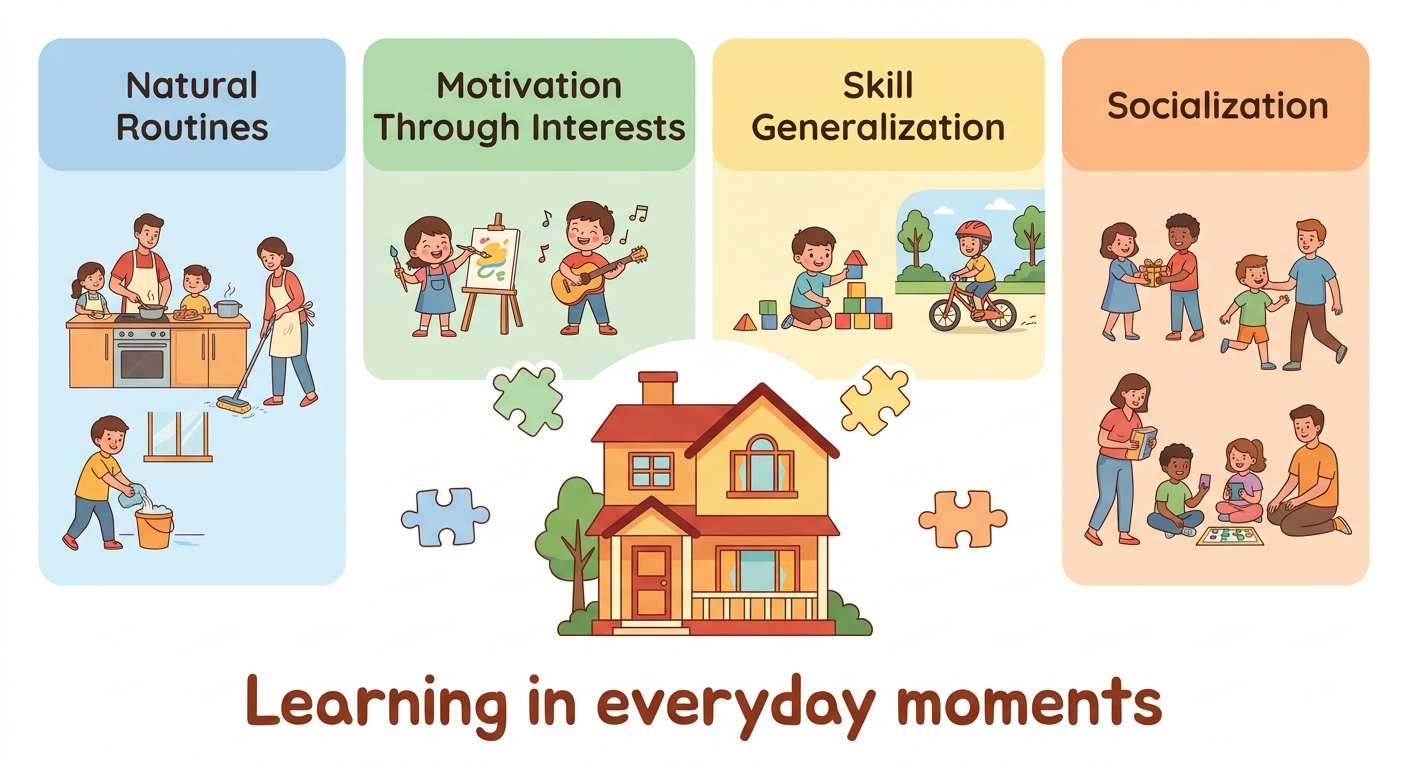
Learning in everyday moments through natural environment teaching.
During a home session, our BCBA-led RBTs weave teaching into play: your child learns to put on shoes as a step-by-step routine or initiates a game to practice communication. These functional skills—requesting, sharing, washing hands—stick because they’re practiced where they’re used.
You’re central to this process. We’ll teach you to spot learning moments in your day, integrating NET into family life. For personalized support, schedule an autism caregiver consultation with our team. This play-based approach sets the stage for other strategies like Discrete Trial Training, helping you feel confident in supporting your child’s growth. Results may vary based on individual patient circumstances.
2. Family Routine Integration
One key advantage of in-home ABA therapy vs clinic-based is the ability to weave therapeutic moments into daily routines, right in the comfort of your home. Integrating ABA therapy functional skills into everyday activities helps children practice learned behaviors in meaningful contexts. At Brighter Care ABA, we guide families to use simple tools like visual schedules for the morning routine—showing steps such as brush teeth and get dressed—so children can follow along with growing independence. During mealtimes, a token economy reinforces appropriate sitting and eating, turning everyday moments into natural learning opportunities.
These practices align with natural environment teaching principles by capturing skills in real settings like the kitchen or bathroom, which helps your child generalize what they learn. BCBAs provide ongoing supervision and adjust these routines as your child progresses, so you’re never alone in the process. We also encourage siblings to join in structured play like turn-taking games, creating organic socialization for children with autism right at home. Integrating these supports doesn’t demand extra time—it simply reshapes existing activities into moments of growth. With consistent guidance and a family-centered approach, you can succeed with ABA, building confidence one routine at a time.
3. Social Skill Development
Beyond building communication and reducing challenging behaviors, ABA therapy also focuses on helping children develop meaningful social connections. At Brighter Care ABA, we help children succeed with ABA by designing individualized social skill goals and using natural environment teaching (NET) to practice them during everyday routines—like playdates, mealtimes, and park outings.
We break down complex social behaviors into small, measurable steps: a child might practice initiating a greeting to a peer three out of five opportunities. Parents play a crucial role—we coach you to facilitate peer interactions with siblings or neighborhood friends during daily life. This hands-on, home-based method significantly improves socialization for children with autism.
Peer-reviewed ABA therapy research articles confirm that natural environment teaching enhances social outcomes. According to the Association for Behavior Analysis International, embedding goals like sharing and reading social cues in real-world settings leads to better generalization. Our team works with your family in familiar places—like the grocery store or playground—so your child builds confidence and practices these skills in the community.
Choosing in-home ABA therapy vs clinic-based options gives children the advantage of learning social skills where they naturally occur, reducing anxiety and promoting genuine connections. You’re not on your own—our parent training and ongoing support empower you to guide your child’s growth every step of the way. These social skills become the building blocks for greater independence in the community, which we explore next.
4. Personalized BCBA Support
Central to every therapy plan is the personalized support of a supervising BCBA—you’re not on your own. When weighing in-home ABA therapy vs clinic-based options, families often choose the familiar comfort of home, where therapy integrates seamlessly with daily life. We assign a dedicated BCBA to your family, who begins with a comprehensive assessment to pinpoint your child’s unique strengths and challenges.
Each of our BCBAs meets the rigorous certification standards of the Behavior Analyst Certification Board. Our approach aligns with recommendations from the ABA professional association, ensuring evidence-based practices. We provide this collaborative model to families in Illinois and Virginia, with your BCBA overseeing every session to maintain consistency.
We provide consistent parent training so you can reinforce skills during daily routines. Your BCBA designs sessions around natural environment teaching, turning everyday moments into learning opportunities. They also coach socialization for children with autism, supporting peer interactions and play in your home’s comfortable setting. This integrated care builds skills that generalize across settings and become a lasting part of your child’s development. Through ongoing collaboration with your family and our RBTs, your BCBA ensures a truly unified experience. A Bright Future is Waiting for Your Child.
5. Insurance Assistance
We understand insurance can be overwhelming, but you’re not on your own. Many families exploring in-home aba therapy vs clinic-based options worry about coverage, so Brighter Care ABA handles the entire insurance process for you. We take care of verification, pre-authorization, and ongoing billing so you can focus on your child’s progress.
Our team works with a wide range of insurance plans and verifies benefits for all therapy settings. Whether your child’s plan emphasizes natural environment teaching or supports socialization for children with autism, we confirm what is covered before treatment begins. Our Board Certified Behavior Analysts (BCBAs) adhere to rigorous BCBA certification standards, ensuring every treatment plan meets the highest ethical and professional requirements that insurers recognize. We manage authorizations and billing from start to finish, removing financial uncertainty so your family can move forward with confidence.
You’re not on your own. Contact us today for a free, no-obligation insurance benefits check, and let us handle the details while you focus on what matters most. Results may vary based on individual patient circumstances, and we encourage families to consult with their healthcare provider for diagnosis or treatment advice.
6. Skill Generalization
When parents weigh in-home ABA therapy vs clinic-based options, one of the most important concepts to understand is skill generalization: the ability to apply a learned behavior across different people, places, and materials. A child who uses a request like “I want water” at the therapy table, at grandma’s house, and in the classroom is demonstrating that the skill has truly become part of their everyday communication toolkit.
Natural environment teaching is the primary ABA strategy we use to build generalization because it embeds learning in the rhythms of your child’s actual day—labeling foods during snack time, practicing greetings when a sibling walks in the door. This is where in-home ABA therapy offers a distinct advantage. Because your home is already the setting where real interactions happen, skills transfer more automatically than they might from a sterile therapy room. A child who learns to greet others during home-based sessions will more naturally extend that same behavior to family members, friends, and visitors because the context is genuine, not simulated. Research confirms that intentional generalization is essential for skill retention and functional independence, and when we deliberately target socialization for children with autism in this way, the social gains achieved at home carry over to playdates, community outings, and school settings.
When skills stick in every setting, your child gains true confidence and the ability to succeed anywhere. Achieving that level of consistency often depends on the partnership we build with parents—a partnership we explore in the next section.
Choosing What Works for Your Child
Once you understand the basics of ABA therapy, the next step is deciding where therapy happens. Choosing between in-home ABA therapy vs clinic-based settings depends on your child’s unique needs, your family’s schedule, and therapy goals. In-home therapy uses everyday surroundings to teach, while clinic sessions offer a dedicated, structured environment. Understanding the benefits of each approach helps you make the best choice.
In-home therapy leverages natural environment teaching by embedding learning into daily routines, helping children generalize skills to everyday life. Clinic-based settings may provide more structured socialization for children with autism through peer interactions, but home-based therapy can incorporate sibling play and community outings. We help parents weigh these factors to decide what fits their child best. We know that a child’s comfort and family involvement are crucial, so we discuss each option with you to find the right balance.
At Brighter Care ABA, we provide home-based ABA therapy with parent training and school consultation. Our BCBAs design individualized plans and oversee progress. You’re not on your own. Contact us for a free consultation. With our support, a bright future is waiting for your child. Results may vary.
