



Table of Contents
Understanding Naturalistic Developmental Behavioral Interventions for Autism
When exploring naturalistic developmental behavioral interventions for autism, families often wonder how these child-led methods differ from traditional ABA therapy. Unlike discrete trial training, which uses adult-directed drills, NDBI embeds learning within motivating, child-initiated activities like playing with toys or sharing a snack. This approach blends developmental and behavioral science to teach communication, social, and adaptive skills in real-life situations. Two widely studied NDBI models, the Early Start Denver Model and Pivotal Response Treatment, have strong research support from the National Institutes of Health. At Brighter Care ABA, we integrate these naturalistic principles into our home-based therapy across Illinois and Virginia, tailoring every session around your child’s daily routines. The result is personalized ABA therapy for children with autism that feels less like clinical exercises and more like playful, relationship-based learning, because we believe a bright future is waiting for your child.
1. Building Skills Through Every Day Play
Play is a natural motivator for children, and with naturalistic developmental behavioral interventions autism-specific approaches, everyday moments like building with blocks or pretending to cook become opportunities to build real-world skills.
These strategies, known as naturalistic teaching or play-based learning, follow your child’s lead and embed goals within their favorite activities. The Early Start Denver Model uses joint play routines to encourage language and imitation, while Pivotal Response Treatment focuses on motivation and self-initiation, targeting pivotal areas like language and social behavior.
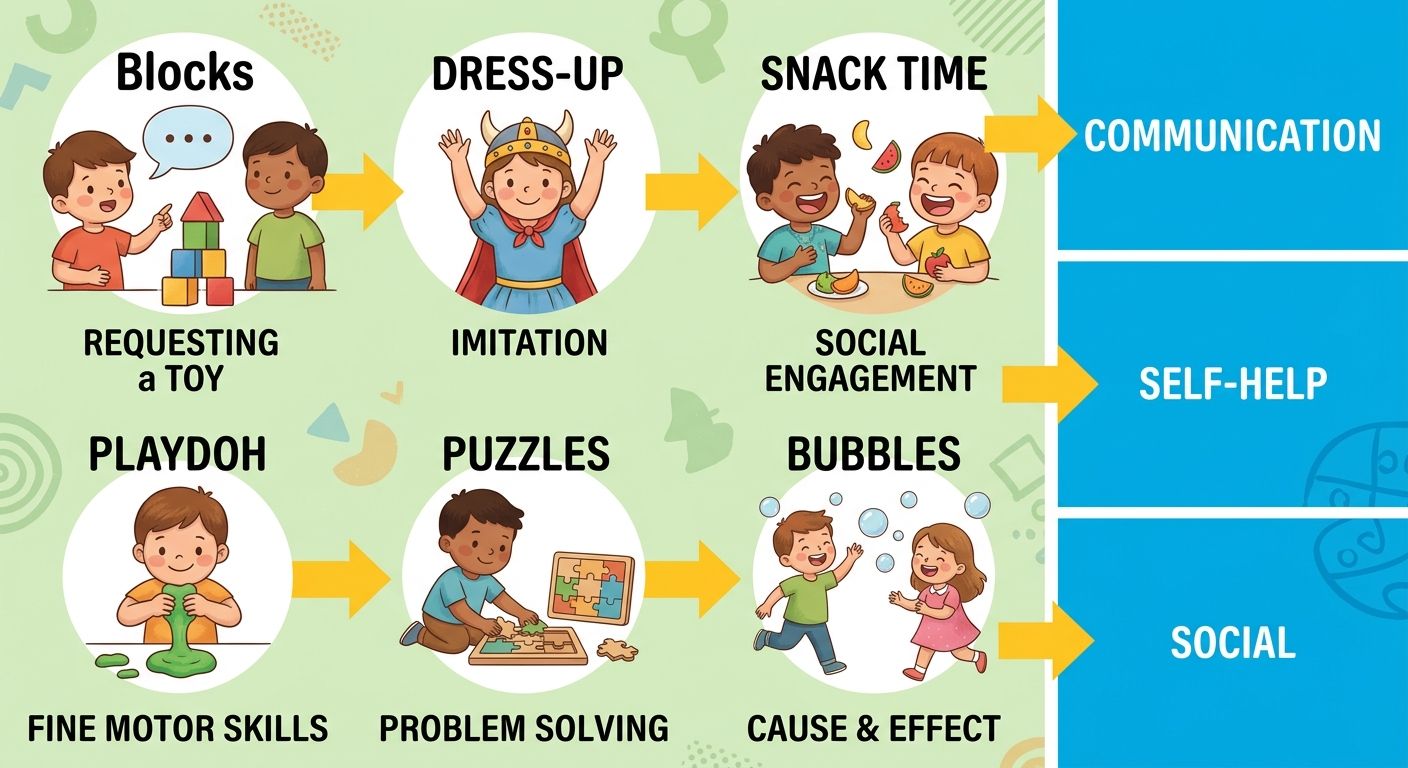
From play to progress: everyday activities that build skills
For instance, during snack time you might encourage your child to request ‘more crackers’ to practice communication, or during dress-up you might work on self-help skills like putting on shoes. We’re here to help you weave these techniques into your daily routines, so your child can succeed with ABA and reach new milestones. Results may vary based on individual patient circumstances. For additional support, families can connect with the Play Based ABA Therapy Association.
2. Turning Routines into Learning Opportunities
Everyday moments like mealtime or getting dressed can become naturalistic developmental behavioral interventions for autism. These naturalistic teaching strategies turn routines into powerful learning opportunities. For example, while brushing teeth, you can model words and reinforce communication. Getting dressed lets you practice following directions and making choices. Such embedded learning moments build social, communication, and self-help skills. Two evidence-based approaches are Pivotal Response Treatment (PRT), which targets motivation and response to multiple cues, and the Early Start Denver Model (ESDM), designed for young children in everyday settings. For more on the research behind these methods, explore naturalistic behavioral interventions resources.
At Brighter Care ABA, our therapists integrate these strategies during home visits, turning daily routines into therapeutic moments. We provide parent training so you can reinforce skills throughout the day. You’re not on your own — our team is here to support you. Results may vary based on individual patient circumstances, but consistent practice can help your child grow. To learn more about our home-based ABA services in Illinois and Virginia, contact us.
3. The Science Behind Naturalistic Teaching
Now that we’ve seen what naturalistic teaching looks like, let’s explore the science behind naturalistic developmental behavioral interventions autism—an evidence base developed through decades of behavior analysis research. The Association for Behavior Analysis International (ABAI) provides authoritative guidelines that support this approach.
These naturalistic developmental behavioral interventions autism are exemplified by the Early Start Denver Model (ESDM) and Pivotal Response Treatment (PRT). Both models use child-initiated interactions and natural reinforcers to strengthen communication, social, and adaptive behaviors. In these child-led sessions, therapists follow the child’s interests, making learning natural and motivating. Each approach is data-driven and individualized, reflecting decades of behavior-analytic research. The Association for Behavior Analysis International (ABAI) confirms that such strategies are grounded in proven behavior-analytic principles. These methods are implemented by practitioners who hold a behavior analyst certification, ensuring fidelity to the evidence base.
This strong scientific foundation translates into the techniques we use every day with families in Illinois and Virginia. By harnessing this science, we help your child succeed with ABA, building skills that last. Results may vary based on individual patient circumstances.
4. How Early Start Denver Model Fits In
Among the NDBI approaches we’ve covered, the Early Start Denver Model (ESDM) stands out for its structured, play-based framework. As a prominent naturalistic developmental behavioral intervention for autism, ESDM is designed for children ages 12 to 48 months, blending ABA strategies with child-led activities.
According to the National Center for Biotechnology Information (NCBI), the Early Start Denver Model is recognized as a well-supported NDBI with evidence of improving communication, social interaction, and cognitive outcomes. Unlike highly structured therapy, the ESDM approach embeds teaching opportunities within everyday routines—mealtimes, play, and family interactions—using natural reinforcement rather than drill-and-practice. This manualized, evidence-based format is why many autism intervention programs incorporate its techniques.
To help your child succeed with ABA, we integrate ESDM principles into home sessions. ABA therapy functional skills are woven into play-based activities in a way that feels natural and motivating.
These elements make ESDM a cornerstone of early NDBI practice; another related model, pivotal response treatment, offers complementary strategies, which we cover next.
5. Pivotal Response Treatment: Focusing on Key Behaviors
One well-researched naturalistic developmental behavioral intervention for autism is Pivotal Response Treatment (PRT). PRT is a child-led, naturalistic ABA therapy that targets pivotal areas—motivation, responsivity to multiple cues, self-management, and initiation of social interactions—rather than individual behaviors. As part of the NDBI category, alongside models like the Early Start Denver Model, PRT emphasizes learning in everyday settings.
PRT focuses on four interconnected pivotal areas—motivation, response to multiple cues, self-management, and initiation—which are taught through natural reinforcement in everyday routines. By following the child’s lead and using preferred activities, we create learning opportunities that feel like play. As a naturalistic developmental behavioral intervention for autism, this approach ensures that new skills carry over to real-life settings.
Research and the U.S. Department of Education support PRT as an evidence-based practice. At Brighter Care ABA, we target pivotal behaviors that build ABA therapy functional skills. We help children succeed with ABA. Results may vary. We’re here to help your child build lasting skills—you’re not on your own.
6. Creating a Supportive Home Environment
Your home is where your child practices new skills in the moments that matter most — and it is the ideal setting for naturalistic developmental behavioral interventions autism programs to thrive. When we shape the home environment to support ABA goals, we help your child generalize communication, play, and daily living skills across the routines your family already follows.
To help your child Succeed with ABA, start with these practical steps you can take today:
- Build predictable routines. A simple visual schedule for morning, after-school, or bedtime reduces anxiety and invites cooperation — especially when your child knows what comes next.
- Design a calm learning space. A clutter-free corner with minimal distractions supports focused therapy sessions, while everyday moments like meals, bath time, and play become opportunities to embed naturalistic developmental behavioral interventions autism.
- Follow your child’s lead. Child-led, play-based approaches — such as the early start denver model — weave teaching into your child’s favorite activities. When your child reaches for a toy, we can model a sound or gesture, turning a natural interest into a communication lesson.
- Use pivotal response treatment strategies at home. Reinforce attempts at communication, choice-making, and self-initiation with praise or a preferred item. This strengthens motivation and helps pivotal skills spread to other areas of development.
- Reduce overstimulation. Labeled bins, visual supports, and sensory-friendly spaces build independence and make transitions smoother for the whole family.
- Involve siblings and caregivers. When everyone in the household uses similar language and reinforcement, your child experiences a unified support system that strengthens every interaction.
Parent training sessions with your BCBA are designed to provide personalized strategies for your home. If you would like additional guidance on setting up your environment, we encourage you to reach out to Brighter Care ABA for a consultation.
Results may vary based on individual patient circumstances.
7. Partnering with Therapists for Consistency
Building on that teamwork, let’s look at how you can partner directly with your child’s therapist. Consistency doesn’t end when the therapy session does—it grows when families and therapists work together. You’re not on your own. At Brighter Care ABA, we make that partnership a daily priority.
Consistency is vital when using naturalistic developmental behavioral interventions such as the Early Start Denver Model or Pivotal Response Treatment, which depend on teachable moments woven into everyday routines. That’s why our parent training equips you with practical strategies to reinforce skills between sessions. Our home-based model means your child learns in the environment they know best, making it easier to practice new behaviors consistently. Our BCBAs provide ongoing guidance and celebrate each milestone with you so you feel confident every step of the way.
This partnership lays the foundation for lasting progress—read on to see what that progress can look like for your child.
8. Tracking Progress with Measurable Goals
We embed progress tracking in naturalistic developmental behavioral interventions autism from the first assessment, setting measurable goals that reflect each child’s unique profile.
Each goal we set is specific and measurable, targeting communication, social, and adaptive skills identified in initial assessments. Data collection happens through direct observation, frequency counts, and graphing during naturalistic ABA sessions at home. Whether we apply the Early Start Denver Model or Pivotal Response Treatment, we monitor child-initiated interactions and developmental gains every session. You’re not on your own: parent training sessions provide regular collaborative reviews so families can see progress and reinforce skills across routines. This behavioral tracking enables our BCBA supervisors to adjust treatment plans precisely, keeping interventions evidence-based and responsive to each child’s growth. We share all data transparently to strengthen our partnership.
By tracking measurable goals, our team ensures naturalistic developmental interventions remain effective. A bright future is waiting for your child, and we’re here to help them succeed with ABA. (Results may vary.)
Embrace Naturalistic ABA for Lasting Progress
Building on that foundation, we embrace naturalistic ABA, a child-led, play-based approach that uses naturalistic developmental behavioral interventions for autism to promote skill generalization in everyday routines. Rooted in Naturalistic Developmental Behavioral Interventions (NDBI), this method contrasts with structured table-top formats, encouraging children to learn through play and daily activities. Two evidence-based NDBI models—the Early Start Denver Model (ESDM) and Pivotal Response Treatment (PRT)—show how playful interactions build communication, social, and adaptive skills that last. Our BCBAs weave these strategies into 1:1 home-based therapy in Illinois and Virginia, making sure progress extends across home, school, and community settings. Reach out to Brighter Care ABA to learn how your child can succeed with ABA.
