

Table of Contents
Navigating School-Based ABA Support for Your Child
Now that you understand the fundamentals of ABA, let’s focus on how school-based aba support helps your child thrive in the classroom. We believe learning happens everywhere, which is why we provide personalized ABA therapy services that extend directly into your child’s school day. As your partner, we coordinate closely with teachers, aides, and your IEP team to align our strategies with the academic environment, creating a consistent circle of support.
Our process begins with you simply requesting a consultation with our BCBA team. From there, we conduct classroom observations, develop a Behavior Intervention Plan, and provide hands-on training for school staff. Every approach is tailored to your child’s unique strengths and the school’s specific culture, ensuring meaningful ABA support in school. As with any therapy, results may vary based on individual patient circumstances. Ready to take the next step? Contact our team to schedule a consultation.
Preparing for School-Based ABA Collaboration
To make school-based ABA support effective, preparation is essential. We help families take a structured approach to collaborating with schools, ensuring your child’s therapy complements their classroom experience. A key part of this is understanding the Individualized Education Program, a legal document that outlines educational goals and any related services. According to the U.S. Department of Education, you have the right to request a copy of the IEP before any meeting, which gives you time to review current goals and think about how ABA support within the school setting can best fit in.
Gather reports from teachers, any previous ABA data, and a written list of your main concerns and questions. Having this information at your fingertips turns a potentially overwhelming meeting into a focused, productive conversation. We also recommend verifying professional credentials. Confirm that the board certified behavior analyst you are working with meets current BACB certification requirements by checking the national registry. This step confirms you have a qualified expert guiding your child’s program.
We offer dedicated school support consultation to help you navigate these steps and align documents with therapeutic goals. You’re not on your own. Contact our team to learn how we can help you prepare for school-based ABA support and we will work together so you and your child can Succeed with ABA.
Step 1: Identify Your Child’s School-Based ABA Needs
Now that you understand the potential benefits of school-based aba support, we can begin with the first and most important step: identifying your child’s unique needs in the classroom. Every child’s journey is different, and clarifying your observations will help you build a strong foundation for your search. We know the journey can feel overwhelming, but you’re not on your own.
To get started, reflect on the specific challenges your child faces during the school day. Does your child have difficulty following group instructions, initiating peer interactions, or staying regulated during transitions? Write down the behaviors that impact their learning and social engagement, and note whether they already receive any support through an IEP or 504 plan. Consider your preferences for communication between the school team, your BCBA, and your RBT, as this coordination is essential. You’ll also want to confirm that any provider you consider meets the state’s BCBA supervision requirements, which mandate at least 5% oversight of total service hours to ensure quality therapy.
Once you have a clear picture of your child’s needs and the type of classroom support that would help, you’re ready to research which providers offer the right fit. Results may vary based on individual patient circumstances. Please consult with a healthcare professional for diagnosis or treatment advice.
Step 2: Communicate with Your Child’s School Team
Once you’ve established a routine at home, the next step is to bring the school team into the loop. Effective school-based ABA support starts with open communication, and we want you to feel empowered. You’re not on your own — we’ll guide you through initiating this partnership with your child’s educators.
Begin by scheduling an initial meeting with the school’s special education coordinator and your child’s classroom teacher. In preparation, we recommend putting together a one-page summary of your child’s current ABA goals, interventions, and progress. Sharing contact information for your BCBA during this meeting opens the door for direct, ongoing dialogue. To formalize this collaboration, request a signed release of information, which enables data sharing between our team and the school. Brighter Care ABA provides comprehensive autism ABA therapy services that extend into the school environment, ensuring consistency in your child’s behavioral strategies. With these communication channels open, you’re ready to move into implementing strategies across both settings.
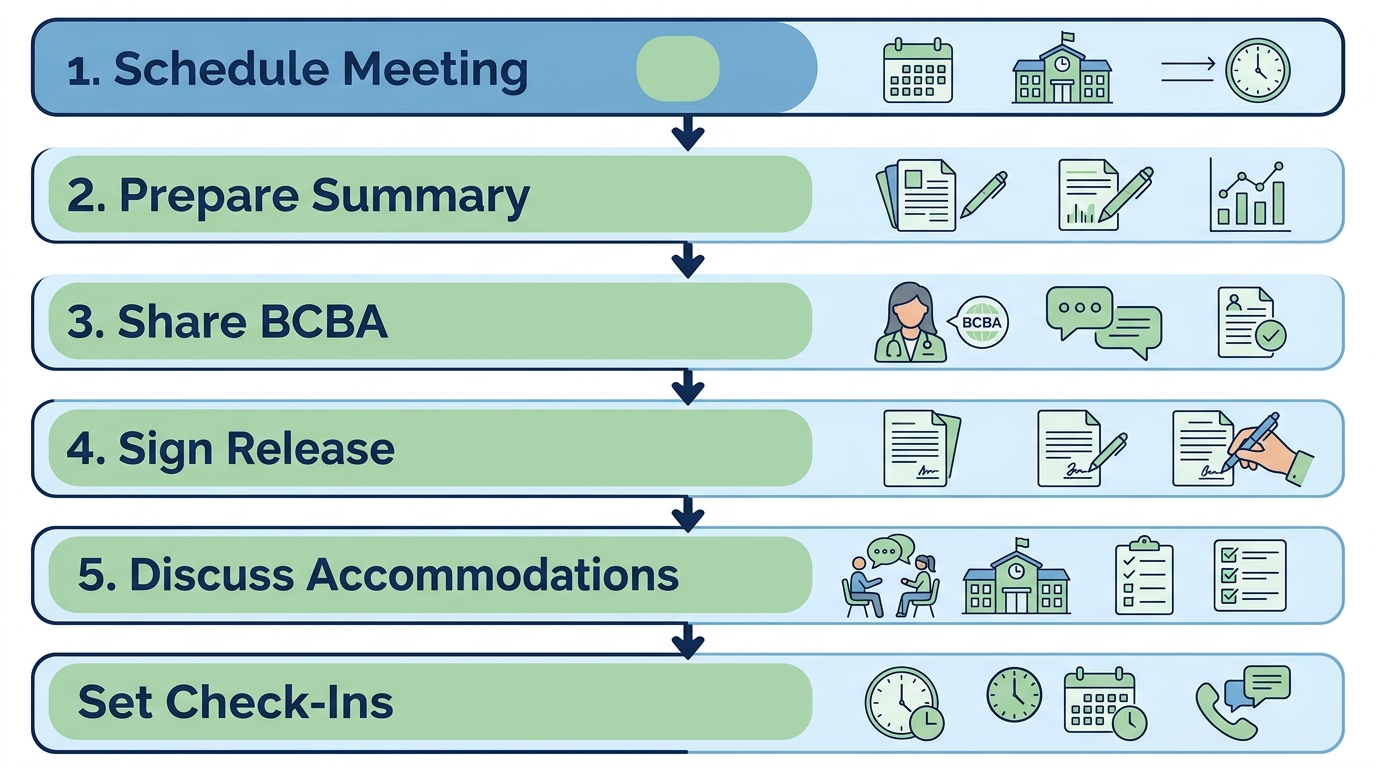
Six-step communication process for school-based ABA support
Step 3: Align ABA Goals with the IEP
Now that you’ve identified your child’s strengths and needs, the next step is ensuring those ABA objectives fit seamlessly with the school’s plan. For school-based ABA support to succeed in Illinois, your child’s therapy targets must complement—not duplicate—IEP academic and behavioral goals. We encourage scheduling a joint meeting with your child’s BCBA and the school’s IEP team so everyone works from the same blueprint.
Bring ABA progress data to the table. Research from the NCBI biomedical databases consistently shows that ABA therapy improves outcomes when goals are coordinated with school plans. By sharing skill acquisition graphs and behavior reduction metrics, you help the IEP team see where classroom accommodations, such as reinforcement schedules or prompting strategies, can be written directly into the plan. Brightcare ABA provides school-based ABA support and consultation in Illinois to attend these meetings alongside you and align home, clinic, and classroom strategies.
This collaboration builds skill generalization across environments. Once goals are aligned, the next step is to monitor progress together with the school team.
Step 4: Integrate ABA Strategies into the Classroom
When seeking school-based ABA support, teachers can apply evidence-based strategies that foster both academic engagement and functional independence throughout the daily routine. We believe that classroom-based ABA support helps children generalize skills they have already practiced in home sessions, building confidence during transitions, group work, and peer interactions.
- Reinforcement systems: A token economy lets students earn points or stickers for on-task behavior, then exchange them for preferred activities. This simple structure keeps motivation high while reinforcing classroom expectations.
- Task analysis and prompting: Break morning routines into defined steps—hang up backpack, turn in homework, start bell work—and use visual or verbal prompts to guide each step until the child performs the sequence independently.
Our BCBAs partner directly with teachers to design an individualized behavior intervention plan that fits the existing classroom rhythm. For example, a Brighter Care ABA behavior analyst might observe a reading block, suggest a peer-buddy reinforcement strategy, and train classroom aides on data collection using interval recording to monitor progress.
With these classroom strategies in place, the next step is monitoring student progress and adapting the approach. Succeed with ABA when every part of a child’s day reinforces independence—a bright future is waiting for your child. For additional guidance on evidence-based classroom strategies, teachers can browse the US Department of Education blogs.
Results may vary based on individual patient circumstances.
Step 5: Arrange RBT Support in School
Brighter Care ABA believes that school-based ABA support extends your child’s progress beyond the home and into the classroom, where real-world social and academic skills take shape. Our team makes the process straightforward so your child receives consistent, coordinated care across every environment.
To arrange an RBT in your child’s school in Illinois or Virginia, start by meeting with your BCBA to discuss readiness and goals. Next, we help you obtain school permission and coordinate directly with teachers and administrators, aligning our support with your child’s IEP or school plan. Once approved, we schedule an RBT—a paraprofessional certified by the Behavior Analyst Certification Board (BACB)—to work during the school day under ongoing BCBA supervision. In-school ABA services help children generalize skills from home sessions to peer interactions and classroom routines, building confidence and independence.
You’re not on your own. We handle the logistics and communication, letting you focus on your child’s success. Results may vary based on individual patient circumstances. When you are ready to bring ABA support into the school setting, contact us to begin the enrollment conversation.
Step 6: Monitor Progress and Adjust Strategies
After we put the plan into action, our Board Certified Behavior Analysts (BCBAs) closely track how your child responds through regular progress reviews. Our Registered Behavior Technicians (RBTs) collect data during every 1:1 therapy session, and we combine that information with the observations you share from outside of therapy hours to get a complete picture of your child’s development. This data-driven collaboration helps us evaluate effectiveness and decide when it is time to refine strategies. Whether we are modifying reinforcement systems, updating skill targets, or refreshing parent training goals, we adjust our approach to help your child make meaningful gains. For families participating in school-based ABA support, we also share progress data with teachers and school staff so the strategies we use at home stay consistent in the classroom. We count on our parents, and by working together we can keep therapy aligned with your child’s evolving needs and work toward the best possible outcomes. Results may vary based on individual patient circumstances.
Step 7: Foster Ongoing Communication Between Home and School
Finally, to make all previous steps stick, we at Brighter Care ABA encourage maintaining consistent, two-way communication between home and school. Effective school-based ABA support relies on a strong partnership where strategies and wins are shared openly, ensuring your child’s progress is reinforced across every environment. We act as your bridge, helping align goals and celebrate milestones together.
To build this collaboration, start with small, consistent habits. Schedule a weekly 15-minute check-in with your child’s teacher — a quick call or shared note works perfectly. Use a simple daily communication log to record functional-skill successes and any challenges observed at home or in the classroom. We also recommend sharing your BCBA-approved behavior plan with the school team and proposing a joint meeting at the start of each term so everyone can align on shared objectives.
With these steps, we help weave school-based ABA support into a unified, encouraging system. Brighter Care ABA’s school consultation services are here to facilitate these conversations and keep your child’s development on track. We’re with you, every step of the way.
Results may vary based on individual patient circumstances.
Troubleshooting Common Challenges in School-Based ABA
Successfully providing school-based aba support in Illinois and Virginia involves navigating a series of collaborative hurdles, but with the right strategies, these challenges transform into opportunities for growth. We’ve seen that a common obstacle is a lack of communication and coordination between a child’s home ABA team and the school staff. To bridge this gap, we encourage regular joint meetings between the supervising BCBA and the teacher, using shared behavior tracking tools and parent-mediated communication notes. This ensures everyone is aligned on goals and progress, making every school day a consistent learning experience.
Another difficulty is inconsistency in data collection across settings, which can obscure a child’s true progress. Our team addresses this by introducing a unified data sheet, either paper or digital, that both the RBT and the classroom teacher can fill out. This sheet is then reviewed weekly by the BCBA, providing a single source of truth that captures skill generalization across the home and school environments. According to the Behavior Analyst Certification Board (BACB), this kind of interdisciplinary collaboration is a core ethical responsibility that guides professional conduct in schools and ensures evidence-based practice.
We also find that teachers, while incredibly dedicated, sometimes feel unsure about implementing ABA strategies like reinforcement schedules. To solve this, our BCBAs provide in-service training and create simple, one-page visual guides tailored for the classroom. Building on Brighter Care ABA’s philosophy that therapy promotes independence across all environments, including the school community, collaborative support empowers teachers and helps your child succeed with ABA. You’re not on your own; these strategies are just the start—our team is ready to tailor further school-based aba support for your child’s unique school situation.
Building a Coordinated Support Team for School Success
These same principles extend into the classroom. A strong school team makes all the difference—and at Brighter Care ABA, we believe effective school-based ABA support depends on collaboration. When parents, educators, and behavior specialists work together, children experience the consistency between home and school that helps skills truly stick.
Our Board Certified Behavior Analysts (BCBAs) work alongside each child’s classroom teacher, the special education coordinator, their Registered Behavior Technician (RBT), and you—the parent. Together, we set shared goals and hold regular meetings to review progress data and adjust strategies as needed. This coordinated school approach helps everyone stay aligned and respond quickly when something isn’t working.
You’re not on your own. We also provide parent training so you can reinforce those same strategies at home. A thoughtful school success team—built on communication, trust, and data—gives your child the best chance to thrive across every environment. Every child’s journey is unique, and we’re here to help you navigate it. Contact us to learn more about how our school consultation services can support your family.
