


Table of Contents
- Fundamentals: Naturalistic ABA and Naturalistic Environment Teaching
- Deep Dive: Play-Based ABA and Pivotal Response Treatment
- Practical Strategies: Naturalistic ABA Activities for Everyday Moments
- Advanced Application: PRT at Home and Generalization
- Conclusion
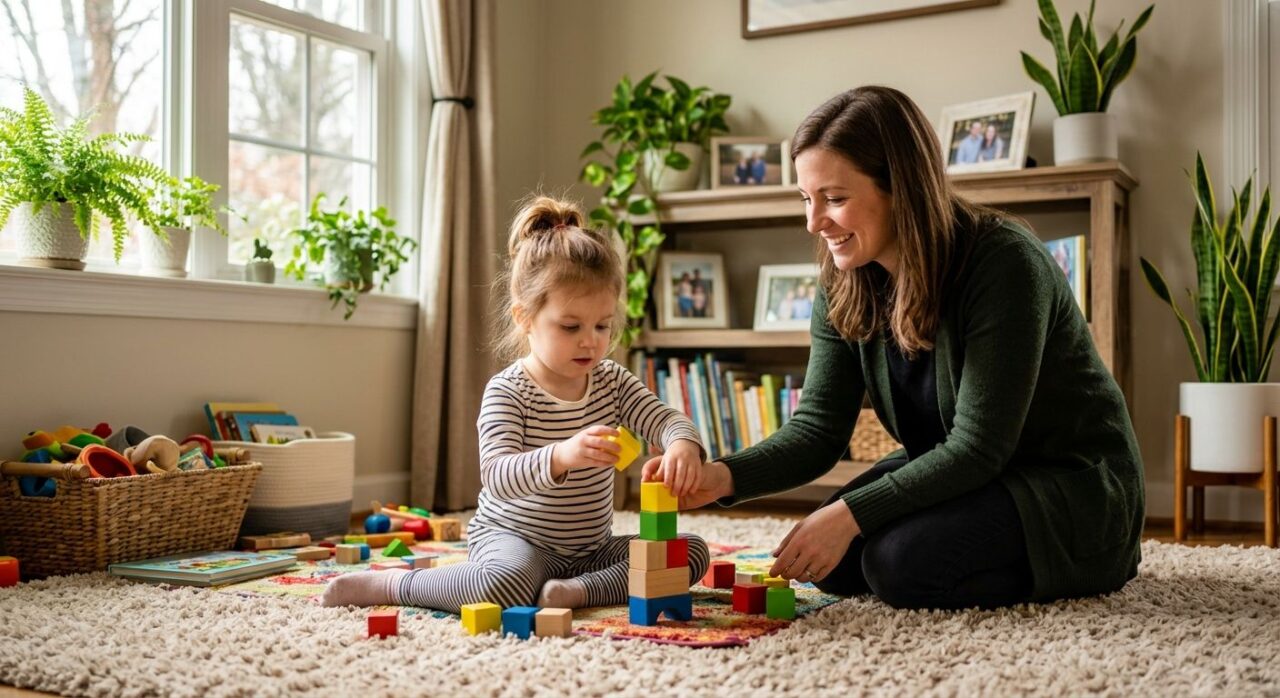
When we bring naturalistic ABA therapy at home, we meet your child where they already learn best — in the middle of everyday Richmond family life. Instead of structured table sessions, your child is learning through play, mealtime chats, and backyard adventures right here in Richmond, Virginia.
This child-led, play-based approach is built on natural environment teaching — a method that embeds skill practice into the routines and activities that already fill your day. For many families, natural environment teaching examples look like a child practicing turn-taking during a favorite board game or learning to make requests while helping prepare a snack. These are real moments, not rehearsed drills, and they build skills that stick because they happen where life actually happens.
At the core of this model is a strategy called pivotal response treatment. PRT focuses on motivation, responding to multiple cues, and self-initiation — teaching the pivotal areas that unlock broader learning. When a child learns to initiate a request because they genuinely want the outcome, not because a prompt tells them to, the motivation shifts from external to internal. That is the heart of what naturalistic ABA aims to achieve.
In Richmond, Virginia, sessions take place 1:1 in your home with a Registered Behavior Technician, while a Board Certified Behavior Analyst designs and oversees the entire individualized plan. WE COUNT ON OUR PARENTS. You are not just watching from the sidelines — you are central to every goal we set, and we build coaching directly into our model. You’re not on your own. We are alongside you, celebrating the wins and adjusting the plan as your child grows.
If you are a Richmond-area parent wondering whether in-home naturalistic methods fit your family, we invite you to reach out for a conversation. Results may vary based on individual patient circumstances.
Fundamentals: Naturalistic ABA and Naturalistic Environment Teaching
What Is Naturalistic ABA Therapy at Home?
Naturalistic ABA therapy at home is an evidence-based approach that blends Applied Behavior Analysis with everyday routines and play. Instead of sitting at a table for structured drills, your child learns through the activities they naturally enjoy. This child-led method follows their motivation, making learning feel like fun rather than work. Core elements of naturalistic ABA include:
- Child-led interactions: Sessions move at your child’s pace, guided by what sparks their interest.
- Natural reinforcement: Praise, play, and preferred toys or activities replace artificial rewards like tokens.
- Embedded learning: Teaching happens during daily moments such as mealtime, bath time, or backyard play.
Approaches like pivotal response treatment share this philosophy, focusing on child-led learning in natural settings. These methods are overseen by a Board Certified Behavior Analyst (BCBA) and delivered in one-to-one sessions, ensuring your child receives individualized attention.
Here’s a quick comparison between traditional and naturalistic ABA:
| Feature | Traditional ABA | Naturalistic ABA |
|---|---|---|
| Setting | Tabletop, structured | Play-based, in-home settings |
| Lead | Therapist-directed | Child-led, following motivation |
| Reinforcement | Artificial (tokens, candy) | Natural (play, praise, preferred items) |
| Learning moments | Discrete trials in blocks | Incidental moments during daily routines |
Traditional ABA is structured and therapist-led, while naturalistic ABA turns everyday play and routines into learning moments. These differences make naturalistic teaching especially powerful for young children, who learn best through meaningful, real-world interactions. When a child discovers that communicating a need during a snack or pointing to a favorite toy during play brings a joyful response, that skill sticks.
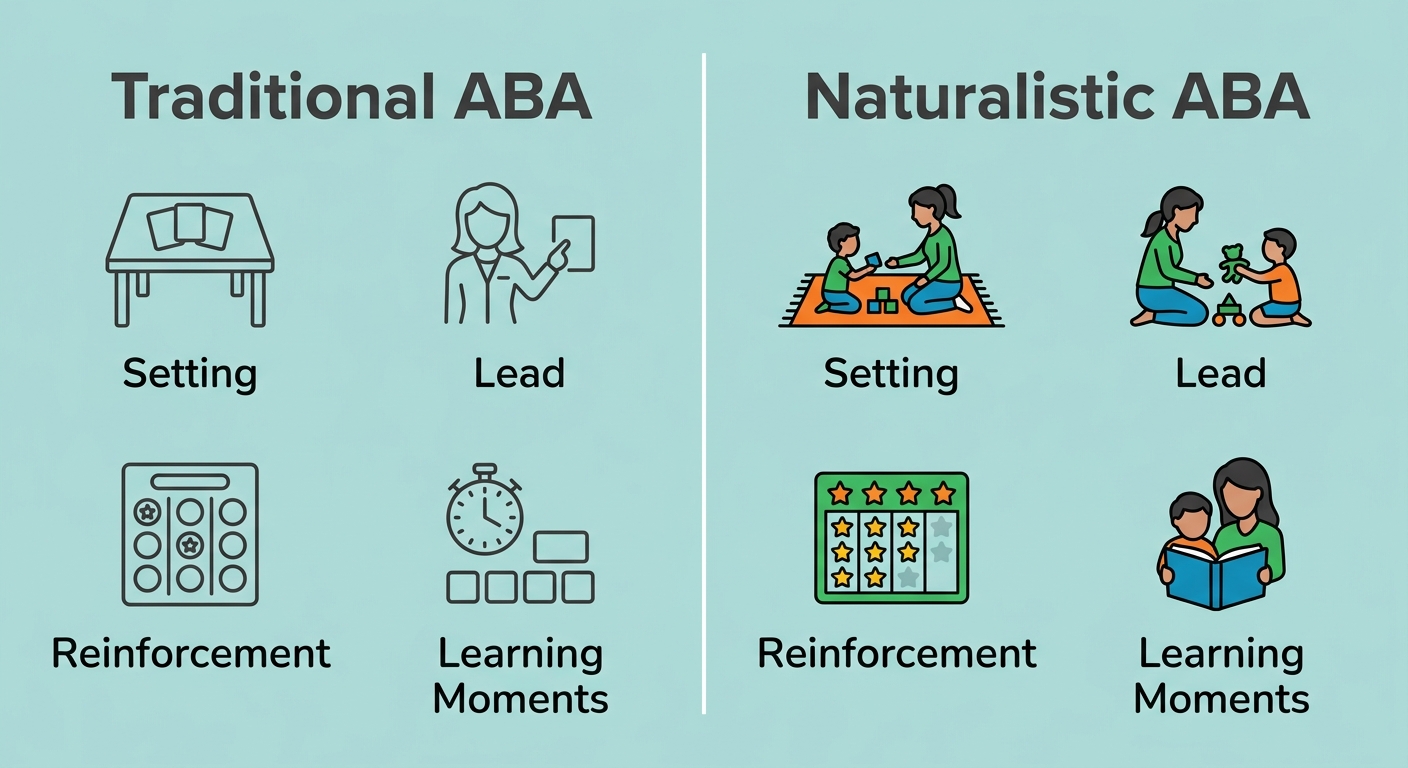
Traditional vs. naturalistic ABA side by side
Why Naturalistic Environment Teaching Matters
Naturalistic ABA therapy at home matters because it equips children with skills they can use everywhere. Naturalistic environment teaching happens in real-life settings—the living room, kitchen, or backyard—using everyday materials, not specialized tools. This real-world practice is one of the best ways to promote generalization, meaning your child learns to apply what they know with different people, in different places, and across different situations. When skills are taught in the environments where they will be used, children don’t need to translate what they learned at a desk to the kitchen; they simply know. This reduces the need for constant prompting and builds real independence.
Young children thrive when learning is woven into play and daily interactions with caregivers. Natural environment teaching examples include practicing requesting during snack time, labeling toys while building with blocks, or taking turns during a board game. These moments are not forced tasks; they are built on your child’s natural curiosity, so motivation stays high.
Early intervention research shows that the earlier these natural learning patterns are established, the more readily children develop communication, social, and adaptive skills. By incorporating ABA strategies into the flow of your family’s day, we help your child build a foundation that feels as natural as play itself. There’s no pressure, no drills—only meaningful progress.
You’re not on your own. In the next section, we will look at how parents can support these natural learning moments every day.
Deep Dive: Play-Based ABA and Pivotal Response Treatment
Play-based ABA, also called naturalistic ABA, weaves therapy goals into the activities children choose and the routines their families already follow. At Brighter Care ABA, we bring naturalistic ABA therapy at home so that communication, social, and play skills are learned where they matter most — right in the living room, kitchen, or backyard. This approach feels like guided play, not a clinical exercise.
Play-Based ABA and Social Skills
When therapists use play-based ABA, they embed social targets directly into the activities children enjoy. Instead of sitting at a table and repeating drills, kids practice social communication while building with blocks, sharing a snack, or rolling a ball. This child-led, naturalistic approach makes learning feel motivating and helps skills stick.
The social skills we build through play-based ABA at home include:
- Joint attention, like looking at a book a parent points to or following a grandparent’s gaze to share a moment.
- Social communication, such as requesting a favorite toy, commenting on a picture, or using gestures and words to express feelings.
- Turn-taking, whether passing a puzzle piece back and forth, taking turns on a swing, or sharing a play-dough cutter.
- Initiating interaction with peers or grownups — tapping a friend’s arm to play tag, saying “hi,” or bringing a parent a favorite book.
Here are a few natural environment teaching examples that bring these social skills to life:
- During snack time, a therapist may hold a cracker just out of reach and wait for the child to make eye contact or gesture to request it — turning a routine moment into a communication lesson.
- While building a tower with blocks, a therapist might label colors (“red block!”) and pause to let the child add the next piece, encouraging turn-taking and joint attention.
- In a game of “Red Light, Green Light,” the therapist can stop and wait for the child to initiate movement, reinforcing the skill of initiating interaction and self-regulation.
Because every moment is a learning opportunity, play-based ABA capitalizes on a child’s natural curiosity. The therapist follows the child’s lead, expands on their actions, and models language in real time, all while tracking progress toward specific, measurable goals. One of the best-researched play-based models is pivotal response treatment (PRT).
Understanding Pivotal Response Treatment (PRT)
Pivotal response treatment (PRT) is a naturalistic developmental behavioral intervention developed by Drs. Robert and Lynn Koegel. Instead of teaching skills in isolation, PRT builds four “pivotal” behaviors that spark widespread improvements. Brighter Care ABA’s own guide explains that PRT is one of several naturalistic developmental behavioral interventions that turn everyday activities into learning moments.
The four pivotal behaviors are:
- Motivation: boosting a child’s desire to engage and persist.
- Responding to multiple cues: noticing more than one detail at a time.
- Self-management: monitoring actions and emotions independently.
- Self-initiation: starting conversations or interactions without a prompt.
Research over the past few decades shows that PRT supports communication, language, and social interaction in children with autism. It is not a cure, but a research-supported approach that helps children progress when used consistently.
Here’s how PRT compares with more structured discrete trial training (DTT):
| Feature | PRT | DTT |
|---|---|---|
| Structure | Child-led, embedded in play | Therapist-led, tabletop trials |
| Reinforcement | Natural, directly tied to the activity | Tangible or token-based, unrelated to task |
| Focus | Pivotal areas: motivation, initiations, responding to multiple cues | Specific individual skills and behaviors |
| Session feel | Like play or everyday conversation | Structured drills with clear beginnings and ends |
How Play-Based ABA Teaches Social Skills
Both are evidence-based strategies; PRT simply makes learning feel like play.
We use PRT’s principles to deliver naturalistic ABA therapy at home across Virginia and Illinois, where our BCBAs and therapists embed social goals into everyday routines. We count on parents to extend these moments into all parts of the day. A bright future is waiting for your child. (Results may vary based on individual needs, and we encourage families to consult a healthcare professional for diagnosis or treatment advice.)
Practical Strategies: Naturalistic ABA Activities for Everyday Moments
Bringing the principles of ABA into daily life does not require a therapy room or special toys. When you practice naturalistic ABA therapy at home, you transform the moments you already share — meals, baths, play, and household tasks — into powerful learning opportunities. Our team sees these everyday interactions as the heart of skill building, and we want to make it easy for you to get started.
Naturalistic ABA Examples for Home Routines
Routines are predictable and motivating, which makes them ideal for planting new skills. The table below offers natural environment teaching examples for four common home activities, each targeting foundational social, communication, and daily-living abilities.
| Daily Routine | Skill Target | Naturalistic Strategy |
|---|---|---|
| Mealtime | Requesting, labeling, choosing | Place food slightly out of reach; prompt “eat” or “more”; offer choices between two cups |
| Bathtime | Body parts, following directions | Ask “Show me your belly”; splash water when your child correctly responds |
| Playtime | Turn-taking, joint attention, communication | Roll a ball back and forth; pause and model “My turn” or “Your turn” |
| Chores | Matching, sorting, following multi-step directions | Ask your child to match socks or place toys in bins; give natural praise as they complete each step |
At mealtimes, placing a favorite food just out of reach prompts your child to communicate — a simple request like “more” or pointing to the cup they want. You reinforce the effort by handing over the food, which is the most natural reward there is.
During bathtime, singing “Head, Shoulders, Knees, and Toes” or asking “Show me your belly” teaches body parts in a splashy, joyful context. Your child’s correct response earns an instant, playful splash that makes learning feel like fun.
Play becomes a social classroom when you roll a ball back and forth, pausing to model “My turn” and “Your turn.” The pause and the child’s anticipation build the very motivation that natural environment teaching relies on.
Even chores like matching socks or sorting toys into bins strengthen matching and sorting skills, while your natural praise at each completed step keeps the activity positive and encouraging. Over time, your child learns to follow multi-step directions within a meaningful routine.
These examples show how NET uses a child’s interests to build communication — and that is exactly what we will explore next.
Using NET to Improve Communication
Instead of drilling skills in isolation, natural environment teaching follows your child’s lead, tapping into what they already want to say or do. When your child reaches for a toy, you pause, wait for a vocalization or gesture, and then offer the toy — turning motivation into a teaching moment. The child’s own request becomes the reinforcer, not a sticker or a treat.
A related evidence-based strategy, pivotal response treatment, works similarly by targeting motivation and self-initiation within natural exchanges. Research shows that when we embed communication practice into activities children genuinely enjoy, we see faster, more generalized progress. However, results may vary based on individual patient circumstances. Please consult with a healthcare professional for diagnosis or treatment advice.
For communication gains to stick, consistency across all of your child’s environments matters. That is why Brighter Care ABA provides comprehensive parent training — our BCBAs coach you to weave naturalistic strategies into whatever your day brings. We count on our parents to be active partners, because you are with your child in the moments that matter most. You are not on your own; our team works alongside families in Virginia to personalize these approaches and celebrate every small victory.
When you practice naturalistic ABA therapy at home consistently, you help your child build a foundation that supports language, social connection, and independence. Succeed with ABA, and take the next step toward the bright future that is waiting for your child.
Advanced Application: PRT at Home and Generalization
Once you understand PRT’s core principles, the next step is bringing them into your child’s everyday world. Naturalistic ABA therapy at home truly shines when you transform playtime, snack time, and family routines into powerful learning moments.
Bringing PRT Into Your Home
Naturalistic ABA therapy at home means weaving learning into the moments your child already enjoys — no drill work, no rigid tables. You can bring pivotal response treatment into your home by following these simple, child-led actions.
Bringing PRT Into Your Home
| PRT Strategy | How to Apply at Home |
|---|---|
| Child choice | Offer two to three activities and let your child choose what to play with. |
| Natural reinforcement | Allow access to the chosen activity as the reward for communication. |
| Interspersing maintenance skills | Mix easy, known tasks with new challenges to keep motivation high. |
| Following the child’s lead | Join your child in what they are already doing; add language and play ideas. |
With parent training support from Brighter Care ABA, you can deepen your naturalistic ABA therapy at home practice and help your child build skills in the spaces where they feel most comfortable.
Measuring Progress and Strengthening Generalization
To see if PRT strategies are working, keep it simple. During a 10- to 15-minute play session, tally unprompted communication attempts — words, gestures, or sign language — and note how often your child responds to a choice. Look for gradual increases over two to four weeks. This low-tech tracking helps you spot growth and adjust activities without adding stress to your day.
Generalization means skills aren’t tied to one person or room. Practice the same child-choice and natural-reinforcement approach in the living room, at the kitchen table, and in the backyard or at a park, with at least two different people — a parent, sibling, grandparent, or therapist. These natural environment teaching examples go beyond play: use them during bath time, getting dressed, mealtime, and even quick errands so learning happens throughout the whole day. Our BCBA-designed plans and parent training make generalization an explicit goal, helping your child carry new skills across every setting. You’re not on your own. Remember, every child’s journey is unique; results may vary based on individual patient circumstances. With consistency and support from Brighter Care ABA, a bright future is waiting for your child.
Naturalistic ABA therapy at home turns everyday play into learning. Pivotal response treatment and natural environment teaching examples turn daily moments into growth.
With Brighter Care ABA, your child receives 1:1 therapy from caring RBTs under BCBA guidance, with parent training included. Our model blends BCBA oversight, individualized plans, and support that fits your family’s daily life.
You’re not on your own. We partner with families in Virginia and Illinois, celebrating each step forward. Contact our team for a consultation. A bright future is waiting for your child. With the right support, they can Succeed with ABA.
