
Table of Contents
- Applied Behavior Analysis Benefits That Shape Long-Term Development
- Understanding the Core Benefits of Applied Behavior Analysis
- How Applied Behavior Analysis Enhances Social Skills and Communication
- Building Functional Communication Skills Through ABA Therapy
- Maximizing Daily Living Skills and Measuring Success in ABA
- Frequently Asked Questions About Applied Behavior Analysis Benefits
- A Bright Future for Your Child with Applied Behavior Analysis
Applied Behavior Analysis Benefits That Shape Long-Term Development
Now let’s explore the specific applied behavior analysis benefits that shape long-term development. By breaking down skills into teachable steps and reinforcing every success, ABA therapy may lead to enduring gains in communication, social interaction, and daily living. These improvements are rooted in evidence-based methods and personalized to each child’s unique strengths.
Our ABA therapy services in Virginia and Illinois are delivered by Board Certified Behavior Analysts who adhere to the BACB’s rigorous standards.
For functional communication skills, we often begin with simple requests and gradually introduce verbal labeling; each small success is reinforced, helping children become more expressive at home, in school, and during play.
Social skills development for autism follows a similar path, with structured practice of turn-taking, eye contact, and sharing. In peer-modeling or natural settings, these interactions can become more automatic over time, supporting friendships and inclusion.
In terms of behavior, therapists teach replacement actions and self-regulation techniques. A child who learns to use a calm voice or request a break may experience fewer meltdowns, which makes it easier to participate in family routines, school activities, and community outings. Over time, these applied behavior analysis benefits promote lasting independence in everyday tasks like dressing, eating, and playing with others.
These long-term benefits form the foundation of our ABA therapy services, which we tailor to each child’s unique needs. Results may vary based on individual patient circumstances. Please consult with a healthcare professional.
Understanding the Core Benefits of Applied Behavior Analysis
Building on the fundamentals of ABA, this section explores the core benefits that make it a powerful intervention. The applied behavior analysis benefits are supported by decades of research, and ABA therapy for children with autism offers a range of scientifically validated gains. We design individualized plans guided by standards from the Behavior Analyst Certification Board (BACB) and evidence from the National Center for Biotechnology Information (NCBI). The table below outlines the primary benefit areas, key outcomes, and the ABA methods that drive them.
| Benefit Area | Key Outcomes | How ABA Supports This |
|---|---|---|
| Social Skills | Improved eye contact, joint attention, peer interaction | Structured reinforcement, modeling, natural environment teaching |
| Daily Living Skills | Self-care, toileting, dressing, household routines | Task analysis, prompting hierarchies, positive reinforcement |
| Communication Skills | Functional requests, labeling, manding for needs | Functional communication training, PECS, speech-generating devices |
Understanding these benefit areas helps families in Virginia and Illinois see how our home-based therapy builds lasting skills. Our BCBAs and RBTs translate structured techniques into real-world progress.
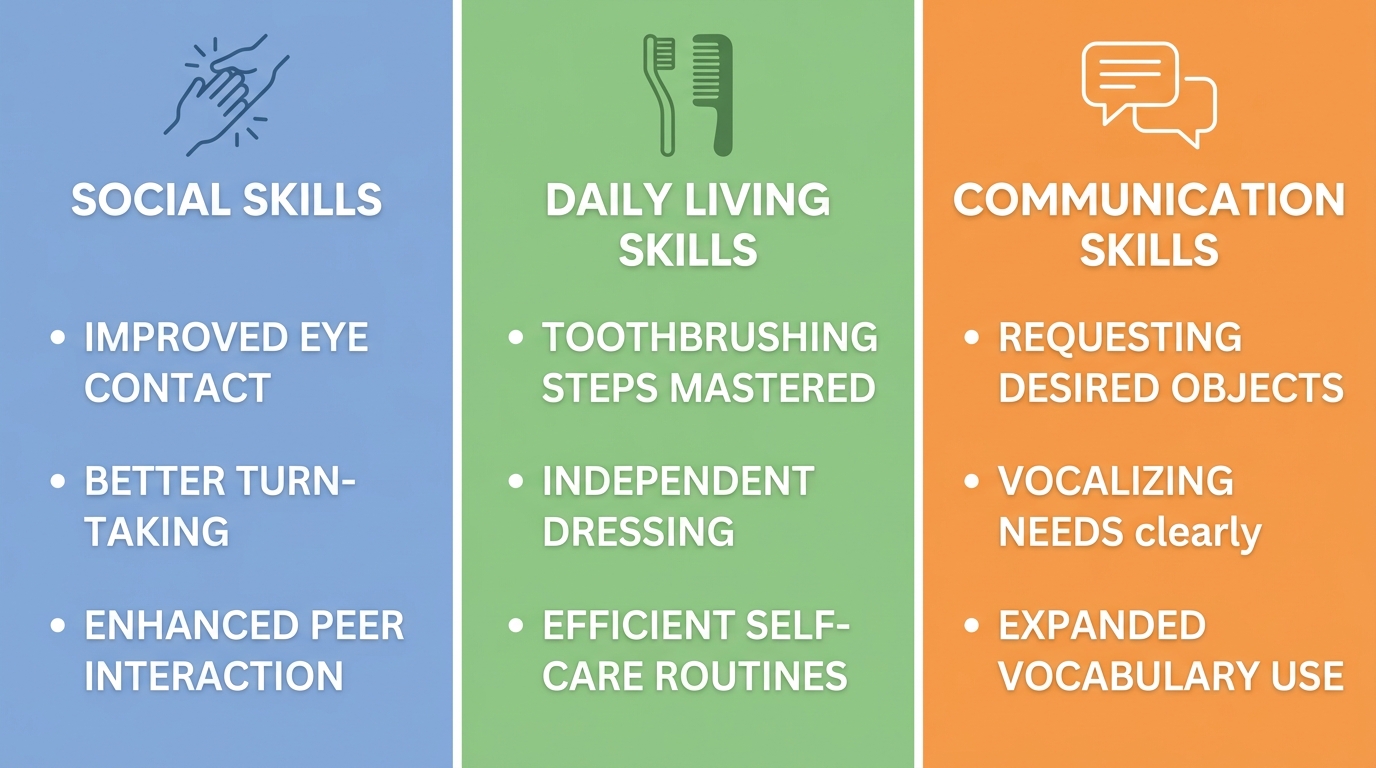
Core benefits of ABA therapy for social, daily living, and communication skills.
We’ll now explore each area in more detail.
Social Skills
Social skills are a central focus of ABA. Using structured reinforcement and modeling, we help children improve eye contact, joint attention, and peer interaction. Our programs target social skills development for autism, applying natural environment teaching to ensure gains generalize. Many children show greater social engagement and form friendships, enhancing their overall quality of life.
Daily Living Skills
We focus on building independence through daily living skills such as self-care, toileting, dressing, and household routines. Using task analysis, we break complex tasks into manageable steps. Prompting hierarchies provide the right level of support, and positive reinforcement encourages progress. Over time, children learn to complete these activities with growing confidence. Home-based sessions integrate these skills into family routines, making practice natural and effective.
Communication Skills
Functional communication skills are vital. Through functional communication training (FCT), we teach functional requests, labeling, and manding for needs. When appropriate, we incorporate tools like PECS and speech-generating devices to support expression. This approach reduces frustration, minimizes challenging behaviors, and improves social interactions. Our therapists reinforce these skills across home, school, and community settings.
These core benefits form the foundation of our personalized therapy programs. By targeting social, daily living, and communication skills, we help children achieve greater independence. The full applied behavior analysis benefits emerge through data-driven plans that adapt to each child’s progress. Results may vary based on individual patient circumstances, but our commitment to evidence-based practice ensures every milestone is celebrated. In the next section, we’ll explore how these benefits are achieved through the ABA process.
How Applied Behavior Analysis Enhances Social Skills and Communication
Now let’s see how ABA specifically enhances social skills and communication. One of the most meaningful applied behavior analysis benefits is the way it helps children with autism build connections and express themselves. At Brighter Care ABA, our BCBAs design individualized programs that target core social milestones through structured, play-based learning.
Key Social Milestones Achieved Through ABA
Early intervention often focuses on foundational social behaviors like joint attention, eye contact, parallel play, and turn-taking. Joint attention is the ability to share focus on an object or event with another person, while parallel play involves playing alongside peers without direct interaction. Our approach to social skills development for autism builds these skills incrementally, using natural environment teaching—embedding learning into everyday routines—and incidental teaching, where we capitalize on naturally occurring opportunities. Under BCBA supervision, RBTs guide children through these interactions in comfortable home settings, encouraging eye contact during story time or turn-taking during simple games. These small victories lay the groundwork for more complex social exchanges.
Measuring Progress in Social Interactions
To ensure that each child’s social abilities are improving, we collect objective data during every session. Frequency recording counts how often a specific social behavior occurs (for example, initiating a greeting), while duration recording measures how long an interaction lasts, such as sustained eye contact or cooperative play. Interval recording tracks whether a target behavior happens within predetermined time windows, giving us a clear picture of consistency. Progress is tracked under BCBA supervision requirements to ensure therapy fidelity. Our BCBAs oversee all data collection, reviewing at least 5% of total service hours monthly and a minimum of one hour per client, per month. This rigorous oversight allows us to adjust teaching strategies quickly.
Long-Term Social and Communication Outcomes
When social skills are taught early, the benefits extend well into childhood. Over time, children develop functional communication skills that let them express wants, needs, and feelings, reducing frustration and enabling richer peer relationships. Parent training reinforces these gains at home, where we coach families on using the same positive reinforcement and prompting techniques that work in therapy. In schools, our BCBAs collaborate with teachers—sharing visual supports and training classroom staff—so that skills like turn-taking or asking for help carry over from home to the classroom. As noted in research from the National Center for Biotechnology Information, early social skill gains contribute to long-term communicative competence and improved peer interactions. The applied behavior analysis benefits continue to unfold as children mature, building a foundation for greater independence and meaningful friendships.
The following table shows typical social goals and outcomes across developmental stages so you can see how expectations evolve as your child grows.
| Age Group | Social Skill Goal | Therapy Approach | Measurable Outcome |
|---|---|---|---|
| Toddlers (1–3 years) | Joint attention, eye contact, basic turn-taking | Natural environment teaching, incidental teaching | Increased frequency of shared attention, more consistent eye contact |
| Preschoolers (3–5 years) | Peer play, sharing, initiating conversations | Structured play sessions, social stories, video modeling | Improved peer engagement, longer play duration, verbal initiations |
| School Age (5–12 years) | Perspective-taking, managing conflict, group participation | Role-play, peer mentoring, self-monitoring strategies | Reduced behavioral incidents, improved classroom inclusion, self-reported social confidence |
Sources: Brighter Care ABA — Social Skills Development; PubMed — Social skill outcomes in ABA.
For toddlers, joint attention forms the foundation for later communication. Preschool programs use interactive play to teach sharing and conversation, while school-age therapy emphasizes perspective-taking and conflict resolution. As these abilities grow, children show fewer behavioral incidents and gain social confidence.
Understanding these social gains sets the stage for how parents can reinforce them at home.
Every child’s progress is unique, and results may vary based on individual circumstances. For personalized guidance, please consult with a healthcare professional for diagnosis or treatment advice. By using this Site you indicate your acceptance of our Privacy Policy.
Building Functional Communication Skills Through ABA Therapy
Among the many applied behavior analysis benefits, functional communication stands out as the foundation for all learning. At Brighter Care ABA, we teach functional communication training (FCT), an evidence-based intervention that replaces challenging behaviors with appropriate communicative responses. Building functional communication skills early reduces frustration and opens the door to social interaction and independence. Our team prioritizes communication from the first assessment because every other skill grows from the ability to connect with others.
To help toddlers develop these skills, we use augmentative and alternative communication methods: PECS teaches initiation, Sign Language builds motor imitation, Speech-Generating Devices provide voice output for non-verbal children, and Verbal Modeling shapes natural speech. The table below compares these methods.
| Communication Method | Description | Best For | Example Goal |
|---|---|---|---|
| Picture Exchange (PECS) | Child exchanges a picture card to request or comment | Non-verbal toddlers, early learners | Independently request preferred item using single picture card |
| Sign Language | Manual signs paired with verbal models | Children with good motor imitation skills | Use sign for “more” or “all done” during meals |
| Speech-Generating Device (SGD) | Tablet-based app or dedicated device that produces speech | Children with fine-motor challenges or who need voice output | Touch icon to request a drink during snack time |
| Verbal Modeling | Therapist models target word/phrase and shapes approximations | Children with emerging vocal ability | Vocalize “up” when reaching to be held |
PECS is particularly effective for non-verbal toddlers who are not yet ready for sign language. Sign Language works well for children who readily imitate movements. Speech-Generating Devices empower children with limited fine-motor control to produce audible words. Verbal Modeling is most beneficial for children who are beginning to vocalize; we shape approximations into meaningful words through repeated practice.
Why Functional Communication Takes Priority in ABA
ABA programs are overseen by BCBAs who stay current with BCBA certification updates to apply the latest functional communication training techniques. Research shows that FCT can reduce problem behaviors by up to 90% when implemented consistently; one of the key applied behavior analysis benefits is teaching children to communicate effectively. Communication unlocks all other learning. When a child learns to communicate, they can participate in social interactions, follow instructions, and build relationships. At Brighter Care ABA, we embed communication goals into every session, knowing that a child who can ask for help is less likely to resort to frustration. By focusing on functional communication early, we set the stage for long-term success. Succeed with ABA when communication becomes the cornerstone of progress—it is the skill that makes every other goal achievable. Consistent communication practice at home magnifies these gains, which is why parent involvement is essential.
Strategies Parents Can Use to Support Communication at Home
Our home-based ABA therapy supports functional communication practice in everyday routines, helping skills generalize beyond therapy sessions. We count on our parents to reinforce learning between sessions. Try these three strategies: First, model language during daily routines—labeling objects during bath time, naming foods at snack, and narrating actions during play—helps your child learn words in context. Second, create communication opportunities by placing a favorite toy just out of reach and waiting for your child to request it; this builds motivation to communicate. Third, reinforce every attempt at communication—when your child points, vocalizes, or exchanges a picture card, immediately provide the item and say “Great job asking!” to strengthen the connection. These strategies embed functional communication skills into your day, making progress lasting. You’re not on your own—our team partners with you to adjust strategies as your child grows.
Examples of Functional Communication Goals for Toddlers
In our treatment plans, we set measurable goals that are tailored to each child. For example, a typical goal for a toddler learning to use PECS might be: “Independently request ‘more’ using a PECS card during snack.” Another goal focusing on early labeling might read: “Label ‘ball’ by pointing or vocalizing during play.” A third goal targeting signed requests could be: “Use the sign for ‘help’ when frustrated with a toy.” These objectives give families a clear picture of what their child is working toward. For families in Virginia, accessing early intervention services through the local Infant & Toddler Connection can include ABA-based communication goals, ensuring toddlers receive support as early as possible. Once a child can express wants and needs, we can build social skills such as turn-taking and joint attention, paving the way for social skills development for autism. A bright future is waiting for your child.
Results may vary based on individual patient circumstances.
Maximizing Daily Living Skills and Measuring Success in ABA
One of the most impactful applied behavior analysis benefits is the ability to teach daily living skills that lead to real independence. At Brighter Care ABA, we structure our programs around self-care, household routines, and community participation so each child gains skills to succeed with ABA. Our evidence-based approach combines proven techniques with supportive family coaching.
The following table provides a quick-reference summary of how we target each skill domain:
| Skill Domain | Example Task | ABA Technique | Success Indicator |
|---|---|---|---|
| Self-Care | Toothbrushing, dressing, toileting | Task analysis, chaining, visual schedules | Independent completion of each step with fewer prompts |
| Household Routines | Setting the table, putting away toys | Behavioral momentum, token economies | Increased compliance, reduced refusals |
| Community Participation | Waiting in line, crossing the street safely | Social narratives, video modeling, in-vivo prompting | Safe and independent performance in community settings |
Every strategy is overseen by Board Certified Behavior Analysts (BCBAs) who ensure fidelity and adjust plans based on data. We follow the supervision protocols outlined by Brighter Care ABA and adhere to professional standards from the Behavior Analyst Certification Board (BACB).
In self-care, we use task analysis to break toothbrushing into steps such as wetting the brush, applying paste, brushing, and rinsing. For dressing, we apply chaining and create visual schedules—a picture strip on the bedroom door showing shirt, pants, socks, and shoes in sequence. We embed functional communication skills into these routines by teaching your child to request items or assistance. Success is measured by tracking the number of prompts needed per step.
Household routines benefit from behavioral momentum—starting with an easy task such as handing you a cup before asking your child to put away toys. Token economies reward each chore with a sticker, building positive momentum. By recording refusals per session, we see steady gains in cooperation and the development of everyday independence.
For community participation, we use social narratives—short illustrated stories—and video modeling to teach waiting in line and crossing the street. We practice in-vivo during outings in Richmond and throughout Illinois and Virginia so skills transfer to real settings. These same strategies also promote social skills development for autism, helping your child interact safely with peers. We document safe street crossings and calm waiting.
Research indexed in the biomedical literature database PubMed supports the effectiveness of task analysis and video modeling for teaching daily living skills. We actively coach parents in Richmond and throughout Illinois and Virginia to reinforce these techniques at home.
We track prompts, refusals, and community performance to personalize each child’s plan. While we celebrate every milestone, individual results may vary based on patient circumstances. With these strategies, a bright future is waiting for your child.
Frequently Asked Questions About Applied Behavior Analysis Benefits
To help you understand these benefits more clearly, here are answers to frequently asked questions.
What are the main applied behavior analysis benefits for children with autism?
We witness applied behavior analysis benefits in improved socialization, communication, and daily living skills through personalized, home-based plans guided by our BCBAs. Results may vary based on individual patient circumstances.
How does ABA support social skills development for autism?
We support social skills development for autism by teaching turn-taking, sharing, and initiating play in natural home routines. This approach helps children interact comfortably with family and peers.
Can ABA improve functional communication skills?
Our therapists help children build functional communication skills through requesting, labeling, and responding. We follow evidence-based guidelines from the Association for Behavior Analysis International to ensure quality care.
Medical disclaimer: Please consult with a healthcare professional for diagnosis or treatment advice.
A Bright Future for Your Child with Applied Behavior Analysis
With all these elements working together, the benefits of applied behavior analysis extend far beyond the therapy room—a bright future is waiting for your child. Recognized by the Behavior Analyst Certification Board (BACB), ABA is an evidence-based practice that builds social skills development for children with autism and functional communication skills that prepare your child for school and community. We partner with families through parent training to ensure these skills stick, because lasting progress happens when therapy becomes part of everyday life. Reach out to Brighter Care ABA today to take that first step.
