


Table of Contents
- ABA Therapy and School: How They Work Together for Your Child
- ABA Therapy vs. School Support: What Sets Them Apart
- Combining Traditional School with Private ABA Therapy
- How Coordinated ABA and School Support Works
- Aligning Your Child's ABA Goals with Their School IEP
- A Bright Future is Waiting for Your Child
ABA Therapy and School: How They Work Together for Your Child
ABA therapy and school support go hand-in-hand to help children on the autism spectrum succeed if used together. When families consider aba therapy vs school options, they often discover that working closely with therapists and teachers improves outcomes for their kids in both environments. At Brighter Care ABA we partner up with teachers here in Illinois and Virginia to make sure your child’s therapy objectives mesh well with what he or she does in class so the learning can continue once you’re home for the day.
Board Certified Behavior Analysts create individualized treatment programs which they implement one-to-one focusing on improving a child’s ability for social skills, communication, self-help and academic skills. Due to the personal nature and the fact that therapy takes place within the home environment, our plans evolve alongside each child, ensuring that as children learn new skills in their therapy sessions those skills generalize across environments. Our program allows us to link home life with school based learning and to help your child Succeed with ABA.
Key Takeaways
- When you consider aba therapy vs school support, there are many aspects that need to be taken into consideration such as purpose, setting, legal framework.
- Yes, your child can absolutely attend school while receiving private ABA therapy at home.
- If therapy and school have common objectives, then they should function well together.
- The comparison of aba therapy vs school can help families understand how therapy and education work hand-in-hand to teach lifelong skills for kids.
- All children benefit when they have goals based off their own individual strengths.
ABA Therapy vs. School Support: What Sets Them Apart
When you consider aba therapy vs school support, there are many aspects that need to be taken into consideration such as purpose, setting, legal framework. Although these two types of care can often work together, they do not replace each other. The school system provides legally mandated education-focused services under federal law, while private aba therapy delivers clinically driven, individualized skill-building in home and community settings.
How Schools Define and Support Autism Under IDEA
Autism is characterized by developmentally significant impairments in both verbal and non-verbal communication skills as well as in social interactions and is usually first observable prior to age three. In order to receive special educational services under the Individuals With Disabilities Education Act (IDEA), this condition must affect a student’s educational performance negatively. Such students often perform repetitious behaviors and actions, have stereotyped movements, resist changes to routine, display an odd response toward specific objects, or experience intense reactions toward ordinary, expected objects/behaviors and environments. It should be noted, though, that this term will not describe those whose difficulties in school originate from primary emotional disturbances.
All schools provide IDEA special education to eligible children ages 3 through 21, ensuring those eligible have access to a free appropriate public education (FAPE) regardless of suspension or expulsion. A child must have a recognized disability and be in need of specially designed instruction (SDI). If a child needs only related services and not specially designed instruction, they will not qualify as IDEA eligible. Additionally states can also use a developmental delay category until they turn nine years old.
School Services: these are legally mandated and must be educationally focused and provided on school grounds to help pupils gain full access to the curriculum and make good progress within their learning.
| Purpose | Legal Framework | Setting | Provider | Focus Areas | Eligibility |
|---|---|---|---|---|---|
| Education-focused services to meet curriculum goals | Governed by IDEA (federal law) | School environment | School-based special education team | Academic progress, classroom participation, social skills within school context | Children ages 3–21 with disabilities who need specialized instruction |
| Clinically driven skill-building for daily life | Parent-initiated, insurance-supported | Home and community environments | BCBA-designed plans, RBT therapists, parent training | Social skills, communication, adaptive/daily-living skills, generalization across settings | Children with autism whose families pursue additional therapy |
The two systems have different yet complementary functions. The schools’ work is mandated by law, whereas the family can choose to supplement their child’s clinical skills with the help of private ABA therapists.
What Private ABA Therapy Adds Beyond the Classroom
ABA Private Therapy is designed by Board Certified Behavior Analysts (BCBAs), targeting social, communication and adaptive skills through individualized treatment plans. These plans are implemented in home and community settings so skills generalize beyond school hours and environments. Brighter Care ABA delivers this care through 1:1 private therapy with Registered Behavior Technicians (RBTs), parent training, and school support and consultation to align goals across settings.
School services mainly aim at academic success, while private ABA therapy supports students throughout their day-to-day activities, including socializing with their families as well as participating in society outside school premises. In this way, ABA therapy helps students learn new behaviors and skills through reinforcement in settings which they find themselves in normally during the course of their day.
School-based intervention combined with individualized behavior analysis create a coordinated plan that addresses both educational and developmental goals.
A Bright Future is Waiting for Your Child
Combining Traditional School with Private ABA Therapy
Yes, your child can absolutely attend school while receiving private ABA therapy at home. Families in Virginia and Illinois don’t have to choose between the two. Instead, we help coordinate care so therapy and school work together, reinforcing the same skills in different settings. Our home-based sessions are designed to fit around a school week, using flexible scheduling and routines that align with your family’s daily life.
We work hand-in-hand with your child’s teachers so therapy goals will be supporting what they’re working on in class. This way, your child can continue practicing these new things at home before applying them in the school setting, bridging the gap between these two environments. Our programs help kids who struggle with transitioning from one activity to another, following multi-step directions, and/or asking for help. We develop routines that carry over into school time as well.
Can Your Child Do Both? How Coordinated Care Fits a School Week
Our therapists design home-based sessions to complement school attendance, not compete with it. We meet families where they are — scheduling sessions before or after school, on weekends, or during school breaks when that works best for your routine. Because we focus on skills that matter in everyday life, your child can practice communication, waiting turns, and following routines at home and then carry those abilities into the classroom.
We can help you ensure that all family members, whether parent, therapist or teacher, respond the same way when faced with any problem behavior. If everyone uses the same strategy, this will cause less disruption for your child and boost their sense of competence. When people respond similarly, it’s easier to transition between activities and reinforce the appropriate response, be it at home or school.
The Skills ABA Builds That Prepare Children for the Classroom
ABA Therapy can help kids learn basic skills needed for classroom success in various ways. We’ll work together on these specific skill areas:
- Social interaction with peers: Learning to take turns, share, and engage in cooperative play builds the foundation for group activities and friendships.
- Communication of needs and wants: Using words, signs, or visual supports to express themselves helps children advocate for themselves and participate more fully in lessons.
- Following group instruction: Practicing sitting for short periods, listening to directions, and completing multi-step tasks prepares children for structured classroom environments.
- Adaptive daily-living skills: Mastering routines like transitions between activities, handwashing, or packing a backpack supports independence and reduces reliance on adult support during the school day.
Many kids aren’t learning only about their abilities within a therapy setting, but in all places life takes them, whether it be at home, school, or elsewhere. When children generalize these abilities across home, school, and community, they gain confidence and competence that lasts beyond the school year.
How Coordinated ABA and School Support Works
If therapy and school have common objectives, then they should function well together. We teach the abilities your child has acquired from at-home ABA treatments into his regular classroom setting where he’ll feel confident in employing those talents each day. And you’re not on your own in this process.
From Intake to Individualized Programming
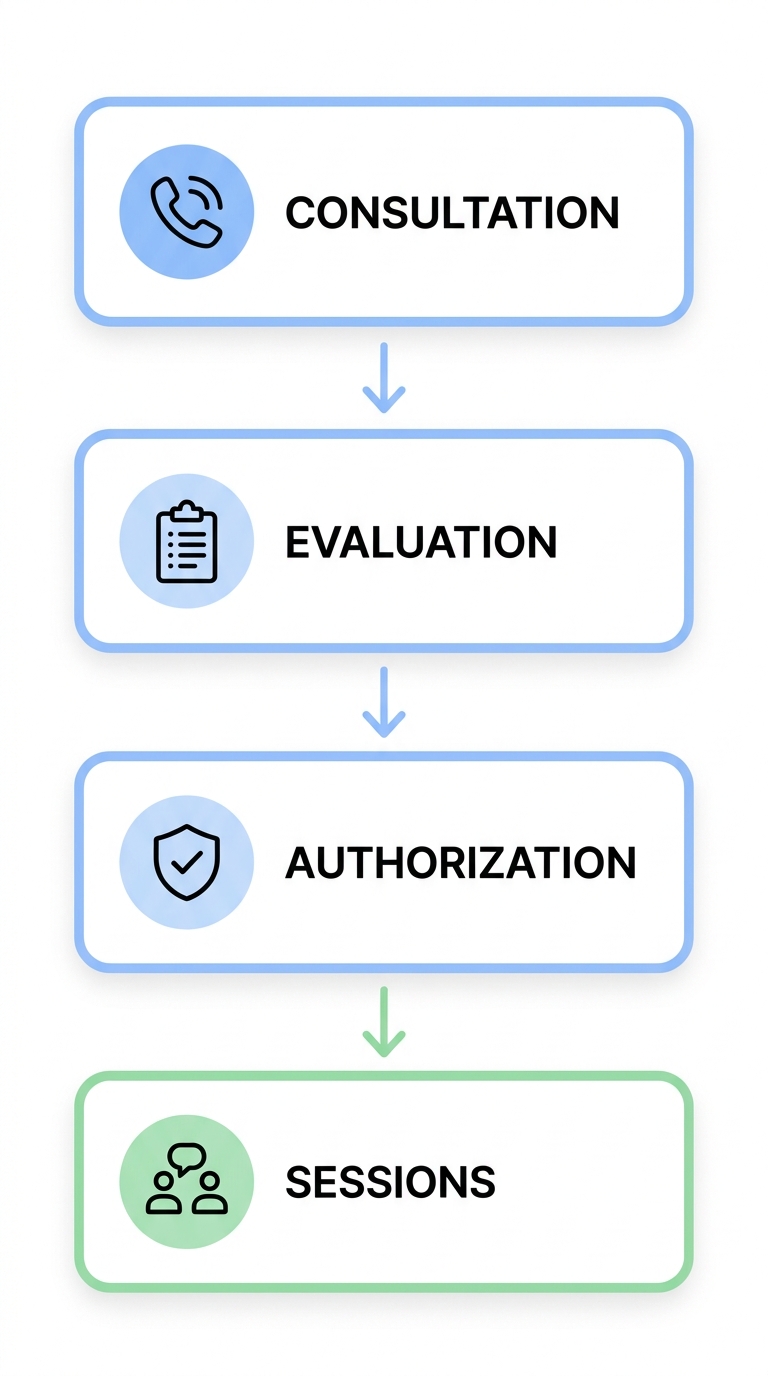
Our process starts with going from your first meeting all the way up until consistent one-to-one sessions. Firstly, there will be an introductory consultation where we get to know about your child, their individual needs and what matters most to your family. Then, a BCBA does a complete evaluation in order to find out what the main problems are that need to be worked on as well as skill gaps that exist within them. Next, our team gets your insurance authorized on your behalf so that you can take care of your child without any distractions such as paperwork. Lastly, once approval has been received, your child attends regular sessions led by an RBT who gives them one-on-one attention under the BCBA’s oversight.
This step-by-step approach ensures every child receives an individualized plan built for success. We also help families understand how ABA therapy works with school collaboration to support their child’s progress, bridging the gap between home and classroom environments. By aligning our clinical goals with classroom expectations, we create a seamless transition for your child. This coordinated approach also helps parents feel supported throughout the process, knowing their efforts are working together.
Bringing Therapy Skills into the School Day
Generalizing is the link between therapy and successful classroom performance. NET allows us to practice school type activities like turn taking, raising our hands, and listening to teacher’s directions at home so they feel comfortable in the actual classroom environment when their time arrives. We make simple skill cards based on what behavior targets apply to your child and how we can reinforce them. We give this information out to your child’s teachers to help ensure consistency.
A shared communication log or notebook keeps parents, therapists, and educators aligned on the prompts and rewards being used. To confirm skills stick, we run maintenance probes—unprompted checks that verify your child retains and applies what they’ve learned in new settings. This ongoing loop of collaboration ensures the gains made in therapy translate smoothly into the school day.
Aligning Your Child’s ABA Goals with Their School IEP
The comparison of aba therapy vs school can help families understand how therapy and education work hand-in-hand to teach lifelong skills for kids. If parents take time to make sure that their child’s Applied Behavior Analysis (ABA) goals match up with their IEP (Individualized Education Program) goals, they help create a seamless bridge between home, therapy, and school. That alignment ensures skills learned in one setting are practiced and reinforced in another, helping him generalize behaviors like turn-taking, following instructions, and managing transitions.
Preparing for IEP Meetings and Understanding Your Protections
Before attending a meeting about your child’s education program at school, ask if you can get a copy of the IEP in advance. This way, you’ll be ready when you go to the meeting with specific questions and will have some idea what goals the school wants him to achieve. It helps to know that IEPs contain more stringent legal protection for kids than 504 plans do, because they must contain special, legally binding instructions for how children should learn and grow according to their particular needs.
Before your meeting write up a brief list of any questions you have regarding goals, accommodation needs, and upcoming assessments. Bring a pen and paper to take some notes during the meeting. You don’t need to know everything, but make sure that you’re there to stand in your child’s corner. We won’t give out legal advice about this, however knowing what these provisions mean can help you make more informed decisions when asking your school about their actions and to protect your child.
Building Consistency Between Home, Therapy, and School Teams
Consistency is the key to progress. Our team often sees families make the biggest gains when home, therapy, and school teams work together as one. Start with a fifteen-minute weekly check-in with your child’s teacher to review progress, share observations, and adjust strategies as needed. Keep a shared data log or notebook where everyone—parents, therapists, and teachers—can record notes on behaviors, reinforcement, and prompting levels.
Skill Card: A one-page summary of your child’s main behaviors, with any reinforcement strategies that seem most effective for your child to follow. If you have had success with a token economy at home, let your teacher know! The teacher may be able to implement a similar approach during school time. NET may allow your child to practice at home tasks like raising his/her hand in class or standing in a line which will make the transition into the classroom less difficult for the child.
To develop these skills over time, break down the work being done at different times during the day, such as morning arrival or transition from one activity to another. Each step must be taught separately, then combined once your child can complete each piece on their own. Also called maintenance probes, we use them to check that skills aren’t just learned but retained and used in new settings. By keeping the focus clear on shared goals and tools, there is more consistency for kids.
Frequently Asked Questions
What is the difference between school-based ABA support and special education services?
School-based ABA support focuses on classroom-specific skills like following instructions and peer interaction, while special education services provide legally mandated academic instruction under IDEA. School services are education-focused and delivered on school grounds, whereas ABA therapy builds broader life skills in home and community settings.
Can a child attend both a traditional school and receive private ABA therapy?
Yes, a child can attend a traditional school while receiving private ABA therapy at home. Brighter Care ABA coordinates care so therapy and school reinforce the same skills in different settings, using flexible scheduling around school hours.
How does ABA therapy help prepare a child for a successful transition into a classroom environment?
ABA therapy builds social interaction, communication, following group instruction, and adaptive daily-living skills through individualized plans. These skills are practiced in home and community settings so children generalize them in the classroom, increasing confidence and competence.
Does Aba Therapy Serve as a Complete Replacement for Traditional Schooling?
No, ABA therapy does not replace traditional schooling. School services provide legally mandated academic instruction under IDEA, while ABA therapy supplements with clinically driven skill-building in home and community environments to support overall development.
How can I Coordinate my Child’s Aba Therapy Goals with their School Iep?
Parents can align ABA therapy goals with their child’s IEP by requesting a copy of the IEP before meetings, sharing skill cards with teachers, and using shared communication logs. This ensures consistent reinforcement of goals across home, therapy, and school teams.
A Bright Future is Waiting for Your Child
All children benefit when they have goals based off their own individual strengths. Our team of Board Certified Behavior Analysts creates individualized treatment plans, breaking each goal into small, measurable steps that fit your child’s pace and personality. Whether practicing new skills at home or generalizing them in the classroom, our team focuses on progress that lasts beyond the session.
We’re here to support both aba therapy vs school choices. Our team collaborates with your child’s school to connect therapeutic goals with educational goals. We also provide you with necessary resources such as strategies to continue at home throughout parent training. We take care of insurance concerns so that you have less things to worry about and can help your child reach their greatest potential. We work closely with families within Illinois and Virginia using proven approaches to aba therapy specific to each child.
This can be done easily by reaching out at any given time for BCBA evaluations, which then make us assist in acquiring approval from insurance providers as well as help you begin regular individualised treatment programs at your home.
Results may vary based on individual circumstances. Please consult with a healthcare professional for diagnosis or treatment advice.
Start with a BCBA Evaluation
You now understand how ABA therapy and school support each play a distinct, complementary role in your child’s development. From BCBA-designed treatment plans and teacher collaboration to skill generalization and IEP alignment, coordination between home and classroom is what makes progress stick. You’re not on your own in navigating this journey. We serve families across Illinois and Virginia with home-based, one-on-one sessions built around your child’s strengths. Getting started is simple: reach out to our team, complete a BCBA evaluation, and begin consistent sessions with support for insurance management along the way. Every child’s results vary based on individual circumstances, so we also encourage you to consult a healthcare professional for diagnosis or treatment advice. Contact us today at (833) 400-3970 or [email protected] to schedule your consultation.
