


Table of Contents
- Understanding ABA Therapy Cost in 2026
- Fundamentals: Understanding the Price Variables
- Deep Dive: The Private Pay and Insurance Landscape
- Practical Section: How to Evaluate ABA Provider Pricing
- Advanced Section: Navigating Cost and Quality in 2026
- FAQ: Common Questions About ABA Therapy Cost
- Understanding ABA Therapy Cost-Per-Hour in 2026
Understanding ABA Therapy Cost in 2026
When families begin exploring support for a child with autism, the question of ABA therapy cost per hour 2026 is often one of the first that comes to mind. We understand that navigating these expenses can feel overwhelming. As we’ll explore, the true investment isn’t just an hourly figure; it’s about securing a tailored, evidence-based program that delivers meaningful, lasting progress for your child.
Several key factors shape the overall cost of ABA therapy, which is why one-size-fits-all pricing simply doesn’t exist. The intensity of the program, defined by the number of recommended hours per week, is a primary driver. The professional overseeing and delivering the therapy also plays a significant role. Understanding the BCBA vs RBT hourly rates is essential—Board Certified Behavior Analysts (BCBAs) design and supervise the treatment plan, while Registered Behavior Technicians (RBTs) provide the daily one-on-one support. BCBA time, critical for quality assurance and program adjustments, is typically billed at a higher rate than direct RBT sessions. Geography matters too; costs in major metropolitan areas often differ from those in smaller communities. Our comprehensive ABA therapy services weave all these elements together—home-based sessions, parent training, and insurance management—into a cohesive plan focused on your child’s unique needs.
How a family chooses to fund therapy introduces another layer of consideration. While many rely on health insurance, which negotiates its own rates with providers, some families explore private pay ABA therapy rates for greater flexibility in scheduling or program design. In reality, many families we work with utilize a blend of both, and our team is here to help you understand your options.
Above all, when weighing the financial aspect, the focus should remain on value and outcomes. According to general research from the National Center for Biotechnology Information (NCBI) on the effectiveness of evidence-based interventions, high-quality, consistent therapy can lead to significant long-term benefits. At Brighter Care ABA, we firmly believe that personalized, compassionate care, not the lowest hourly rate, is what builds a foundation for lifelong skills and independence.
It’s important to remember that every child’s path is unique, and results may vary. Because costs are influenced by so many individual factors, the most accurate way to understand the investment is through a personalized conversation. We invite you to reach out to our team for a free consultation, where we can review your child’s specific needs, verify your insurance benefits, and help you build a clear picture of what a brighter future can look like.
Fundamentals: Understanding the Price Variables
When families begin researching aba therapy cost per hour 2026, the initial search can feel overwhelming. At Brighter Care ABA, we believe that transparency starts with understanding the “why” behind the numbers. Several key variables shape the investment in your child’s future, primarily revolving around the qualifications of the professional providing the service and the environment where therapy takes place. We want your child to succeed with ABA, and that begins with informed decision-making. By breaking down the fundamental factors that influence cost structure, we empower you to navigate these choices with confidence.
Cost Breakdown: RBT vs. BCBA Services
The most significant variable in your therapy plan is who is delivering the service. Choosing the right ABA therapy provider is key to understanding how qualifications affect service costs. Our team includes both Registered Behavior Technicians (RBTs) and Board Certified Behavior Analysts (BCBAs), and the rate difference between these roles reflects their distinct responsibilities and educational backgrounds.
For families considering private pay aba therapy rates, the difference between BCBA and RBT hourly rates is a major factor. BCBA services require a higher rate due to advanced education, including a master’s or doctoral degree, and rigorous board certification from the Behavior Analyst Certification Board (BACB). These professionals are responsible for designing, supervising, and adjusting every unique treatment plan. We count on our parents to understand that this investment covers expert oversight. In contrast, RBTs are trained paraprofessionals who work directly with your child, implementing the BCBA’s program during one-on-one sessions under close, ongoing supervision, as mandated by the BACB.
Home-Based vs. Center-Based Cost Factors
The setting where therapy occurs also shapes the overall cost structure. We specialize in home-based ABA therapy, which brings treatment directly into your child’s natural environment. This approach eliminates travel time for your family, allowing for a comfortable, individualized focus on learning within daily routines. However, the cost structure may reflect the therapist’s dedication to a single family and the logistics of consistent travel and material transport.
Conversely, center-based therapy operates from a dedicated clinical space. The cost structure in this setting can be influenced by shared resources, such as a wider array of toys, learning materials, and specialized equipment maintained in a single location. This environment offers a structured, distraction-controlled setting that can be highly effective for some children. Both approaches offer unique advantages, and the rate differences are a function of these varying operational and clinical factors. According to the NCBI biomedical database, supervised, evidence-based therapy leads to better outcomes, regardless of the setting. Understanding these variables helps families see that a bright future is waiting for your child, and you’re not on your own in figuring out the best path forward.
Now that we understand the variables of provider type and setting, let’s explore how insurance can help manage these costs.
Deep Dive: The Private Pay and Insurance Landscape
Navigating the financial aspects of therapy can feel overwhelming, but understanding your options for private pay and insurance is an important step toward accessing consistent, high-quality care. To help you better understand the financial landscape, let’s take a closer look at private pay and insurance options. When considering aba therapy cost per hour 2026, families should understand the factors that drive state-by-state variations rather than focusing on a single number. At Brighter Care ABA, we believe that when families have clear information about their payment choices, they can plan with confidence and focus on what matters most: their child’s progress.
Variations in Private Pay Rates by State
Private pay aba therapy rates can differ significantly from state to state, and these differences are driven by several interconnected factors. First, the local cost of living plays a major role; areas with higher housing, transportation, and operational expenses naturally see higher rates for professional services, including ABA therapy. Second, state insurance mandates create varying levels of coverage, which in turn influences the private pay market in each region. Third, the regional availability of Board Certified Behavior Analysts (BCBAs) and Registered Behavior Technicians (RBTs) affects the supply of providers, and areas with fewer certified professionals may see different rate structures.
Understanding bcba vs rbt hourly rates helps families anticipate the range of expenses, as these two provider types have different levels of training, responsibility, and billing structures. A BCBA holds a master’s degree or higher and designs and oversees treatment plans, while an RBT delivers direct one-on-one therapy under the BCBA’s supervision. Because of these differing roles, the cost for their time varies, and this variation is reflected in private pay arrangements across states. We encourage families to view rates not as a simple price tag but as a reflection of the expertise and individualized attention their child receives.
While Brighter Care ABA does not disclose specific pricing on our website, we are dedicated to helping families navigate their insurance and payment options through personalized consultation and hands-on insurance management. Our team can explain how your state’s mandates and your specific plan apply to ABA services, so you never have to decode complex policies on your own.
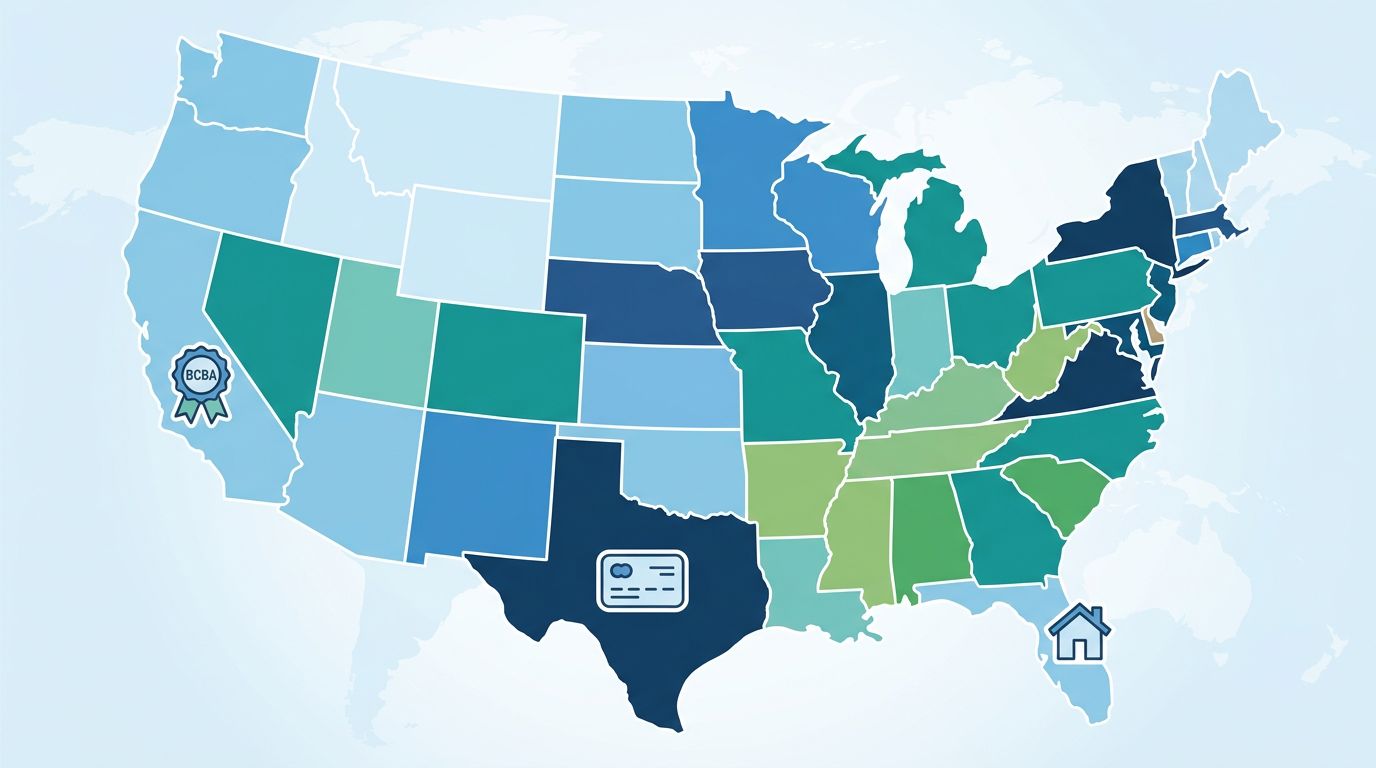
Infographic of ABA therapy cost-of-living impact across the US
This visual illustrates how cost-of-living factors and state-level insurance mandates contribute to the landscape of private pay rates, reinforcing why a personalized conversation is far more valuable than comparing online estimates.
Prompt-Pay Discounts and Private Pay vs. Out-of-Network Benefits
Beyond standard private pay arrangements, many providers offer prompt-pay discount programs that can make therapy more accessible for families who are able to pay cash or upfront. These programs work by offering a reduced rate in exchange for immediate payment at the time of service or for a prepaid block of sessions. Families can simply ask during the intake process whether a prompt-pay option exists and what the terms would be, as these discounts are often available but not always advertised.
When evaluating your options, it is helpful to understand the difference between private pay and out-of-network benefits. Private pay means you cover the full cost of therapy directly, which can offer maximum flexibility in choosing a provider without being restricted by insurance network requirements. Out-of-network benefits, on the other hand, involve using an insurance plan that provides partial reimbursement for services from providers who are not contracted with the insurer. This route may reduce your upfront responsibility compared to pure private pay, but it requires submitting claims and understanding your plan’s reimbursement rates and deductibles.
We help families succeed with ABA by guiding them through these choices, weighing factors like provider availability, coverage limits, and personal budget considerations. For a deeper, more personalized conversation, families can schedule an autism caregiver consultation to discuss their payment options and explore discount opportunities. At Brighter Care ABA, we manage insurance eligibility and authorization on your behalf, so you can spend less time on paperwork and more time celebrating your child’s milestones. You’re not on your own. Understanding your payment options is the first step toward accessing quality ABA therapy. A Bright Future is Waiting for Your Child.
Results may vary based on individual patient circumstances.
Practical Section: How to Evaluate ABA Provider Pricing
Now that you understand the factors that affect pricing, here’s how to evaluate a provider’s costs in practice. For families planning ahead, understanding the landscape of aba therapy cost per hour 2026 is a smart first step as rates and insurance landscapes evolve. What really matters is not a fixed number, but understanding what is included in a therapy package and how it aligns with your child’s unique needs. Our team at Brighter Care ABA believes in transparent conversations from the very first call, because we know that financial clarity is essential for reducing your stress and letting you focus on what’s most important: your child’s progress. We’re here to help you navigate these questions so you can move forward with confidence. Results may vary based on individual patient circumstances.
A Checklist of Questions to Ask a Potential Provider
Before you commit to a provider, it’s vital to have a detailed conversation about what your investment covers. We encourage you to start by reviewing the range of ABA therapy services offered, then ask the following questions. Getting clear answers upfront helps prevent surprises and ensures the program is a good fit for your family. Remember, a quality provider will welcome these questions and answer them openly.
- Supervision hours: How many hours of BCBA supervision are included in my child’s weekly schedule? Active BCBA oversight is critical for a high-quality program and for driving meaningful progress.
- Cancellation policy: What is your policy for sessions canceled due to illness or family emergencies? You’ll want to understand any potential charges for missed visits so you can plan accordingly.
- Sliding scale or payment plans: Do you offer a sliding scale, need-based scholarships, or a structured payment plan to help manage costs? This can be a lifeline when navigating private pay aba therapy rates.
- Insurance billing: How do you handle insurance billing, and what is the process for verifying my benefits? We know this can be daunting, so a provider who manages authorizations and claims on your behalf, like we do at Brighter Care ABA, can save you an immense amount of time.
- Additional fees: Are there separate fees for the initial assessment, regular parent training sessions, or school support consultations? It is also helpful to ask about the bcba vs rbt hourly rates reflected in your plan breakdown, as a BCBA’s time for program development is billed differently than an RBT’s direct 1:1 therapy.
Steps to Estimate Your Total Monthly ABA Therapy Cost
Getting a clear picture of your monthly financial responsibility involves a few practical steps. By following this process, you can move from uncertainty to a solid estimate that helps you plan your family budget. This is your roadmap to understanding the investment in your child’s future.
- Verify your insurance benefits. Call the member number on your insurance card to confirm your plan’s coverage for ABA therapy. Specifically ask about your deductible, co-pay or co-insurance percentage, and your annual out-of-pocket maximum for in-network and out-of-network services.
- Request a good faith estimate. After an initial assessment, ask the provider for a written good faith estimate of the recommended weekly therapy hours. This recommendation is based on your child’s specific clinical needs and is the foundation for all your cost calculations.
- Inquire about private pay rates. If you plan to pay without using insurance or are facing a high deductible, ask for the provider’s private pay aba therapy rates. This gives you a clear alternative cost basis for comparison and a plan B if needed. Understanding the bcba vs rbt hourly rates in this context helps you see where program costs are generated.
- Calculate your estimated monthly hours. Take the recommended weekly hours from step two and multiply that number by 4.3. This converts the weekly recommendation into a realistic monthly hours estimate, as there are slightly more than four weeks in each month.
- Factor in ancillary costs. Once you have your monthly therapy estimate, add in any one-time or periodic fees you identified from your checklist. This should include the cost of the initial assessment, ongoing parent training workshops, and any fees for school support services.
Many providers, including our team at Brighter Care ABA, offer a complimentary initial consultation to walk through these very questions, discuss your child’s needs, and explain our specific billing processes. With these questions and steps, you’re ready to compare providers and make an informed choice for your child’s therapy.
Advanced Section: Navigating Cost and Quality in 2026
Now that you know how ABA therapy works, let’s explore how to balance cost and quality when planning for 2026. Many families weigh the aba therapy cost per hour 2026 against the level of personalized care their child needs, and understanding what drives both is the first step to making a confident choice.
Several factors influence the overall investment in ABA therapy. Provider qualifications play a major role. Board Certified Behavior Analysts (BCBAs) design and oversee every treatment plan, while Registered Behavior Technicians (RBTs) deliver the day-to-day therapy under close supervision. This tiered structure impacts bcba vs rbt hourly rates because the advanced expertise and oversight a BCBA provides differ from the direct, one-on-one support an RBT offers. Session intensity and duration also matter; a child requiring more hours of therapy each week will naturally have a different cost profile than a child with a lighter schedule. Geographic location introduces additional variability, as operating costs and service availability differ from one community to the next. Finally, whether a family uses insurance benefits or explores private pay aba therapy rates can significantly change the monthly financial picture.
While cost is an important consideration, quality remains the most critical measure of effective ABA therapy. At Brighter Care ABA, our quality starts with rigorous BCBA oversight. Every program is guided by a certified professional who monitors progress, adjusts goals, and ensures all interventions align with evidence-based practices. Our individualized treatment plans target the specific social, communication, and adaptive skills each child needs to thrive at home and in school. We also prioritize parent training, because caregivers are the most consistent influence in a child’s life, and we provide the tools families need to reinforce progress between sessions.
We know navigating insurance benefits can feel overwhelming, which is why our team handles eligibility checks and claims on your behalf. Many of the families we serve find that insurance coverage substantially reduces their out-of-pocket costs, making high-quality, consistent care more accessible. Because every child’s needs are unique, we do not disclose pricing online. Instead, we encourage you to contact us for a personalized quote based on your child’s specific goals, schedule, and benefit plan.
Please consult with a healthcare professional for diagnosis or treatment advice. The Behavior Analyst Certification Board (BACB) sets rigorous standards for certified professionals, reinforcing the importance of choosing providers who meet these requirements. Understanding these factors is the first step toward Succeed with ABA. Reach out today and take that next step with confidence.
Results may vary based on individual patient circumstances.
FAQ: Common Questions About ABA Therapy Cost
We’ve answered some of the most common questions below.
What factors affect the cost of ABA therapy? The aba therapy cost per hour 2026 varies by location, therapy intensity, session frequency, and provider credentials.
How do BCBA and RBT roles affect cost? BCBA vs. RBT hourly rates reflect different responsibilities: BCBAs design and supervise, while RBTs provide direct therapy. This structure affects the overall investment.
Does insurance cover ABA therapy? Many insurance plans cover ABA therapy. Our team handles insurance authorization and benefit verification to help minimize your out-of-pocket expenses.
How can I get an estimate for my child’s therapy? Contact us for a personalized cost estimate. We’ll review your child’s needs and explain private pay aba therapy rates and insurance options.
Results may vary based on individual patient circumstances. Please consult with a healthcare professional for diagnosis or treatment advice. By using this Site you indicate your acceptance of our Privacy Policy.
Understanding ABA Therapy Cost-Per-Hour in 2026
If you’re researching aba therapy cost per hour 2026, you’re already taking a powerful first step toward helping your child succeed with ABA. We want you to feel informed, not overwhelmed, so let’s walk through the key drivers that shape hourly rates. Knowing these factors will help you understand why pricing varies so widely and why a personalized conversation is the most accurate way to plan for your family’s needs.
The credentials of the professional providing therapy have a significant impact on cost. Bcba vs rbt hourly rates differ because these roles require different levels of training and responsibility. A Board Certified Behavior Analyst holds a master’s degree, designs the overall treatment plan, and supervises the clinical team. That advanced expertise is reflected in a higher rate. The person working directly with your child during most sessions is a Registered Behavior Technician, who implements the plan under the BCBA’s guidance. The supervising BCBA is certified by the BACB certification board, which sets rigorous standards for education and experience.
Location is another major influence. Urban areas or states with a higher cost of living, such as California and New York, will generally have higher average rates than rural communities. The therapy setting matters too. Home-based and school-based sessions may include travel time and different logistical considerations compared to clinic-based therapy, affecting the overall cost structure.
Your funding source also plays a role. Private pay aba therapy rates can look different from insurance-negotiated rates, because insurance companies establish contracted amounts with providers. At Brighter Care ABA, we manage insurance authorization on your behalf so you don’t have to navigate that complexity alone.
Because we build a completely individualized treatment plan for every child, there is no single price we can quote without first understanding your child’s unique strengths and goals. We invite you to contact us for a consultation and insurance check so we can give you clear, personalized information that reflects your family’s actual situation.
Resources
- Get Personalized ABA Home Therapy for Autism
- Find Expert Home-Based ABA Therapy Provider
- Learn About Parent Training in ABA Therapy
- Explore ABA Therapy Locations in Illinois and Virginia
- Discover ABA Therapy Options for Children with Autism
- Explore ABA Therapy Careers with Competitive Pay
- Get Personalized ABA Consultation for Autism
- Access Biomedical Databases and Research Tools
- Find BACB Certification Standards and Requirements
