



Table of Contents
- ABA for Obsessive Behaviors: A Comprehensive Guide for Families
- Understanding Obsessive Behaviors in Autism and the Role of ABA
- How BCBAs Identify the Root Cause of Obsessive Behaviors Through Functional Assessment
- Putting ABA into Practice: Strategies for Reducing Obsessive Behaviors
- Advanced ABA Techniques for Sustained Behavior Change
- Common Questions About ABA and Obsessive Behavior Management
- Supporting Your Child's Progress with ABA Therapy
ABA for Obsessive Behaviors: A Comprehensive Guide for Families
ABA for obsessive behaviors in kids who have autism is an evidence-based approach that uses structured, personalized strategies to replace strict habits with more malleable, adaptive skills while respecting each kid’s unique needs. The goal is to show parents how Applied Behavior Analysis might benefit a young person whose repetitious thoughts and uncontrollable actions become a burden in relation to other facets of life such as friendships, academic work, and family obligations.
At Brighter Care ABA, we build each therapy program according to the child’s daily surroundings including home, school, and community. Board Certified Behavior Analysts develop personalized plans that focus on teaching children how to regulate their emotions, communicate effectively, and participate in typical day-to-day activities during one-on-one instruction from Registered Behavior Technicians. Additionally, our team provides ongoing education for parents, works closely with teachers, and ensures any progress made at home can be replicated when the child arrives at school.
Language loss, extreme discomfort when routines change or sensitivity to certain sounds can mean there’s a need for professional help. The parent guidance section of Brighter Care ABA introduces parents to the Antecedent-Behavior-Consequence model, a tool clinicians use to understand what triggers a behavior and how to teach a safer, more effective replacement.
Understanding what obsessive behaviors are and how ABA addresses them is an essential first step for families; the discussion ahead explores the specific forms these behaviors can take in autism and breaks down the ABA principles that guide meaningful, lasting change.
Key Takeaways
- Obsessive behaviors in autism spectrum disorder often appear as repeated movements, rigid routines, or intense, focused interests.
- When families come to us searching for ABA for obsessive behaviors, our first step is a thorough functional assessment.
- When putting ABA for obsessive behaviors into practice, the focus shifts from analysis to action, to reduce rigid patterns and build flexible, functional skills.
- As a new BCBA assesses the child’s behavior, they create a link between where the child currently functions and what families hope the child will be able to do.
- How can ABA therapy help with obsessive behaviors?
Understanding Obsessive Behaviors in Autism and the Role of ABA
Obsessive behaviors in autism spectrum disorder often appear as repeated movements, rigid routines, or intense, focused interests. These behaviors frequently serve a purpose, such as providing comfort, regulating sensory input, or creating a sense of control in a world that can feel overwhelming. Research from the Association for Behavior Analysis International (ABAI) highlights that repetitive behaviors may be adaptive or challenging and are often maintained by automatic reinforcement or a need for predictability.
While some habits might look similar to compulsive acts seen in OCD, the reasons behind these actions vary greatly.
| Feature | Repetitive Behaviors in Autism | OCD Compulsions |
|---|---|---|
| Underlying Motivation | Often serve sensory, self-regulatory, or communication functions; can be adaptive or self-soothing, per ABAI research | Typically performed to neutralize or reduce distress caused by intrusive, unwanted thoughts |
| Emotional Trigger | Frequently linked to sensory overload, routine disruptions, or a need for predictability; not primarily anxiety-driven | Triggered by obsessive, anxiety-provoking thoughts that the person feels unable to control |
| Relationship to Anxiety | Anxiety may co-occur but is not the primary driver; behaviors can appear even when the child is calm | Anxiety is central; the compulsion is a direct response to emotional distress |
| Flexibility | Often shows variability and can be interrupted or redirected without extreme distress; patterns may shift over time | Typically rigid, rule-bound, and performed in a precise, ritualized manner; deviation causes intense anxiety |
| Typical Response to Intervention | ABA focuses on functional assessment and teaching alternative, flexible responses; improvement is gradual and skill-building | Standard treatment is Exposure and Response Prevention (ERP) and cognitive therapy; reducing compulsive rituals is a central goal |
These differences will guide the kind of support that a child needs. With autism, behaviours often function as communication or coping strategies, so teaching replacement skills and making the environment more predictable can reduce reliance on the behaviour itself.
Our team is curious about these behaviors. The Board Certified Behavior Analysts (BCBAs) on our staff utilize the ABC framework to determine the antecedents (what happens before the behavior occurs), as well as the maintenance for the behavior (what happens during or following the behavior which will keep it happening). By understanding the function of the behavior, our BCBAs can then create a plan to teach replacement behaviors based upon this information. Plans are delivered in the home and are grounded in evidence-based interventions and practices. Ongoing data collection measures progress and guides adjustments.
Understanding why patients engage in their particular behavior creates the base for functional assessment, the next step in this process as we identify causes and create a plan for improvement.
How BCBAs Identify the Root Cause of Obsessive Behaviors Through Functional Assessment
When families come to us searching for ABA for obsessive behaviors, our first step is a thorough functional assessment.
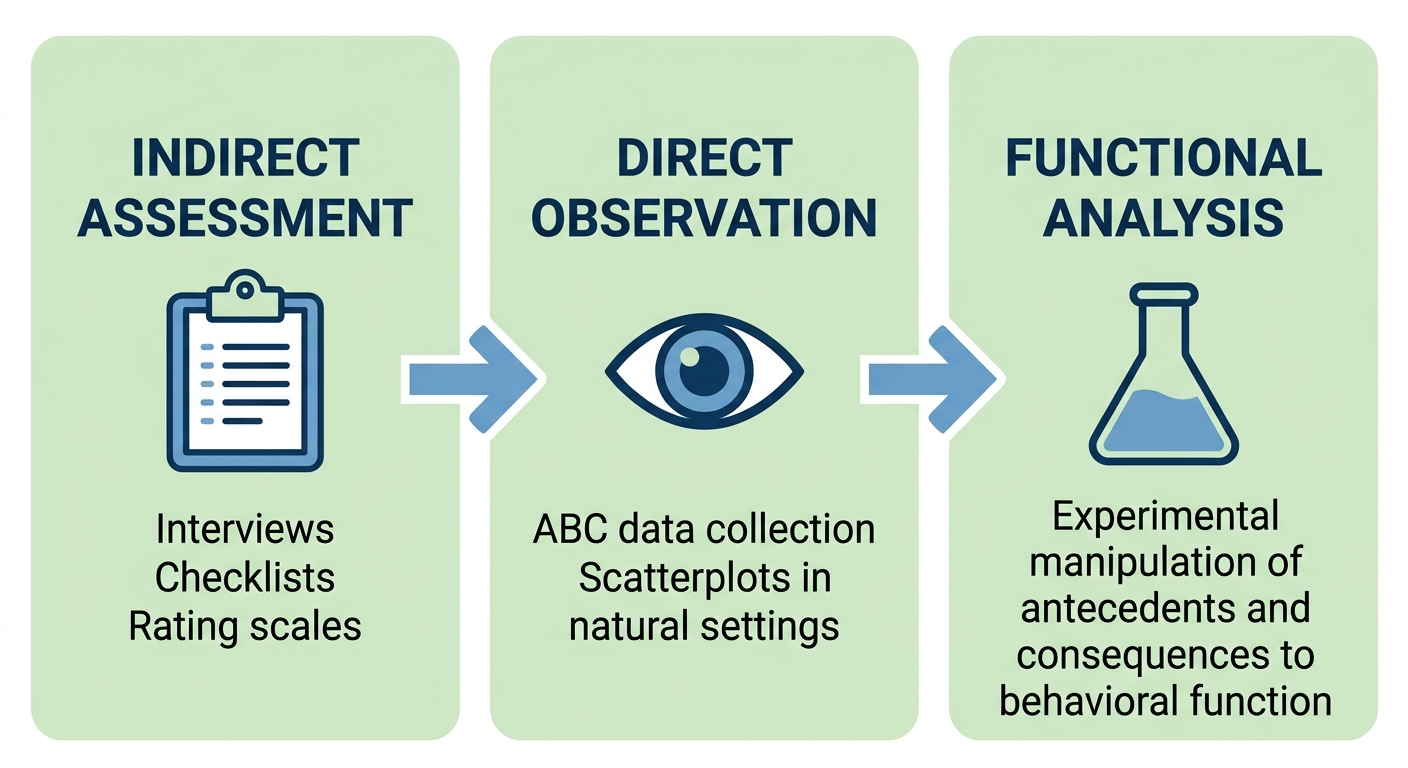
The Functional Behavior Assessment (FBA) Process
We then perform an FBA following a defined approach for gathering detailed data on the subject’s behaviour through interviews with carers and parents to determine how long the behavior has been present, its setting and what has already been done to try and reduce that particular behavior.
Finally, we perform direct observation of the child within their own surroundings, usually their house. The BCBA will then document the antecedent, the behavior and consequence in order for them to understand exactly what leads up to and comes after that specific behavior.
If observations and interviews leave uncertainty about function, we perform a functional analysis, in which, in a controlled way, we introduce or remove environmental variables to test hypotheses about why the behavior continues, confirming the root cause before a treatment plan is designed.
Distinguishing Between Sensory and Escape-Maintained Obsessive Behaviors
Sensory-maintained versus escape-maintained behavior tells us what type of intervention we need. Sensory-maintained behavior can provide its own internal reinforcement. For example, a kid who repetitively rocks when seated may be getting vestibular input that feels calming.
Escape-maintained behaviors can remove or delay aversive demands from occurring. For instance, if a child starts spinning objects upon being asked to complete their handwriting worksheet they might be trying to avoid completing that homework. The ABC data show that the request for this worksheet always comes before the spinning and also the consequences of this behaviour are removal or delay of that aversive demand.
BCBAs can separate the two based on when a behavior starts and what happens next, then develop appropriate interventions for each behavior function.
Using Data Collection to Shape Individualized Treatment Plans
Our BCBAs use ABC charts for recording each episode as well as daily datasheets to track frequency, duration, and intensity.
If data indicates a sensory component, we will teach a replacement sensory activity that meets the same need but is more adaptive in its role. If the data suggests that the child is seeking escape from tasks or demands, then teaching him a functional communication response such as requesting a break by tapping his break card or verbally saying he wants to take a break would help him meet that need appropriately.
- ABC charts document antecedent, behavior, consequence.
- Daily sheets record frequency, duration, intensity.
- Data reviews refine hypotheses and adjust goals.
With a clear picture of the root cause, we are ready to design targeted strategies that reduce the behavior and teach new skills.
| Function | Description | Example of Obsessive Behavior | ABA Intervention Approach |
|---|---|---|---|
| Sensory Stimulation | Behavior produces internal sensory reinforcement independent of others | Hand-flapping or repetitive rocking that provides visual or vestibular input | Teach a replacement activity that delivers similar sensory input in a socially appropriate way |
| Escape | Behavior removes or delays an aversive situation or non-preferred task | Spinning objects or tapping surfaces each time a demand is placed | Teach a functional communication response, such as requesting a break |
| Attention | Behavior results in social reactions from peers or adults | Lining up toys repeatedly while looking toward a caregiver for a reaction | Provide scheduled, high-quality attention for appropriate behaviors and minimize reaction to the target behavior |
| Access to Tangibles | Behavior gains access to a desired item or activity | Grabbing and clutching a preferred object when told “not yet” or “wait” | Teach appropriate requesting skills and implement clear waiting procedures |
Putting ABA into Practice: Strategies for Reducing Obsessive Behaviors
When putting ABA for obsessive behaviors into practice, the focus shifts from analysis to action, to reduce rigid patterns and build flexible, functional skills. You’re not on your own.
| Technique | Description | When to Use | Example |
|---|---|---|---|
| Replacement Behavior Training | Teaching a new, socially valid behavior that serves the same function as the obsessive behavior. | When the obsessive behavior fulfills a clear need, such as sensory input or escaping a demand. | Teaching a child who engages in repetitive hand-washing to follow a visual chart for a functional hand-washing routine. |
| DRA (Differential Reinforcement of Alternative Behavior) | Rewarding a specific, appropriate alternative behavior that serves the same purpose as the obsessive behavior. | When a child needs a direct replacement for a behavior that helps them communicate a need. | Encouraging a child to request a break using a card instead of engaging in repetitive rocking when overwhelmed by a task. |
| DRO (Differential Reinforcement of Other Behavior) | Providing reinforcement when the obsessive behavior is not occurring for a set period of time. | When the goal is to reduce the overall frequency of a behavior, regardless of what the child does instead. | Delivering praise or a small reward after every three-minute interval without repetitive vocalizations. |
| DRL (Differential Reinforcement of Low Rates) | Reinforcing the behavior only when it occurs below a predetermined rate or frequency. | When the behavior itself is not harmful but becomes problematic because of how often it occurs. | Allowing a child to engage in a rigid lining-up routine, but only providing attention and praise when they line up three objects instead of ten. |
A BCBA will choose and modify these methods after conducting a thorough functional assessment of the child to make sure the chosen method matches the child’s specific needs and daily routines.
Replacement Behavior Training for Daily Life Interference
Replacement behaviors teach another new behavior that fulfills the same purpose, just in a better manner. For instance, a child may flap his hands because he needs sensory input, but then learns how to squeeze a stress ball instead. Alternatively, if your kid was obsessed with washing her hands, she would be shown a visual schedule which teaches her when it’s time to wash and how long to wait before washing again.
Differential Reinforcement Techniques to Encourage Adaptive Skills
DRA (Differential Reinforcement of Alternative Behavior) rewards a specific behavior that serves the same purpose—for instance, teaching and reinforcing handing over a "break" card instead of repetitive rocking to escape a task. DRO (Differential Reinforcement of Other Behavior) provides reinforcement whenever there aren’t any instances of the problematic behavior occurring. DRL (Differential Reinforcement of Low Rate) reduces behaviors that are not harmful but occur too frequently, like repeated door-checking, by reinforcing only when the behavior meets a lower-rate criterion.
Our BCBAs use the Antecedent-Behavior-Consequence framework to predict triggers, set appropriate reinforcement schedules, and adjust plans based on ongoing data collection.
Parent Training and Home-Based Consistency Strategies
At our house, we take care of treatment as part of your everyday life at home, including parent training where parents and caregivers learn how to practice behavior replacement and reinforcement techniques with their children when they are not in their appointments with us.
The main thing we teach them is a simple tool—how to keep a basic data chart to track occurrences of the target obsessive behavior.
Training in replacement behaviors, differential reinforcement, and family members practicing at home builds a solid foundation for more complex procedures that last over time.
Advanced ABA Techniques for Sustained Behavior Change
As a new BCBA assesses the child’s behavior, they create a link between where the child currently functions and what families hope the child will be able to do. When we pair targeted strategies for managing restrictive or repetitive patterns, such as Applied Behavior Analysis for obsessive behaviors—with advanced techniques rooted in assessment data, the changes become more durable and transferable across everyday life.
Our comprehensive evaluation uses the Verbal Behavior Milestones Assessment and Placement Program, or VB-MAPP, to measure 170 learning and language milestones across three developmental levels: 0–18 months, 18–30 months, and 30–48 months. This detailed map of a child’s current skills allows our clinicians to select generalization activities matched to their developmental stage. For example, a learner in the early 18–30 month range might practice requesting a preferred item first during a one-on-one session, then with a parent in the kitchen, and later with a teacher during classroom choice time—each step intentionally planned from the VB-MAPP profile.
Next is a functional behavior assessment (or FBA) in addition to the VB-MAPP. An FBA allows us to find out what specific environment factors might be causing difficult behaviors as well as how those behaviors function. Determining the reason(s) a behavior happens will help us identify the correct replacement behavior that meets the need for which this behavior was originally used (escape, obtain attention, or some type of sensory need) but in a way that is less disruptive. We also must consider where a Behavior Intervention Plan should be implemented, since our interventions cannot only occur in the therapy room but have to be in place throughout many aspects of life such as the classroom, grocery store, or even at dinnertime.
Skill generalization, or the ability to use a learned behavior in different settings, and maintenance, which is the persistence of that behavior over time, are the core goals we pursue with every family. By grounding technique selection in the rigorous data our assessment provides, we help children carry their progress into the places where it matters most, a commitment that naturally invites the common questions families ask about long-term outcomes.
Common Questions About ABA and Obsessive Behavior Management
How can ABA therapy help with obsessive behaviors?
Personalized plans, designed by our BCBAs, tackle what your child needs most. This can include teaching them how to communicate effectively in their day-to-day life as well as coping methods.
What does an ABA treatment plan for obsessive behaviors involve?
We start with an initial assessment from our BCBAs before beginning with home-based 1-on-1 therapy sessions focused on helping the student learn and practice alternative ways to behave. Goals will be set up and we’ll monitor progress in order to change techniques if necessary.
How can parents reinforce ABA strategies for obsessive behaviors at home?
We provide parents training and home-based sessions, giving them tools to put these things into play.
Does ABA therapy for obsessive behaviors include school support?
We give school consultations that match up the techniques employed in class with your child’s therapeutic goals. Through these collaborations, we make sure your youngster practices their newly learned actions in all settings.
These answers guide you as you continue supporting your child’s progress.
Frequently Asked Questions
What is the difference between repetitive behaviors in autism and OCD-related compulsions?
Repetitive behaviors in autism often serve sensory, self-regulatory, or communication functions and are not primarily anxiety-driven. In OCD, compulsions are performed to neutralize distress caused by obsessive, unwanted thoughts, and anxiety is central. Autistic repetitive behaviors can often be interrupted with less extreme distress than the rigid, rule-bound rituals characteristic of OCD.
How does ABA therapy help manage obsessive behaviors in children with autism?
ABA therapy helps by first conducting a functional assessment to identify the root cause of obsessive behaviors, then teaching adaptive replacement behaviors and using differential reinforcement to encourage flexible responses. Treatment is data-driven and individualized, with BCBAs and RBTs delivering sessions that include parent training to maintain consistency at home.
Can ABA therapy be used to reduce obsessive behaviors that interfere with daily life?
Yes, ABA therapy can reduce obsessive behaviors that interfere with daily life. After a functional assessment identifies the behavior’s function, BCBAs implement replacement behavior training and differential reinforcement strategies like DRA, DRO, and DRL to decrease the behavior’s frequency and teach more flexible, functional skills.
How do BCBAs identify the root cause or function of obsessive behaviors?
BCBAs identify the root cause through a Functional Behavior Assessment that includes caregiver interviews, direct observation of the child in their natural environment, and ABC data collection on antecedents, behaviors, and consequences. If uncertainty remains, a functional analysis in a controlled setting tests hypotheses to confirm the function.
What techniques does ABA use to replace obsessive behaviors with more adaptive skills?
ABA uses replacement behavior training to teach a new behavior that serves the same function as the obsessive behavior. Differential reinforcement techniques include DRA rewarding a specific alternative, DRO reinforcing intervals without the behavior, and DRL reinforcing lower rates, all selected based on the functional assessment.
Supporting Your Child’s Progress with ABA Therapy
It’s clear that using ABA for obsessive behaviors is most effective when families and clinicians work together. Parent involvement is key, and our parent training tools help you reinforce practical daily skills like household chores and emotional regulation between home-based sessions guided by a BCBA. School collaboration also aligns therapy goals with academic progress. We encourage families to consult with a healthcare professional for diagnosis or treatment advice. Because every child’s journey is unique, our team is here to walk alongside your family every step of the way.
Start Your Family’s ABA Journey
Now that you have a comprehensive understanding of how ABA therapy addresses obsessive behaviors, you can take the next step toward personalized support. The home-based therapy model combines BCBA oversight with practical strategies that you can implement at home. Their parent training and school collaboration ensure consistency across all settings. With the tools and insights from this guide, you’re ready to empower your child’s development. Reach out to learn about an initial evaluation and a tailored treatment plan. Your family’s progress is a partnership, and expert guidance is just a call away.
Start Your Family’s ABA Journey
