



Table of Contents
How ABA Therapy Helps Children with Autism Manage Anger
ABA for anger management in autism gives parents a clear, caring method to manage their child’s meltdowns by teaching them how to identify feelings and use coping skills while they are still happening. Our clinicians employ the ABC framework (what occurred before and after an outburst) to target the underlying issue, rather than only the behavior.
We know that anger and meltdowns aren’t a parenting failure, but a sign that our children need help learning new skills that work for how they experience the world. Our ABA services focus on positive reinforcement, play-based learning and other skill-building activities so our kids can learn to handle their feelings of frustration without forcing them to conform to someone else’s expectations or change who they are. Before we jump in to teaching new behaviors, we need to recognize what triggers anger before it blows up, so families can respond in confidence and calmness.
Key Takeaways
- Often our children with autism appear to be angry because of predictable patterns we miss, instead of just being defiant on some random day.
- Recognizing the difference between a meltdown and a tantrum is key to responding in ways that help our kids feel safe and understood.
- After conducting a functional assessment to determine the reasons for a child’s aggression, the next step is teaching them how to appropriately obtain what they’re looking for.
- Positive reinforcement is when you give a positive reward right away after a desired action to increase the likelihood of that action happening again.
- We know how hard it can be when kids get frustrated going through their day as they have to stop playing at the end of playtime, start doing their work, etc.
1. Spot Anger Triggers Before They Escalate
Often our children with autism appear to be angry because of predictable patterns we miss, instead of just being defiant on some random day. If we pay attention to when and where frustration occurs for them in daily life we can begin to recognize what provokes the reactions.
The ABC framework (antecedent, what happened before, behavior, how a child reacted, and consequence, what followed) can help us spot these patterns in our home too. For instance, when a child’s anger erupts during the switch from activity to activity, the switching might be what triggered the child to feel angry. Keeping a simple log of the times when these situations arise can point us toward whether the problem might be related to a child’s sensory sensitivity to certain textures, sounds, etc., which are making the child upset.
This can even be compounded by sensory overload and delayed communication, making it hard for kids to tell us what they need. The sooner we recognize these things, the better able we are to adapt our routines and help them regulate themselves emotionally, so that the escalation doesn’t happen in the first place.
2. Know the Difference Between Meltdowns and Tantrums
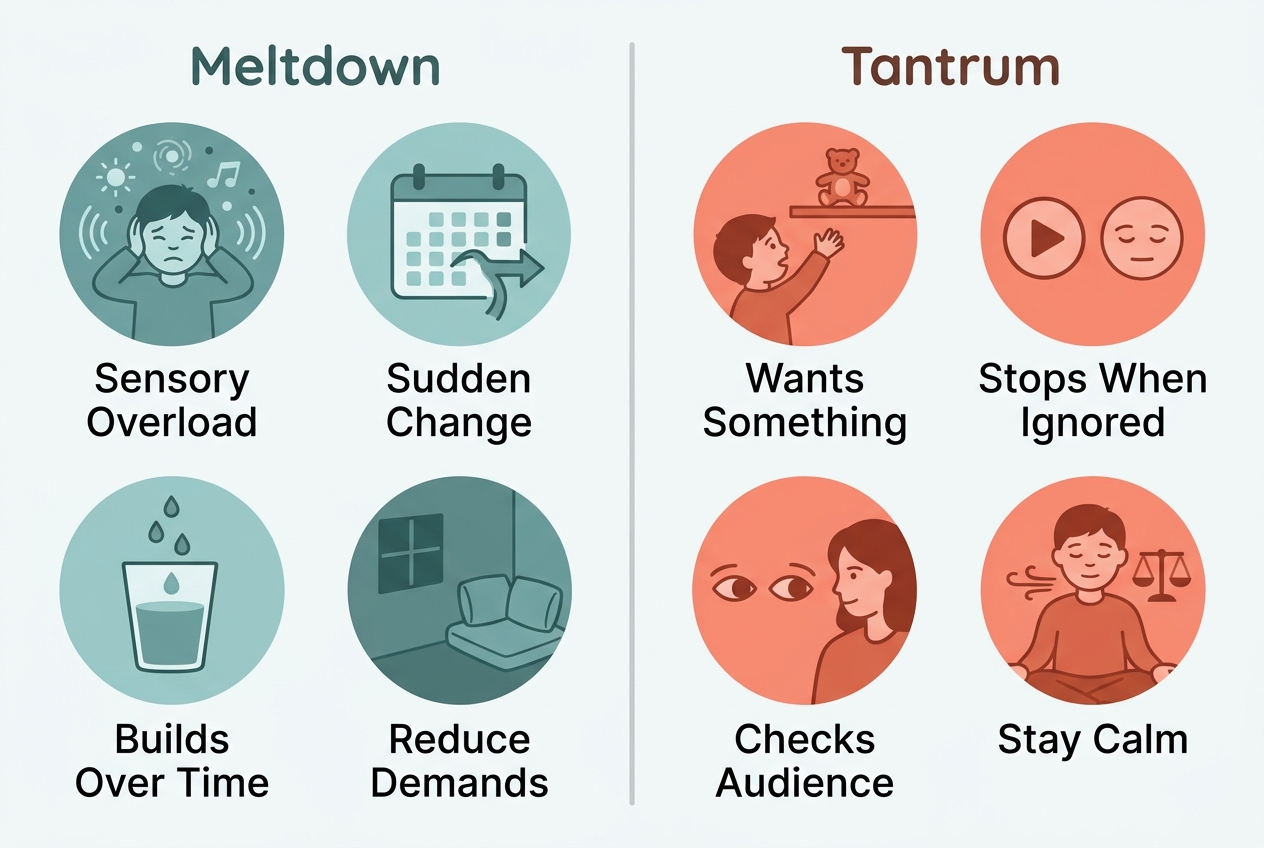
Recognizing the difference between a meltdown and a tantrum is key to responding in ways that help our kids feel safe and understood.
A meltdown is when your child’s system becomes overloaded. There’s too much noise, a sudden change, or frustration has been building for hours. They’re not trying to get something. They’re trying to cope. A tantrum, however, is goal directed. They want a toy, a snack, or attention, and will stop if they get it or if we look away.
That difference matters because our response changes too.
Discover the Real Cause with Functional Assessment
Once you begin to see that aggression isn’t just random, the next thing is to try to figure out what is causing it. And that’s where the functional behavioral assessment (FBA) comes in, which is the process that professionals go through to determine the factors that are contributing to the behavior so we can be proactive and support the student rather than react after-the-fact.
Science says behavior has a function, and by using functional analysis to understand the “why,” we can better teach kids how to communicate their needs in appropriate ways. It is not about putting the blame on a child’s behavior; instead, it is about figuring out what their behavior is trying to say to us, which federal guidance emphasizes will help reduce our own implicit bias in our interpretations.
You’re not on your own. Federal education guidance confirms that FBAs never delay or deny a full evaluation for a child suspected of having a disability under IDEA or Section 504, so you can pursue assessment with confidence in your child’s rights and next steps.
4. Replace Aggression with Functional Communication
After conducting a functional assessment to determine the reasons for a child’s aggression, the next step is teaching them how to appropriately obtain what they’re looking for. Functional Communication Training (FCT) takes the aggression out of a situation and replaces it with something that is clear and teachable, allowing children to request, protest or ask for help in ways that get their point across.
Our BCBAs tailor each plan based on what maintains the child’s behavior, reinforcing the appropriate communication and not providing reinforcement for aggressive behavior. Using a functional approach, FCT focuses on the underlying cause of the destructive behavior instead of just addressing its surface behaviors.
This approach extends beyond therapy rooms. Behavioral momentum theory boosts its effectiveness in everyday settings, so children can use their new skills where they matter most. For parents exploring ABA therapy, this means aggression can be replaced by a functional skill tailored to the child’s unique needs and supported by a trusted local team.
Build Emotional Regulation with Positive Reinforcement
Positive reinforcement is when you give a positive reward right away after a desired action to increase the likelihood of that action happening again. In terms of emotional regulation, this could be congratulating your child when they use a calming technique, cope with frustration, or ask for help or what they need instead of getting angry. For our team, it’s the connection between teaching new skills and helping turn those skills into habits in the home.
Try these simple ways to reinforce emotional regulation:
- Praise the moment your child takes a deep breath or uses a coping phrase
- Offer a preferred activity right after they calm down from a tough moment
- Give high-fives or stickers for using words to express feelings
The more consistent families are, the better. So, our parent training helps families practice these techniques together. We also suggest that families work on reinforcement, along with the communication strategies from the previous section, so that they can continue to make progress in all settings.
Use ABA Anger-Management Techniques at Home
We know how hard it can be when kids get frustrated going through their day as they have to stop playing at the end of playtime, start doing their work, etc. Splitting these big moments into smaller steps will help them feel successful rather than angry. For example, setting a five minute timer before taking away a game offers them a clear end to their play, which cuts down on the anxiety that can trigger a big emotional reaction.
Using visual tools such as now/then boards and timers can help establish predictability by illustrating what is happening now and what is coming next. Use this in conjunction with a consistent phrase, like “First play, then snack,” to further enforce the routine.
If you can teach your child how to simply ask for a break—for example by handing you a card—it gives them a tool to express their needs before frustration escalates. And positive reinforcement works just as well at home as in therapy. Praising calm behavior right away encourages your child to repeat those responses.
Stay Consistent Through Caregiver Training
When your child starts doing some anger-management practice at home, the hard work shifts to you, as the caregiver. We teach families how to respond the same way when they’re frustrated, no matter where it happens to be, at the table, in the grocery store, on the playground. We guide parents in demonstrating what calm looks like, role-playing different scenarios, and giving clear feedback, so that these strategies will come more naturally to them at home.
Consistency doesn’t only mean sticking to the plan, but it’s also about ensuring that everyone involved in your child’s care does things the same way. When siblings, grandparents and teachers handle big emotions all the same way, your child will learn much faster and feel a lot more secure. We work with families to create simple reinforcement routines, so that regardless of whether it happens in Richmond or all across Illinois and Virginia, positive behavior receives the same response.
The good stuff shows up in the small stuff: less tantrums, easier transitions, and skills they carry out on their own when we are done working together.
8. Watch Progress Grow with Data-Driven Plans
Our ABA for anger management in autism programs are made up of small and measurable steps that increase as your child does. Board Certified Behavior Analysts (BCBAs) assess each child’s strengths before breaking down goals into clear, manageable steps that they can work on at home and elsewhere.
During one-on-one sessions, our Registered Behavior Technicians collect real-time data while supervised by our BCBA, so every response is tracked and every success is visible. By watching and measuring our progress we can determine if a skill has been mastered or if some work needs to be done. Families get a clear indication of their child’s progress. Since we focus on positive reinforcement and teaching through play, the skills our children develop are meaningful and not just a lesson in compliance.
As these skills become a habit, they transfer naturally to the home, classroom, and social settings, making your child feel calmer and more confident everywhere.
Frequently Asked Questions
How does ABA therapy help children with autism manage anger and frustration?
ABA therapy helps children with autism manage anger and frustration by teaching them to recognize feelings and use coping skills during outbursts. Clinicians use the ABC framework to identify triggers and reinforce positive behaviors, replacing aggression with functional communication and emotional regulation strategies.
What are the common triggers for anger and meltdowns in autistic children?
Common triggers for anger and meltdowns in autistic children include predictable patterns like sudden changes, sensory overload, or frustration from transitions between activities. Keeping a log of these situations can reveal whether sensory sensitivities or delayed communication contribute to the reactions.
Can ABA techniques be used at home to help with a child’s anger management?
Yes, ABA techniques can be used at home to help with anger management. Parents can use visual tools like timers and now/then boards, break activities into smaller steps, and reinforce calm behavior immediately with praise or preferred activities to reduce frustration.
How do BCBAs identify the root cause of aggressive behavior in children with autism?
BCBAs identify the root cause of aggressive behavior through Functional Behavior Assessments (FBA), which analyze antecedents, behaviors, and consequences to determine the function of the aggression. This process helps tailor interventions to address the underlying needs.
What is the difference between an autism meltdown and a tantrum in terms of ABA support?
An autism meltdown is an involuntary response to overload, such as sensory overload or sudden change, while a tantrum is goal-directed, like seeking attention or a desired item. ABA support differs: meltdowns require reducing demands and providing comfort, while tantrums may respond to ignoring or addressing the specific request.
A Calmer Path Forward for Your Family
We know how hard it can feel when your child faces emotional or behavioral challenges, and we’re here to help. Our personalized ABA plans are built around your child’s strengths, broken into small, manageable steps so progress feels achievable rather than overwhelming. Whether it’s practicing calmer emotional responses or building skills that fit naturally into daily routines, we focus on what works for your family.
Each child is on his/her own path and we provide support outside of our one-on-one sessions including parent training, working with the schools, and coordinating insurance. So, you can continue to focus on your child! Contact us today for a BCBA evaluation and let’s take that first step towards a calmer, more confident life for your child and your family.
Begin Your Child’s Evaluation Today
You now have eight practical strategies for helping your child manage anger, from spotting triggers early to building emotional regulation through positive reinforcement. Understanding the difference between meltdowns and tantrums is a powerful first step, but professional support can turn those insights into a personalized plan. Every child’s progress unfolds at their own pace, and the right assessment makes each next step feel achievable rather than overwhelming. At Brighter Care ABA, treatment plans developed by BCBAs are built around your child’s individual strengths and broken into small, manageable steps. Parent training, school collaboration, and insurance support are part of the journey alongside one-on-one therapy. Results may vary based on individual circumstances, and we recommend consulting a healthcare professional for diagnosis or treatment advice. If you’re ready to explore what personalized ABA could look like for your family, our team is here to help.
