



Table of Contents
Understanding School Support Planning for Children with Autism
The main difference between 504 plan vs IEP for autism is that an IEP is a formal legal document providing specialized instruction and measurable annual goals for students who need intensive educational intervention. On the other hand, a 504 plan is a civil rights accommodation under Section 504 that prevents discrimination and can apply without learning disabilities.
Kids who have ASD experience issues when they try to communicate with other kids and also experience difficulties in learning. Planning correctly will help these young kids succeed with ABA.
Based on Children’s Mercy Kansas City’s comparison, we can assist parents and families in deciding whether an IEP or a 504 plan best fits their child’s needs.
The first thing we need to know about this topic is what legal provisions allow for all of those supports under federal law: The Individuals With Disabilities Education Act (IDEA), and Section 504 of the Rehabilitation Act.
Key Takeaways
- When comparing a 504 plan vs IEP for autism, know the legal foundations.
- An IEP provides legally enforceable specialized instruction that a 504 plan cannot offer, making it the more protective option for students who need more than classroom accommodations.
- Section 504 accommodations plans allow for the openning up of the classroom by giving some little yet significant changes that let students in on learning without putting down their expectations.
- There is a lot to consider when deciding between a 504 plan vs IEP for autism in Virginia.
- This all starts with two separate federal statutes: IDEA governs IEPs and states that to qualify, a child must fit into one of 13 disability categories and require specialized instruction.
1. Understanding IDEA and 504 Rights
When comparing a 504 plan vs IEP for autism, know the legal foundations. The Individuals with Disabilities Education Act (IDEA) provides an IEP with specialized instruction for students who qualify under one of thirteen disability categories. An IEP team includes parents, a general education teacher, a special education teacher, a school psychologist, and a district representative. IEPs are reviewed annually, with full reevaluation every three years.
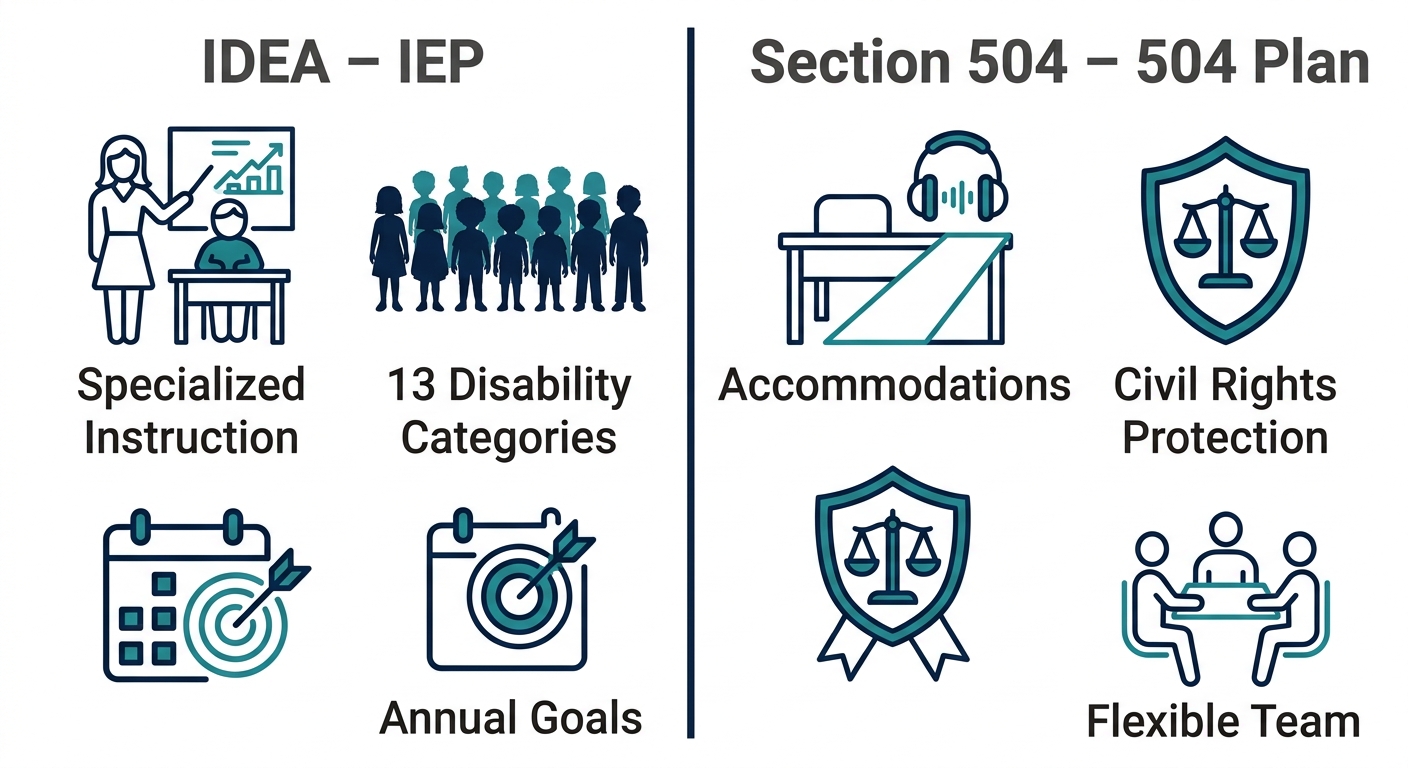
504 of the Rehabilitation Act is a civil rights act providing that children will receive accommodations to eliminate learning barriers when there’s no need for specialized instruction. Although 504 plans may last only briefly, they must still be renewed yearly, as would be required with an IEP. Legal rights allow families of autistic kids to determine whether their needs require the more intensive support available through an IEP. We assist parents in obtaining school accommodations.
2. When an IEP Provides Stronger Protections
An IEP provides legally enforceable specialized instruction that a 504 plan cannot offer, making it the more protective option for students who need more than classroom accommodations. According to guidance from Geisinger Health, eligibility for an IEP requires that a child fall under one of 13 specific disability categories defined by the Individuals with Disabilities Education Act (IDEA) and demonstrate a need for specially designed instruction.
There’s a difference between special education services and modifications provided under a 504 plan. The former involves specially developed goals for each child in his or her individual education program (IEP), and instruction must be provided using these specified tactics and tools. For its part, the 504 plan will be tailored to eliminate impediments that keep students from having fair opportunity to succeed academically. But as with special education, both documents are legally binding, and parents have the right to review their child’s educational records and request modifications at any stage of the process.
If you’re part of a family from Pennsylvania, there exists a helpline called ‘ConsultLine’ that can be reached at (800-879-2301), which provides no cost help for parents to understand IEPs and 504 plans. However, when children require more than just accommodations and need some form of direct teaching methods as well, then the IEP will offer these kids extra legal protections.
3. How a 504 Plan Removes Learning Barriers
Section 504 accommodations plans allow for the openning up of the classroom by giving some little yet significant changes that let students in on learning without putting down their expectations. In our meetings with school teams, we see how these accommodations remove common barriers, from adjustments to testing environments to built-in movement breaks that help students regulate throughout the day.
According to Brighter Care ABA’s school support guide, effective accommodations often emerge from classroom observation, behavior intervention planning, and staff training on evidence-based strategies like token economies and task analysis. Families, teachers, and behavior specialists work together to identify what a student needs, whether that means preferred seating, visual schedules, or timed prompts for transitions between activities.
These accommodations differ from the specialized instruction an IEP provides. Instead of modifying curriculum content, a 504 plan adjusts the environment so the student can demonstrate what they know. For students who need that more intensive, individualized support, the next step would be partnering with the school team to develop an IEP that delivers targeted instruction.
4. Navigating the IEP Meeting Process
Whereas a 504 Plan has no specific requirement for a meeting in order for a student to receive needed accommodation, the IEP requires a certain grouping of individuals who meet in a structured, legally mandated gathering. According to Commonwealth Charter Academy, this group includes you as the parents, a regular education teacher, a special education teacher, a school psychologist, and a representative from the local educational agency. The group then develops a plan that takes into account the results of all the evaluations conducted that can assist in making appropriate provisions for children with disabilities.
The team meets once a year to review progress and set new goals; a full reevaluation occurs every three years, or every two years for students with an intellectual disability. These annual sessions keep the plan aligned with your child’s development.
We could come prepared with a list of what our child is good at, is having trouble with, and goals for next year. We have the right as members of the team to disagree with the plan, request an independent educational evaluation, or call an additional meeting. The state of Virginia also protects us.
5. Virginia 504 Plan and IEP Guidelines
There is a lot to consider when deciding between a 504 plan vs IEP for autism in Virginia. While a 504 plan offers accommodations including extended time or sensory breaks, an IEP provides personalized teaching methods along with other support services such as speech therapy. In either case, both plans can be obtained through the public school system in Virginia.
The process of understanding the differences between a 504 plan vs IEP in Virginia will help make your upcoming school meetings simpler. We recommend that parents get a copy of their child’s IEP before attending the school meeting. By signing and releasing permission to our BCBA, parents enable her to work with the school teacher to ensure that the child’s therapy is consistent with classroom support services. If you have any questions about this difference, please feel free to contact your district representative or special educator advocate.
Brighter Care ABA provides school consultation throughout all areas in VA, offering guidance on making decisions about school plans that help connect between home life and academic environment. After becoming familiar with those basics, your next move would be taking into account what qualifications are required for each type of plan, so you can decide on which course will provide assistance for your son.
6. Qualifying Criteria: 504 Plan vs IEP
This all starts with two separate federal statutes: IDEA governs IEPs and states that to qualify, a child must fit into one of 13 disability categories and require specialized instruction. The IEP also outlines how much progress these kids should be expected to make each year, and sets forth those expectations via specific yearly goals. On the other hand, Section 504 is a Civil Rights statute. This law covers students whose physical or mental impairment substantially limits a major life function such as learning or focus, but may not call for any sort of special education. These kids may get extra help from certain accommodation strategies like having more time on exams, etc.
For a student with autism, a 504 plan may be appropriate when only testing modifications or sensory breaks are needed, while an IEP is necessary when direct academic intervention is essential. A 504 plan can also be temporary, during concussion recovery, unlike an ongoing IEP. Both plans are reviewed annually. Once you know which plan fits your child, you may wonder whether a student can have both a 504 and an IEP.
7. Can a Child Have Both a 504 and an IEP?
A child can have both a 504 plan and an IEP.
The Commonwealth Charter Academy states that IEPs are governed by IDEA and provide specialized instruction for students who meet one of thirteen specific disability categories. A 504 plan, under Section 504 of the Rehabilitation Act, offers accommodations—such as extra time on tests or modified seating—to remove barriers for students whose disabilities affect major life activities, even if they do not require specialized instruction.
Because the legal foundations and purposes differ, a child who needs individualized teaching and environmental support may still qualify for both. There needs to be yearly reviews of all these plans in order that any additional supports can be included based on how they change each year.
Talk with your school team if you think your son or daughter would benefit from two kinds of support. Discussing this with them may provide ideas about combining your child’s ABA program and his/her school-based support plan.
8. Integrating ABA Therapy with Your Child’s School Support Plan
ABA Therapy in the Classroom Strengthens Your Child’s Learning by Reinforcing the Same Skills Across Home and School. First we’ll observe your child during their school day in order for our BCBA to get an understanding of what they’re like in class on a daily basis. After that we create a behavior intervention plan (BIP) specific to the classroom and provide direct training for any teachers, paraprofessionals or other support staff.
These types of strategies include token economies that lead to increased participation in activities as well as task analysis, which helps break down complex skills into small steps for training that supports more independent skills.
We make everything official in this process by having all parties sign a release of information.
Before their formal meeting, parents may ask for copies of the IEP in order to read over what they’re currently working on and talk about ways ABA could be included as part of school objectives.
When ABA therapy objectives match up with IEP goals, kids receive consistent help from both places. Our team helps families in Illinois and Virginia build a fully coordinated support system. More information about that partnership will be provided shortly.
FAQ
Is 504 or IEP stronger?
An IEP is stronger than a 504 plan. An IEP provides legally enforceable specialized instruction and measurable annual goals for students who need more than classroom accommodations. A 504 plan is a civil rights accommodation that removes learning barriers without modifying curriculum content.
Why is an iep better than a 504
An IEP is better than a 504 plan when a student needs specialized instruction. An IEP delivers individually designed teaching and measurable goals, while a 504 plan only provides accommodations like extra time or sensory breaks to remove barriers. For students who require direct academic intervention, the IEP offers more comprehensive, legally enforceable support.
Can a student have a 504 and an IEP
Yes, a student can have both a 504 plan and an IEP. The Commonwealth Charter Academy notes that an IEP provides specialized instruction under IDEA, while a 504 plan offers accommodations under Section 504. Because the purposes differ, a child may qualify for both, and both plans are reviewed annually.
Partnering with Brighter Care ABA for a Coordinated Support System
We focus on aligning ABA therapy strategies with your child’s educational plan so that academic goals and behavioral support work together. Whether your child has a 504 plan or an IEP for autism, our team coordinates with school staff to identify where evidence-based classroom strategies—like token economies and task analysis—can promote engagement and independence. Collaboration is formalized through signed releases of information, creating a data-sharing loop between our BCBAs and the school team.
Call us now. Toll free phone number (833) 400-3970. Contact us to get started creating a support plan for your child. The outcomes will be different in each case according to his/her particular circumstances. If you would like more information about this condition please talk to your health care provider first. By using this site you indicate your acceptance of our Privacy Policy.
Coordinate School and ABA Support
Understanding the differences between a 504 plan and an IEP for autism is an important first step, but implementing the right school support can feel challenging. We help families align ABA therapy with their child’s school plan, whether it’s an IEP or a 504. Our team works with school staff to integrate evidence-based strategies like token economies and task analysis into the classroom. We also handle insurance coordination so you can focus on your child’s progress. With a collaborative approach that includes signed release forms and regular communication, we ensure consistency between home and school. Learn more about our services and take the next step toward a coordinated support system for your child. Contact us today to start building that partnership.
Coordinate School and ABA Support
