



Table of Contents
- The ABA Authorization Process 2026: Navigating Insurance for ABA Therapy
- Understanding ABA Insurance Authorization: Key Concepts
- State vs Federal Authorization Guidelines for ABA Therapy
- Mastering the ABA Authorization Workflow: Documents, Timelines, and Codes
- Medical Necessity and Insurance Criteria for ABA Authorization
- Answers to Your ABA Authorization Questions
- Streamlining Your ABA Authorization with Brighter Care ABA
The ABA Authorization Process 2026: Navigating Insurance for ABA Therapy
Navigating the ABA authorization process in 2026 can feel like a maze for families seeking ABA therapy for a child with autism. Insurance authorization is the critical gateway to funding these vital services—without it, families may face steep out-of-pocket costs. But we’re here to help you through every turn. We’ll walk you through the essential steps and show how our team at Brighter Care ABA can simplify the journey.
The first step is verifying your insurance benefits: always check your insurer’s online portal and confirm your child’s in-network status directly with us. Brighter Care ABA’s internal guide stresses that proving medical necessity is key; you’ll need a formal autism diagnosis, a physician’s referral, and a detailed treatment plan developed by a Board Certified Behavior Analyst (BCBA). We coordinate with your insurer and assemble all required documentation so you don’t have to.
Once therapy is approved, ongoing reauthorization is required every six months. Our clinical team continuously collects progress data to justify continued services. This regular cycle ensures that therapy remains aligned with your child’s evolving needs and that coverage never lapses. If a claim or authorization is denied, we manage the appeals process, communicating directly with the insurance carrier to advocate for your child’s care.
Understanding these key concepts behind ABA insurance authorization is the first step in this process.
Understanding ABA Insurance Authorization: Key Concepts
With a general understanding of how the authorization process works, we can now turn to a few key concepts that bring greater clarity. Insurance authorization simply means getting approval from your health plan before starting ABA therapy, confirming that the service is a covered benefit and that the treatment plan meets the insurer’s clinical standards.
Medical Necessity and How It Is Documented
Medical necessity is the clinical justification that ABA therapy is essential for your child’s development. We show this by gathering specific records:
- A formal autism diagnosis from a qualified healthcare professional
- A physician’s referral that recommends ABA therapy
- A comprehensive treatment plan written by a Board Certified Behavior Analyst (BCBA)
The BCBA’s assessment ties your child’s current skills to measurable goals, creating a clear picture of why therapy is needed. Our clinical team develops these plans so they align with insurance requirements while reflecting your child’s unique strengths and challenges.
In-Network vs. Out-of-Network Status
An in-network provider has a contract with your insurance carrier, which typically lowers your out-of-pocket costs and simplifies the claims process. We recommend verifying network status early, either by logging into your insurer’s online portal or calling the member services number on your card. Our team can also handle this verification directly, confirming coverage details before you commit to services.
Documentation You Need for Authorization
Essential documents include:
- Insurance card (front and back)
- The BCBA’s treatment plan and progress notes
- The formal diagnosis report and physician referral
- A log of every conversation with the insurance company, noting the representative’s name, the date, and any reference numbers provided
Why a Consistent Therapy Environment Matters
Insurance reviewers want to see that skills are being practiced in the places where your child lives and learns. When the same therapeutic strategies carry over from home to school to community outings, the treatment plan is being implemented uniformly, which strengthens both clinical outcomes and the authorization case. Our model reinforces this consistency by coordinating with families, teachers, and caregivers so that progress is visible across every setting.
These concepts form the foundation for navigating the authorization process, and they also prepare us for the next conversation: understanding how authorization guidelines can differ between state and federal levels. A bright future is waiting for your child, and building this knowledge today helps clear the path toward the support your family deserves.
State vs Federal Authorization Guidelines for ABA Therapy
Now that we understand what ABA authorization entails, it’s important to see how the rules differ at the state and federal levels. For families in our service areas, knowing these distinctions helps plan effectively.
State-Level Requirements for Medicaid ABA Authorization
Virginia’s 2026–2028 biennial budget introduces a formal autism spectrum disorder diagnosis requirement for Medicaid to authorize ABA therapy—a shift from previous eligibility that allowed coverage for children with various developmental conditions without an ASD diagnosis. ABA Navigator reports that the budget also imposes a 20-hour-per-week cumulative limit on services, but documented medical necessity can bypass that cap through the Early and Periodic Screening, Diagnostic and Treatment (EPSDT) benefit. These provisions are not yet active; they require approval from the Centers for Medicare & Medicaid Services before being implemented. A limited one-year provisional pathway for children age five and younger remains in the budget, yet families across the state face long evaluation waitlists, which in some regions exceed twelve months.
In Illinois, families encounter different authorization expectations—general medical necessity reviews and thorough documentation remain the norm. While no ASD-specific mandate mirrors Virginia’s, families must still present comprehensive assessments and clear treatment plans. In both states, proactive preparation and detailed records make the authorization process smoother.
The CMS ABA Toolkit: Federal Guidance for State Programs
The CMS ABA Toolkit 2026 is an advisory framework for state agencies, not a new federal regulation. Cube Therapy Billing emphasizes that this 173-page document equips states with tools to refine oversight, clinical evaluation, and program integrity for ABA services. Rapid spending growth underpins the guidance: Medicaid and CHIP ABA payments increased from $1.94 billion in 2021 to $10.1 billion in 2025—a 421% jump—while the number of children receiving ABA services grew 189% in the same period.
A key monitoring point is the 32-units-per-day billing pattern flagged by CMS as a potential fraud indicator; states are encouraged to use analytics to spot such outliers. The toolkit also draws from high-value audits in other states that uncovered millions in improper payments due to documentation lapses. While it does not mandate providers, the toolkit signals where future state audits and billing oversight may tighten—making strong documentation and internal reviews essential for ABA practices.
Common Reasons for Authorization Denials and How to Avoid Them
Even with the right coverage, authorization requests can be denied for several common reasons. These include insufficient documentation—incomplete evaluations or missing treatment plans—lack of clear medical necessity, coding errors, and failure to meet renewal timelines. Each of these pitfalls can delay or block services that children need.
To prevent denials, families and providers can take concrete steps: ensure diagnostic documentation is complete and up to date, confirm the specific medical-necessity criteria for your plan, double-check all billing codes before submission, and set reminders for renewal deadlines. We count on our parents to stay on top of renewal timelines—here’s how we help: our team tracks authorization windows and sends proactive reminders so paperwork is submitted well before a lapse occurs.
With these state and federal guidelines in mind, you’re ready to master the actual authorization workflow—documents, timelines, and billing codes—which we cover next. Understanding the ‘why’ behind the rules makes the ‘how’ much easier.
Mastering the ABA Authorization Workflow: Documents, Timelines, and Codes
Once you understand the federal and state guidelines that shape ABA authorization, the next practical step is assembling the right documents and navigating the timeline and codes that make approval possible. Our team guides families in Illinois and Virginia through each stage.
Documentation Checklist for a Successful Authorization
A complete package starts with a few essential items. Parents should have the formal autism spectrum diagnosis from a qualified clinician and any required physician referral or prescription for ABA therapy. Our BCBA then conducts an initial assessment to identify the child’s current skills and areas for growth. From that assessment, the BCBA develops a detailed treatment plan with measurable, time-bound goals that demonstrate medical necessity—the cornerstone of any authorization request. Our team includes an ABA authorization specialist who compiles these documents, along with insurance-specific prior authorization forms, and coordinates submission to the payer.
Keeping a detailed log of every call—including representative names and reference numbers—can help prevent delays and resolve disputes. We also help verify benefits and address any missing items before submission so the request reaches the insurer with the strongest possible case for approval. You’re not on your own.
Timelines: How Long Authorization Takes and Renewal Cycles
Once we submit a complete package, initial authorization decisions often arrive within two to four weeks, though some payers may take longer depending on their review volume and specific documentation requirements.
Re-authorization is typically required every six months. Our BCBA-led team tracks these cycles and begins preparing the renewal well before the current authorization expires. Updated progress data, treatment plan adjustments, and clinical notes are compiled to show continued medical necessity. Throughout the process, our specialists communicate directly with insurers, respond to clinical inquiries, and manage any appeals that may arise, freeing you to focus on your child’s progress.
Understanding ABA Authorization Codes and Their Impact on Approval
When our BCBA-led team prepares an authorization request, selecting the right CPT codes is critical. These codes describe exactly what services will be delivered, and they directly influence whether insurers approve the hours. The table below illustrates the most common ABA authorization codes used in billing and their authorization context.
| CPT Code | Service Description | Typical Units Requested | Authorization Notes |
|---|---|---|---|
| 97153 | Direct 1:1 ABA therapy | 10–30 units per session | Prior authorization typically required; correct code selection strengthens approval |
| 97155 | Protocol modification by BCBA | 2–4 units per session | Reflects supervision and treatment plan adjustments; insurers expect documentation of BCBA oversight |
| 97156 | Family/caregiver training guidance | 2–6 units per session | Often authorized alongside direct therapy; may require documentation of parent participation |
Actual units are determined by the individualized treatment plan and insurer policies. Our specialists ensure that each code request is backed by clinical documentation that meets the payer’s specific guidelines, which helps secure approval and avoid unnecessary denials.
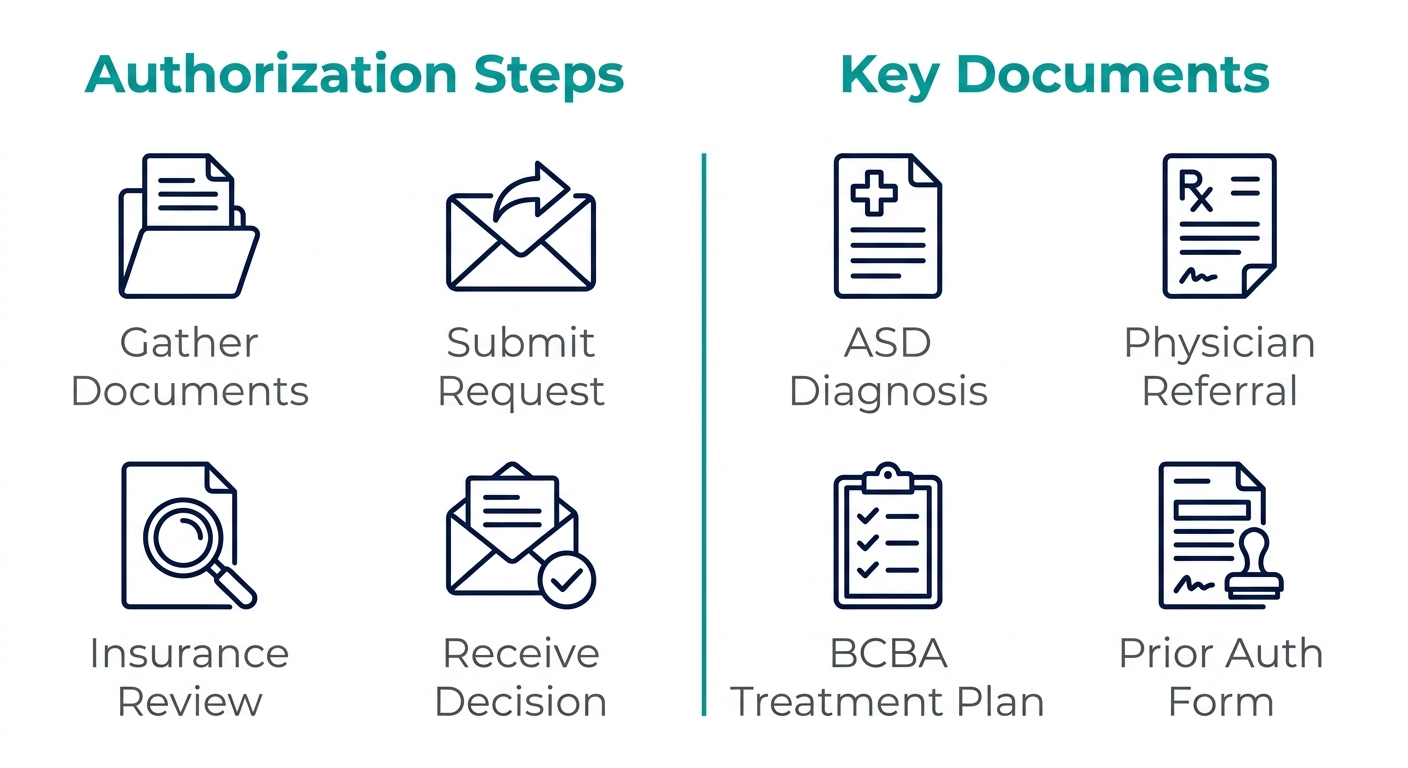
A well-prepared authorization package naturally leads to the core question insurers ask: does this therapy meet the standard of medical necessity?
Medical Necessity and Insurance Criteria for ABA Authorization
Once you collect the required documents, the next key factor is establishing medical necessity under your payer’s criteria. In ABA therapy, medical necessity generally means the treatment is clinically appropriate given a child’s documented needs, the severity of their challenges, and the likelihood that therapy will produce measurable gains. Under most insurance policies, a formal diagnosis is a starting point, but payers also evaluate whether the intensity and duration of services are reasonable for the expected progress.
In Virginia, upcoming policy changes will add new requirements for Medicaid-funded ABA. The 2026-2028 state budget introduces a formal autism spectrum disorder diagnosis requirement, with a limited one-year provisional exception for children age 5 and under. According to ABA Navigator, this rule is not yet active; it still needs approval from the Centers for Medicare and Medicaid Services (CMS) and an update to the Virginia DMAS manual. Currently, children under 21 can qualify through behavioral criteria without an ASD diagnosis. The budget also caps services at 20 hours per week but allows an exception when a provider documents that extra hours are medically necessary under the EPSDT benefit.
Whether you are working with today’s standards or preparing for the pending Virginia rules, thorough documentation is critical. A BCBA assessment pinpoints current skills and deficits; a functional behavior assessment identifies the “why” behind challenging behaviors; and clear treatment goals map out what therapy aims to achieve. Payer authorization systems then compare this documentation against their internal criteria — often checking for standardized scores, progress trends from previous services, and a direct link between the proposed number of hours and the child’s developmental priorities. Our team supports families and providers by helping gather and organize these materials so each submission presents a compelling medical necessity case.
Getting these criteria right often raises questions about diagnosis documentation, hour limits, and exceptions — which we answer next.
Answers to Your ABA Authorization Questions
After learning about medical necessity and insurance criteria, many families have practical questions about how authorization works.
What documents are needed for ABA authorization? Proactive preparation, such as gathering a formal autism diagnosis, physician referral, and detailed treatment plan from your BCBA, can demonstrate medical necessity and reduce administrative hurdles.
How can my provider help with insurance authorization? Our BCBA-led clinical team creates the treatment plan, handles all communication with your insurance carrier, and manages the submission to secure coverage.
How often does reauthorization occur? Reauthorization is typically required every six months. We update your child’s progress data and submit it to the insurance company to keep coverage active.
We suggest keeping a log of insurance conversations, including dates and reference numbers.
Understanding these details helps you feel prepared; our team is ready to guide you through authorization.
Streamlining Your ABA Authorization with Brighter Care ABA
Now you understand the key steps of the authorization process, Our team can help.
Proactive preparation—gathering a formal diagnosis, physician referral, and BCBA-drafted treatment plan—reduces administrative burdens and financial stress.
We handle benefit verification, clinical documentation, and communication with insurers.
We manage reauthorization every six months and support you through appeals.
Results may vary based on individual patient circumstances; consult a healthcare professional for diagnosis or treatment advice.
By using this Site, you accept our Privacy Policy.
Contact us to simplify your ABA authorization process in 2026.
Navigate Insurance with Confidence
You’ve now mastered the essentials of the ABA authorization process, from documenting medical necessity to navigating state and federal guidelines. With a clear understanding of CPT codes and reauthorization timelines, you’re ready to take the next step. Our dedicated team is here to manage the administrative burden, from initial documentation to ongoing appeals. We help families in Illinois and Virginia compile the right paperwork and communicate with insurers. Our BCBA-led clinical team ensures your child’s treatment plan meets all payer requirements. As you move forward, remember that proactive preparation is key to a smooth authorization journey. Reach out to us today to start simplifying your ABA authorization experience.
Navigate Insurance with Confidence
