


Table of Contents
Why Skill Generalization Matters for Your Child’s Future
Skill generalization in ABA is the ability to use a learned behavior across different people, settings, and materials. Without it, the skills your child masters in therapy may not transfer to home, school, or the community.
For instance, a child who learns to say “thank you” during a session may not use it with a teacher, a parent, or a store clerk unless generalization is actively taught. Through play based ABA therapy, we practice skills in the natural contexts where your child will use them every day. This approach reduces the need for constant prompting and helps your child adapt to new situations.
Our ABA therapy services are delivered in your home and community, so skills are practiced where they matter most. Understanding why generalization matters is the first step; next, we’ll explore how you can prepare your child for successful skill generalization. With personalized support, your child can build real-world confidence and Succeed with ABA.
Prepare for Successful Skill Generalization
As we’ve seen, skill generalization in ABA is essential for lasting progress — it helps your child use new abilities beyond therapy sessions. Preparing for this process is something we navigate together.
Natural environment teaching offers a powerful way to create meaningful practice moments within your child’s familiar routines. You can weave skill practice into meals, playtime, or bath time—any moment where communication, waiting, or following instructions naturally occurs. For example, prompting your child to say “open” before you hand over a snack turns a simple action into a request you can reinforce with praise.
To encourage flexibility, invite different family members to prompt the same skill, swap out a favorite toy for something new, or shift practice from the living room to the kitchen. Keeping cues and reinforcement consistent across these changes helps your child understand that the skill matters no matter the setting. We recommend coordinating with your child’s BCBA and RBT to design a generalization plan that reflects your family’s unique rhythms.
These small, intentional steps set the stage for deeper types of generalization, which we’ll explore next. A Bright Future is Waiting for Your Child.
Understanding Stimulus and Response Generalization
To prepare for successful skill generalization, we first need to understand two primary forms: stimulus generalization and response generalization.
Stimulus generalization occurs when a child applies a learned response to a similar but not identical stimulus. For example, a child who learns to say "thank you" after receiving a toy at home might later say "thank you" when a grandparent gives a snack.
Response generalization describes a child’s ability to use different but functionally equivalent behaviors to achieve the same outcome. A child who learns to request a break by saying “break” may also learn to raise a hand or hand over a “break” card—all appropriate ways to get the need met.
WE COUNT ON OUR PARENTS to help reinforce these responses in daily routines. With a clear understanding of these generalization types, we can now see how BCBAs intentionally plan for them from the very start of therapy.
How BCBAs Plan for Generalization from the Start
Building on the foundation of stimulus and response generalization, our BCBAs design for skill generalization in aba from the very beginning of every plan. We use multiple exemplar training early—presenting several examples of a concept so your child learns to focus on what’s important across different materials, people, and settings.
We systematically vary instructors, materials, and environments during teaching to prevent skills from becoming tied to one specific context. Reinforcement schedules are thinned intentionally, and we incorporate natural reinforcers like praise or access to a favorite activity to reduce dependence on artificial rewards.
You’re not on your own. We collaborate with you and school staff from day one to pinpoint everyday routines where new skills can be practiced naturally. You’ll learn how to prompt and reinforce the skill during everyday moments.
With generalization built into the plan, the next step is to use natural environment teaching, where we bring these strategies to life in real-world routines.
Using Natural Environment Teaching to Practice Skills
One key strategy our BCBAs use in their generalization plan is Natural Environment Teaching (NET). This play based ABA therapy approach helps children practice skills in the settings where they occur—at home or during play—so new behaviors stick.
For instance, we might guide a child to request a snack by pointing or using a word, then naturally reward the communication by giving the snack. Similarly, a playdate in a friend’s backyard becomes a chance to practice turn-taking with a ball, building social reciprocity without any therapeutic pressure.
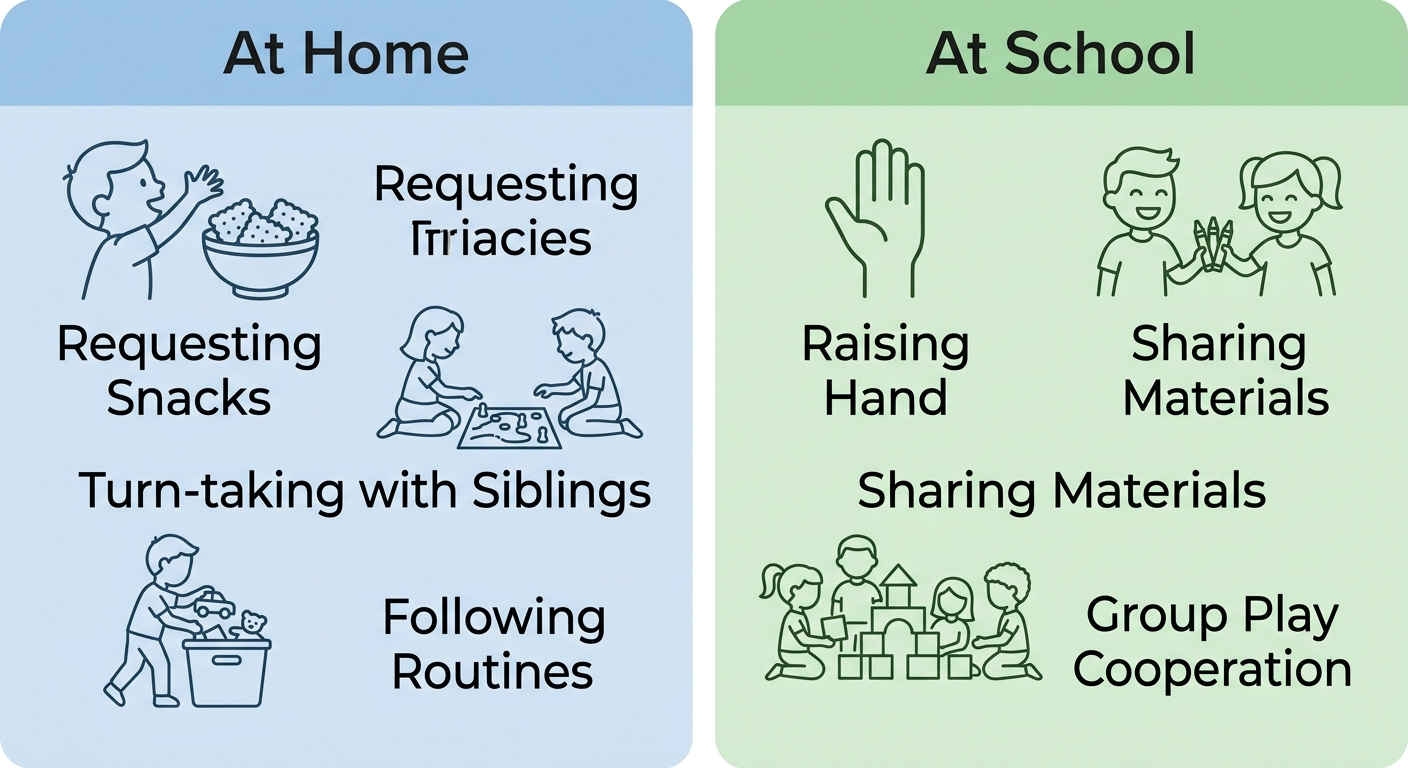
Our BCBAs strategically design these real-world moments to mirror the challenges your child will face. With regular practice across home, community, and play settings, your child gains the confidence to use these same skills independently at school with peers and teachers.
Helping Your Child Apply Skills at School
Natural environment teaching builds a strong foundation for practicing social and communication skills in everyday routines. We can help your child carry those gains into the classroom by working as a team with the school.
We suggest starting with a meeting with the teacher to share the specific ABA targets your child is mastering and agree on simple, consistent prompts. A one-page "skill card" listing three behaviors and the reinforcement that works at home makes it easy for the teacher to copy in the classroom. To keep motivation high, try a daily or weekly check-in like a sticker chart or a note where your child can report how they used a skill. Practicing school-like scenarios at home, like raising a hand or waiting turns, prepares your child for real moments.
When your child starts using these skills in the classroom, tracking how well they stick is the next step. We’ll explore maintenance probes in the next section.
Tracking Progress with Maintenance Probes
After your child begins using skills in the school setting, we use maintenance probes to track skill generalization in aba and make sure those skills last. A maintenance probe is a brief, un-prompted check that happens after your child has mastered a skill. We schedule these probes periodically—sometimes weekly or every other week—to see if your child can still perform the skill on their own. When a child consistently responds correctly during a probe, it tells us the skill has truly generalized and is being maintained.
Probe results provide our BCBA with valuable data to adjust treatment plans as needed—whether that means adding more practice opportunities or trying new generalization strategies. The information tells us whether the skill carries over to different settings, people, or materials. We share this clear picture of your child’s progress with the entire support team, which leads directly into Collaborating with Your Child’s Team for Consistent Support.
Collaborating with Your Child’s Team for Consistent Support
Tracking progress is most effective when everyone on the team works together. When parents, BCBAs, RBTs, and school staff stay aligned, we can help your child apply skills consistently across home, school, and community routines.
We recommend scheduling a brief weekly check-in with your BCBA to review current targets. A shared communication log, such as a simple notebook or an app, keeps all team members informed about what’s working and where extra practice is needed. Sharing maintenance probe data with the team highlights areas that need stronger consistency. A one-page strategy sheet listing each person’s role and your child’s key goals ensures everyone reinforces the same skills. By keeping all team members on the same page, we reduce confusion in every setting.
Strong collaboration naturally paves the way for celebrating milestones and adjusting goals. When we share updates regularly and work together, progress becomes easier to recognize, and every small win feels like a shared victory.
Celebrating Milestones and Adjusting Goals
After collaborating closely with your child’s team for consistent support, it’s time to celebrate the progress you see. Even imperfect attempts deserve recognition—every time your child uses a skill in a new setting or with a new person, acknowledge the effort. A simple progress chart or a milestone jar filled with tokens for each success can make these moments visible and motivating. We share these highlights with the therapy team so everyone can see how far your child has come.
When adjusting goals, we wait until a skill has been reliably demonstrated across at least two different environments. Then we can gently raise the bar by setting new challenges together, asking questions like, “Can you try this at the grocery store next?” This builds ownership and confidence. Occasional setbacks are normal, and we can temporarily lower goals without losing sight of long-term progress. By thoughtfully adjusting goals, you’ll be ready to tackle any generalization challenges that come up next.
Troubleshooting Common Generalization Challenges
Celebrating each milestone is essential, but we know generalization doesn’t always happen automatically. When a child uses a skill beautifully during therapy but not at home, or responds to one person but not another, targeted troubleshooting can help bring that skill into everyday life.
Inconsistent reinforcement often causes skills to fade. If a child gets a warm response and a favorite toy for a word during an ABA session but no reaction at home, the connection weakens. Aligning rewards across settings—by teaming up with your BCBA to identify consistent, meaningful motivators—bridges that gap and strengthens skill retention.
Children may also stumble when cues differ. A child might complete a puzzle when prompted by a therapist’s specific gesture but freeze when a peer tries. Varying the people, materials, and settings during practice early on helps skills transfer more reliably. Our own internal resources highlight how play-based strategies embed learning into child-led activities, making generalization feel less like work and more like natural play.
Motivation dips are a third common roadblock. When a skill feels repetitive or disconnected from what the child enjoys, engagement drops. Linking practice to highly preferred activities—like building blocks, pretend play, or sensory games—rekindles interest. Our therapists in Illinois and Virginia weave therapeutic goals into these favored pastimes, helping children stay engaged while generalizing new skills.
Overcoming these hurdles paves the way for deeper, lasting development. With patience and consistent small adjustments, families can see meaningful progress. Next, we explore how these strategies build lifelong skills.
Building Lifelong Skills Through Generalization
After troubleshooting common generalization challenges, we can see how skill generalization in ABA lays the foundation for lifelong success. When children can apply what they learn across settings, people, and time, they gain the independence and adaptability that will serve them well into adulthood.
Parents play a vital role in reinforcing these skills through consistent practice and environmental adjustments. At Brighter Care ABA, our personalized, home-based approach promotes generalization in contexts—whether during mealtime routines, play, or community outings.
We believe that generalization is not just a therapy goal but a life skill, and our BCBA-led team works closely with families to embed these opportunities into daily routines. Your child can build the confidence and flexibility to navigate new situations with ease. While every child’s journey is unique and results may vary, the focus on generalization builds skills that last. If you’d like to learn more about how our team can support your child’s progress, reach out to us.
Begin Applying Generalization Strategies Now
Now that you’ve learned the steps for promoting skill generalization—from preparing your child and understanding stimulus/response generalization to using natural environment teaching and collaborating with their team—it’s time to put these strategies into practice. Brighter Care ABA’s personalized, home-based ABA therapy makes it easier for children to apply learned skills in real-world settings. Our BCBAs and RBTs work closely with families to design plans that emphasize generalization from day one, ensuring your child can use new abilities at home, in school, and in the community. With support for parent training, insurance coordination, and consistent data tracking through maintenance probes, our team is dedicated to your child’s long-term success. You’ve seen the roadmap; now let our experts help you navigate the journey. Reach out to Brighter Care ABA to begin a customized plan that builds on these principles. Every step forward brings your child closer to the independence and confidence they deserve.
