

Table of Contents
- ABA Parent Training: A Foundation for Success
- Core Principles of ABA Parent Training
- Functional Communication and Parent Training
- Implementing ABA Strategies at Home
- Taking ABA Parent Training Further: Data and Generalization
- Common Questions About ABA Parent Training
- Supporting Your Child with Continued ABA Training
ABA Parent Training: A Foundation for Success
At Brighter Care ABA, we believe ABA parent training is the cornerstone of effective therapy. As part of our ABA therapy services for children with autism, we make parent training a non-negotiable component of every child’s program. This commitment reflects our dedication to empowering you—because when families and therapists work together, progress happens faster and lasts longer.
Our training equips you with practical, evidence-based strategies like positive reinforcement and functional communication. These tools help you reinforce new skills during everyday routines, from playtime to family meals, so your child’s growth extends far beyond therapy sessions. Led by our Board Certified Behavior Analysts (BCBAs), each training plan is individualized to address your family’s unique needs and goals.
We see you as an active partner, not a bystander. By collaborating closely with our clinical team, you gain the confidence and consistency needed to support your child at home, in school, and in the community. This partnership is grounded in research that shows caregiver involvement is essential for lasting progress. At Brighter Care ABA, you’re never on your own—we’re here to guide you every step of the way.
Let’s look at the core strategies we teach parents and how they translate into real-world success.
Core Principles of ABA Parent Training
Now let’s explore the core principles that make parent training effective. Effective aba parent training relies on collaboration, data-driven decision making, and a foundation of positive reinforcement. At Brighter Care ABA, we start by completing an initial BCBA assessment to understand your child’s strengths and routines. This assessment shapes a personalized plan that uses prompting, shaping, and generalization to teach new skills. We also teach you to track progress so we can adjust strategies together.
To help you understand what this training involves, here are the four common components, as described in our evidence-based guide.
| Component | Description | Best For |
|---|---|---|
| Parent Coaching Sessions | One-on-one guidance from a BCBA during live interactions with your child, feedback and strategy modeling included. | Real-time practice, personalized support, building confidence. |
| Written Materials | Handouts, guides, and visual summaries of key ABA concepts and techniques. | Reference at home, sharing with family members, step-by-step instructions. |
| Video Modeling | Pre-recorded or live demonstrations of strategies being implemented correctly. | Visual learners, seeing correct implementation, reducing anxiety. |
| Hands-On Practice | Guided opportunities for parents to implement strategies with immediate feedback from a BCBA. | Mastering techniques, troubleshooting, generalization to routines. |
Each of these components addresses a different learning style. Coaching sessions let you practice skills in real time with expert feedback. Written materials offer step-by-step guides you can revisit at home. Video modeling demonstrates strategies clearly for visual learners. Hands-on practice, with immediate guidance, helps you master techniques like prompting your child to request a snack—a key part of functional communication. Throughout all four approaches, we emphasize positive reinforcement strategies to encourage progress.
The goal is to help you use these skills in everyday routines. With consistent practice and positive reinforcement, you’ll see your child communicate needs more effectively. Data tracking lets us refine the plan as your child grows. While results vary, many families find that this approach supports lasting, meaningful change.
Board Certified Behavior Analysts, guided by the ethics code of the Behavior Analyst Certification Board (BACB), treat you as an active partner. We provide ongoing supervision and adjust based on your observations. You’re not on your own—we’re committed to helping you succeed with ABA.
These principles set the stage for a structured program that empowers parents. In the next section, we’ll explore the specific benefits and next steps. A bright future is waiting for your child, and we’re here to help. Please consult a healthcare professional for developmental concerns.
Functional Communication and Parent Training
One of the most impactful techniques we teach in ABA parent training is functional communication training, which helps children replace challenging behaviors with effective ways to express their wants and needs. In our work with families, we see how this skill builds independence and reduces frustration at home and in school.
Understanding Functional Communication in ABA
Functional communication is any effective method—vocal speech, sign language, picture exchange (PECS), or a speech-generating device—that allows a child to communicate. Instead of focusing only on spoken words, ABA therapy considers what works for each individual child. Functional communication training (FCT) is an evidence-based ABA intervention that teaches a socially acceptable replacement behavior, not just speech. We often coach parents to respond to their child’s requests in a way that reinforces the new skill while making problem behaviors unnecessary.
For example, if a child used to scream to get a toy, we might teach them to hand over a picture of the toy. When they use the picture, the parent provides the toy immediately, using positive reinforcement strategies like praise and access to the requested item. Over time, this new form of communication becomes the child’s preferred way to get needs met. For evidence-based support, parents can access functional communication training resources from national research databases. This approach, rooted in decades of research, is a cornerstone of our parent coaching model.
We work with families to collect data on each communication attempt, which lets us adjust the teaching plan and celebrate incremental progress. We often see children who once struggled with outbursts begin to regularly request items, leading to a calmer, more connected family life.
Teaching Functional Communication to Non-Verbal Children
In our ABA parent training sessions, we emphasize starting with simple, visual tools for children who are not yet speaking. Our BCBAs guide parents through a step-by-step process:
- First, we identify the reason behind the challenging behavior (the function), such as seeking attention or wanting a favorite toy. Understanding the function ensures we teach a replacement that truly meets the child’s need.
- Next, we select a communicative response that is easier than the problem behavior. This could be handing a picture card, pointing to a symbol, pressing a button on a speech-generating device, or using a basic sign. We make sure the response requires less effort than the tantrum or outburst it replaces.
- Then, we practice this response in everyday routines, using prompts and immediate reinforcement. For example, during snack time, a parent might hold up two picture choices and wait. As soon as the child touches one, the parent gives the snack with excitement and praise—using positive reinforcement strategies to build a strong connection between the action and the reward.
- Finally, we gradually fade prompts so the child learns to initiate communication on their own. We teach parents to count silently to five before offering help, giving the child the space to try. This waiting period is crucial because it builds the child’s initiative.
Parents are the central teachers in this process. We coach them to look for opportunities throughout mealtime, play, and bath time to encourage communication. Even an approximation—a hand reaching toward a device or a rough sign—gets a positive response. In our coaching sessions, we model each step with the parent and then observe them practicing with the child. We also work with schools to ensure the same communication tools are used in the classroom, so the child practices consistently. We track the child’s independent initiations to measure progress and adjust the plan as needed. Over time, many non-verbal children begin to use pictures, signs, or devices to express their needs independently, reducing frustration for the whole family.
Comparing Functional Communication Training to Traditional Speech Therapy
Functional communication training (FCT) and traditional speech therapy (ST) differ in focus, but both can benefit a child with communication needs. FCT, embedded in ABA, replaces challenging behaviors with any form of communication, while speech therapy targets articulation, language structure, and fluency. The table below highlights their distinct roles and how they complement each other.
| Aspect | FCT | Traditional Speech Therapy |
|---|---|---|
| Primary Goal | Replace challenging behaviors with functional communication. | Improve articulation, language comprehension, and fluency. |
| Setting | Natural environments (home, school, community) with caregiver involvement. | Typically in a clinic or therapy room led by a speech-language pathologist. |
| Communication Forms | Any effective modality: pictures, signs, AAC devices, verbal approximations. | Primarily verbal speech, often targeting correct sounds or sentence structure. |
| Role of Parent | Parent is the primary interventionist, coached by BCBA. | Parent observes or follows up with home exercises. |
| Progress Measurement | Based on frequency of independent functional communication and reduction of maladaptive behavior. | Based on speech sound accuracy, language milestones, or test scores. |
Because FCT involves parents as primary interventionists, children often make rapid gains in functional communication, while speech therapy builds refined speech skills. At Brighter Care ABA, we coordinate with speech therapists to create a unified plan. Please keep in mind that results may vary, and we recommend consulting with a healthcare professional for personalized guidance.
Implementing ABA Strategies at Home
Now that you understand the basics of ABA, let’s look at how to use these strategies effectively at home. When weighing your options between in-home ABA therapy vs clinic-based approaches, many families find that home-based care allows for natural practice of daily routines. Successful aba parent training starts here, and we’re here to guide you every step of the way.
Structuring Your Home Environment for Success
A predictable environment is the foundation for learning new skills. Brighter Care ABA emphasizes that visual schedules and consistent routines help children feel secure and understand what’s expected of them. Start with one manageable part of the day, such as the morning routine. Create a simple visual schedule using pictures or symbols for each step. For example, a strip of laminated cards might show images for “brush teeth,” “get dressed,” and “eat breakfast” in order. Walk your child through the schedule and let them remove each card as they complete the task. This hands-on interaction builds independence and reduces the anxiety that transitions can cause.
Consistency is key. All caregivers—parents, grandparents, and sitters—should follow the same routine and use the same visual cues so the child receives a unified message about expectations. By embedding therapy into your existing daily rhythm, you turn ordinary moments into powerful opportunities for growth without adding stress to your family’s day.
Effective Positive Reinforcement at Home
Positive reinforcement strategies encourage a child to repeat a desired behavior by following it with something they value. The first step is selecting a reward that truly motivates your child. Observe what they gravitate toward during free time—a favorite toy, a specific snack, or a silly song—and use that item or activity as reinforcement only during teaching moments to maintain its special appeal. To prevent satiation, rotate rewards every few days so the experience stays fresh and exciting.
When introducing a formal system, focus on just one or two target behaviors at first. A behavior chart with clear, simple expectations works well for younger children who benefit from seeing their progress at a glance. Brighter Care ABA’s parent guide notes that celebrating small wins keeps motivation high and builds confidence.
The following table summarizes a few common reward systems to help you decide what might fit your child’s personality and your family’s goals.
| System | How It Works | When to Use | Key Considerations |
|---|---|---|---|
| Token Economy | Child earns tokens (stickers, points) for desired behaviors and exchanges them for a larger reward. | Multiple behaviors, building toward long-term goals, visual tracking helpful. | Consistency is key; tokens must be exchanged regularly for meaningful rewards. |
| Behavior Chart | A visual chart tracks specific target behaviors; child gets a reward after meeting goals. | Single or few behaviors, younger children, clear daily expectations. | Charts should be simple; celebrate small wins to maintain motivation. |
| Natural Rewards | Reinforcement is built into the activity (e.g., finishing a puzzle gives access to play). | Encouraging intrinsic motivation, fading out artificial reinforcers. | Must ensure the reward is actually reinforcing for the child; observe preferences. |
Whichever tool you choose, the real power comes from how you use it. Over time, you can fade artificial reinforcers and move toward more natural, social rewards. For example, if your child has consistently earned tokens for putting away toys, transition to offering verbal praise and a high-five instead. This gradual shift helps generalize the skill so your child performs it because it feels good to contribute, not just to earn a sticker. Results may vary based on individual patient circumstances, and your BCBA can help design a fading plan that matches your child’s pace.
Integrating Communication Goals into Daily Life
Functional communication doesn’t happen only at a therapy table—it flourishes during the back-and-forth of everyday life. We encourage families to embed communication opportunities into activities that already happen, like mealtime, play, and transitions between rooms. For instance, during snack time, place a preferred food just out of your child’s reach. When they indicate they want it, prompt them to request “more” or “open” using their current communication method—words, signs, or an augmentative communication device. This simple tweak turns a routine moment into a powerful teaching loop.
Play offers equally rich chances for building language. Narrate what you and your child are doing with simple, parallel phrases like “I’m driving my car” and pause to give your child space to imitate. During clean-up transitions, sing a consistent song that includes verbal fill-ins, encouraging your child to participate vocally. These brief interactions add up, reinforcing the communication goals your BCBA has set and helping your child practice in the setting where they live and play every day. With these home strategies in place, you’ll be ready to partner with your BCBA for even greater progress.
Taking ABA Parent Training Further: Data and Generalization
Taking your ABA parent training to the next level means tracking progress and ensuring skills generalize across settings. These practices turn therapy gains into real-world habits.
We recommend choosing a data tracking method that fits your daily routine. The three most common are paper logs, mobile apps, and BCBA review sessions—each balancing ease of use with accuracy. We count on our parents to stay engaged, and consistent data sharing with your BCBA helps refine interventions. This collaboration keeps plans aligned with real-world needs. Strengthening your ABA parent training with consistent data tracking ensures that progress is measurable and strategies can be generalized.
The table below compares these methods:
| Method | Ease of Use | Accuracy | Parent Involvement |
|---|---|---|---|
| Paper Logs | Easy to start; no tech required. | Depends on consistent recording. | Fills out logs daily and reviews during coaching. |
| Mobile Apps | Moderate setup; intuitive data entry. | High with timers and auto-reminders. | Records data in-app and shares with BCBA automatically. |
| BCBA Review Sessions | Scheduled; requires parent preparation. | Very high; therapist verifies data in real time. | Provides summary data and discusses progress during sessions. |
Under the oversight of the Behavior Analyst Certification Board, BCBA certification requirements ensure high standards, and your BCBA will guide you in interpreting data. This partnership means you’re not on your own, and we’ll help you select the approach that feels most manageable.
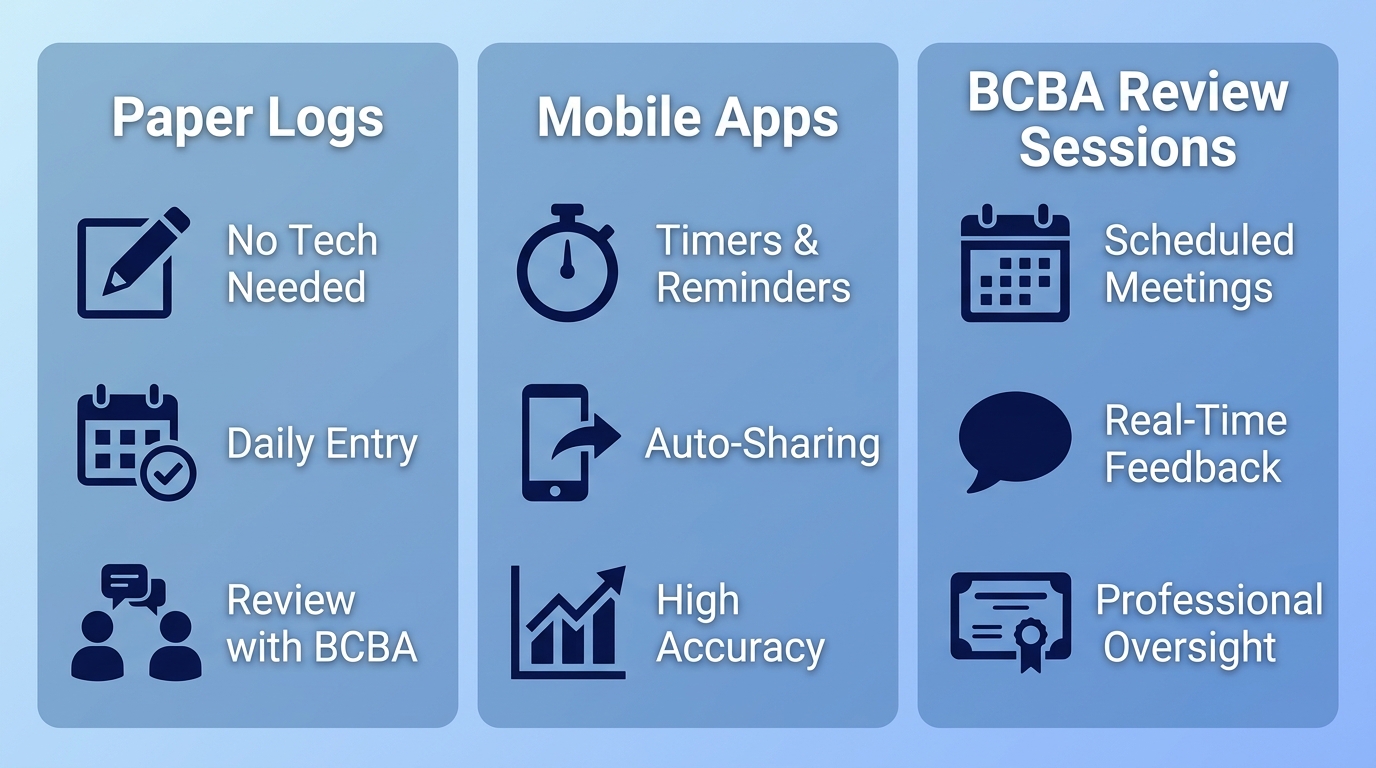
Three ways to track ABA progress: paper logs, mobile apps, and BCBA reviews.
Generalization means your child uses skills in different settings and with different people. For instance, positive reinforcement strategies can be applied during mealtime at home or playdates in the park. Functional communication, like requesting a break, is practiced at school and in the community. During BCBA review sessions, we help identify ways to expand practice opportunities and troubleshoot challenges, so every success transfers across Illinois and Virginia.
Remember, consistent data and generalization transform therapy gains into lifelong skills. A bright future is waiting for your child, and we’re here to support you every step of the way. Results may vary, but together we can achieve meaningful milestones and celebrate progress.
Common Questions About ABA Parent Training
Many parents have questions about aba parent training and how it can support their child’s development. Below we answer some of the most common ones.
How long does parent training last? Because every child is different, our BCBAs tailor the duration and frequency of sessions to your family’s specific needs and goals. Training continues as long as it benefits your child, with the plan evolving as progress is made.
What topics are covered? We teach positive reinforcement strategies to encourage helpful behaviors and functional communication techniques so your child can express their needs effectively. You will also learn behavior management skills to support your child’s independence in everyday settings.
Is my participation mandatory? Your involvement is highly encouraged because it strengthens learning and consistency at home. However, we understand that families have busy schedules, so we design sessions to fit your availability without adding pressure.
How does parent training help my child become more independent? By practicing these strategies together, you help your child apply skills in real-world situations. This gradually reduces reliance on caregivers and builds the confidence needed to navigate the community safely.
Supporting Your Child with Continued ABA Training
Beyond therapy sessions, ABA parent training helps you succeed with ABA at home, supporting skill development in daily routines. By using positive reinforcement strategies like praise and token boards, and teaching functional communication to express needs, you promote generalization across settings. We partner with families across Illinois and Virginia through 1:1 therapy and parent training because WE COUNT ON OUR PARENTS—you’re not on your own. We also encourage exploring behavior analysis professional development to deepen skills; results vary, consult a healthcare professional for diagnosis or treatment advice.
