


Table of Contents
- Evidence Based ABA Techniques for Child Development
- Core Concepts in Evidence Based ABA Therapy
- How Evidence Based ABA Techniques Benefit Children and Families
- Applying Evidence Based ABA Techniques in Practice
- Maximizing Outcomes with Evidence Based ABA Strategies
- A Bright Future with Evidence Based ABA Therapy
Evidence Based ABA Techniques for Child Development
Building on the principles of ABA, we rely on evidence based ABA techniques that are supported by decades of research in child development. These methods are designed to teach functional skills in a systematic, data-driven way, ensuring each child’s program is grounded in proven strategies. By tailoring our approach to each child’s unique strengths, we create a supportive learning environment that promotes meaningful progress.
Discrete trial training (DTT) breaks new skills into small, manageable steps with clear prompts and reinforcement, while naturalistic teaching strategies like incidental teaching embed learning into everyday play and routines. Additionally, a functional behavior assessment helps us understand the reasons behind challenging behaviors so we can develop proactive intervention plans. These techniques are overseen by Board Certified Behavior Analysts who adapt the curriculum to match each child’s developmental goals.
Family involvement is key to generalizing skills, which is why we offer parent training alongside our home-based sessions. We integrate these research-backed methods into our ABA therapy services provided in the home setting. While outcomes depend on each child’s circumstances, these evidence-based approaches offer a strong foundation for growth. Our commitment to individualized care helps children build independence and confidence.
Core Concepts in Evidence Based ABA Therapy
Defining Evidence Based ABA Therapy and Its Key Principles
Evidence-based ABA therapy is not a one-size-fits-all method. It relies on a continuous cycle of assessment, intervention, data analysis, and refinement to produce meaningful improvements. At Brighter Care ABA, our evidence-based ABA techniques begin with a thorough functional behavior assessment (FBA) that reveals why a behavior occurs—whether to seek attention, escape a task, or fulfill a sensory need. The FBA process involves direct observation, caregiver interviews, and data analysis to decode the function of challenging behaviors. Using this insight, we design personalized plans that are grounded in research and aligned with the ethical standards of the Behavior Analyst Certification Board (BACB) and the ABAI Behavior Analysis Association. Every goal is tailored to the child’s unique strengths and challenges, and we collect daily data to track progress.
We also incorporate parent training, a core component of evidence-based ABA, to equip caregivers with strategies that reinforce learning at home. By following the standards of the BACB and the ABAI Behavior Analysis Association, we demonstrate our commitment to ethical, research-backed care. This collaborative, data-driven approach leads to measurable progress for children with autism spectrum disorder.
The Role of Positive Reinforcement in ABA
Positive reinforcement is the cornerstone of ABA therapy. It involves presenting a rewarding stimulus immediately after a desired behavior, which increases the likelihood that the behavior will be repeated. Because each child has unique motivators, our Board Certified Behavior Analysts use information from the functional behavior assessment to select reinforcers that truly resonate. In a school environment, a teacher might praise a student for raising their hand before speaking, while at home a parent might offer a favorite snack or extra playtime after a child completes their chores.
At Brighter Care ABA, we coach families on how to deliver reinforcement consistently and meaningfully—ensuring that praise or rewards are connected directly to the behavior we want to see more of. Even a simple high-five or words of encouragement, when delivered right after a desired behavior, can significantly boost a child’s motivation. Over time, this process strengthens essential skills like communication, cooperation, and self-help, and it builds a positive, trusting relationship between child and caregiver. Research consistently shows that positive reinforcement, when used systematically, leads to lasting improvements in social and adaptive functioning. Our therapists also track data to verify that reinforcement is working, making adjustments as the child’s preferences evolve. This evidence-based method is a key reason families see meaningful progress in their child’s behavior and confidence.
Latest Research and Techniques for 2026
The field of ABA therapy continues to evolve, with 2026 bringing exciting advancements in technology and methodology. A recent study found in the National Center for Biotechnology Information (NCBI) database highlights the growing use of digital tools—such as tablet-based apps and wearable devices—to collect real-time behavioral data. These tools enable more precise tracking of progress and allow therapists to make immediate, data-informed adjustments.
In addition, naturalistic teaching strategies have gained strong empirical support. By embedding learning within everyday routines like playtime, mealtime, and community outings, children acquire communication and social skills in contexts that feel natural and motivating. We also incorporate parent training as an integral part of our programs, empowering families to implement these strategies at home. At Brighter Care ABA, we stay current with emerging research to ensure that our families benefit from the most effective, compassionate, and scientifically validated approaches available. For instance, some apps allow caregivers to log behaviors and receive instant feedback, while wearable sensors track physiological responses that may indicate anxiety, enabling proactive support. These innovations not only increase the efficiency of data collection but also enhance the ability to individualize interventions in real time. Our team regularly reviews peer-reviewed studies to integrate the latest evidence-based ABA techniques into our Illinois and Virginia programs.
How Evidence Based ABA Techniques Benefit Children and Families
Our high-quality ABA programs are built on evidence based ABA techniques that translate into meaningful progress for children with autism and their families. By grounding every intervention in research and data, we help children develop the skills they need to thrive while empowering families to support that growth at home. These proven approaches create a foundation for long-term independence and collaboration across all settings.
Skill Development and Long-Term Independence
Evidence-based ABA focuses on teaching practical, everyday skills that build independence. In our comprehensive guide to functional skills, Brighter Care ABA explains how Board Certified Behavior Analysts (BCBAs) use task analysis to break complex routines into small, teachable steps. A functional behavior assessment provides the foundation for individualized treatment plans, identifying the specific communication, self-help, and social goals your child needs. For example, we teach communication skills like requesting items or commenting during play, self-help routines such as toileting and dressing, and social skills including turn-taking and initiating interactions. Each step is reinforced with positive feedback, transforming daily moments into opportunities for confidence and mastery. For instance, toilet training is supported through a consistent schedule of prompts every 30 to 60 minutes and differential reinforcement, often helping children achieve daytime dryness within weeks.
Supporting Generalization Across Home and School
For skills to be truly useful, they must carry over to everyday life. We embed naturalistic teaching strategies into therapy sessions, using incidental teaching during play and everyday routines to help children practice abilities in context. As we detail in our FAQ on community independence, Brighter Care ABA partners with families and school teams to ensure consistency across environments. Our BCBAs collaborate with teachers by sharing strategies and monitoring data, so that communication, social, and self-care skills practiced at home also appear in the classroom and community. For example, a child might practice waiting in line at a grocery store or greeting a peer on the playground, with the therapist providing immediate feedback. This real-world practice, paired with school collaboration, ensures that progress is durable and meaningful.
Empowering Parents with Training and Data
Parents are essential partners in the ABA process. We provide hands-on training that includes modeling, role-play, and real-time feedback so you can reinforce strategies with consistency at home. During training sessions, our BCBAs will model a skill, such as prompting your child to request a snack, then guide you as you practice with your child and provide constructive feedback. Brighter Care ABA shares progress through clear graphs and regular notes, making it easy to see your child’s gains and adjust as needed. This transparent partnership gives you the tools and confidence to incorporate skill practice into daily routines, from mealtimes to morning routines. This collaborative loop reinforces consistency and builds your confidence as a partner in your child’s progress.
By building these essential skills, children gain tools that serve them across all environments.
Applying Evidence Based ABA Techniques in Practice
We now turn to applying our evidence based ABA techniques in daily settings. Our BCBAs and RBTs support families in Illinois and Virginia with structured assessments and naturalistic teaching. We also guide families on ABA classroom integration to ensure consistent support at school.
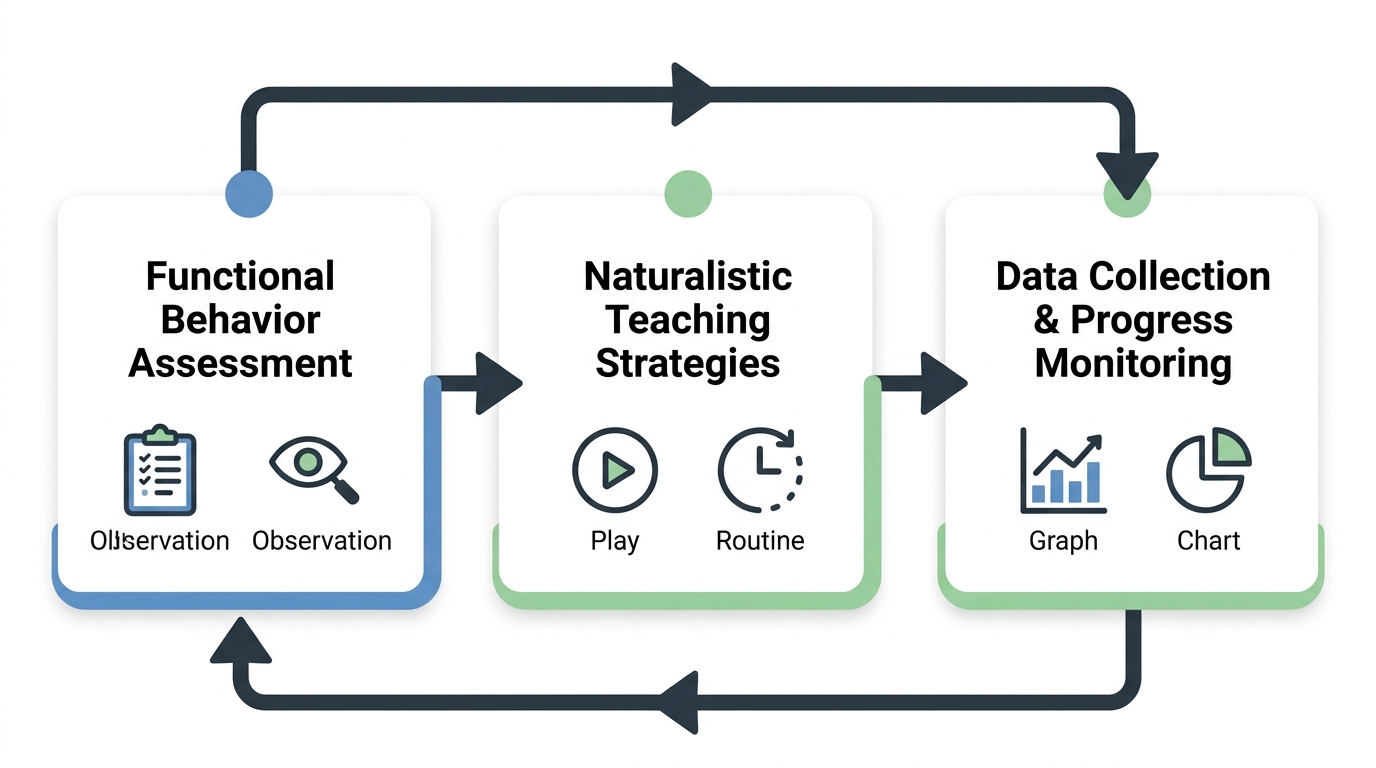
Evidence-based ABA techniques application cycle diagram
Here are the three core components.
Conducting a Functional Behavior Assessment at Home
At Brighter Care ABA, our functional behavior assessment process starts by working with you to identify the target behavior precisely. We then collect ABC data—antecedents, behaviors, consequences—over several days, often with your observations supplementing our records. Our BCBAs analyze the patterns to determine the function: is the behavior meant to escape a task, gain attention, obtain a tangible, or meet a sensory need? From this analysis we develop a hypothesis that becomes the foundation of your child’s behavior intervention plan. Because we embed this assessment into your daily routine, it feels natural rather than clinical, and your insights are vital every step of the way. We may ask parents to keep brief ABC charts and frequency records across routines to spot patterns.
Implementing Naturalistic Teaching Strategies
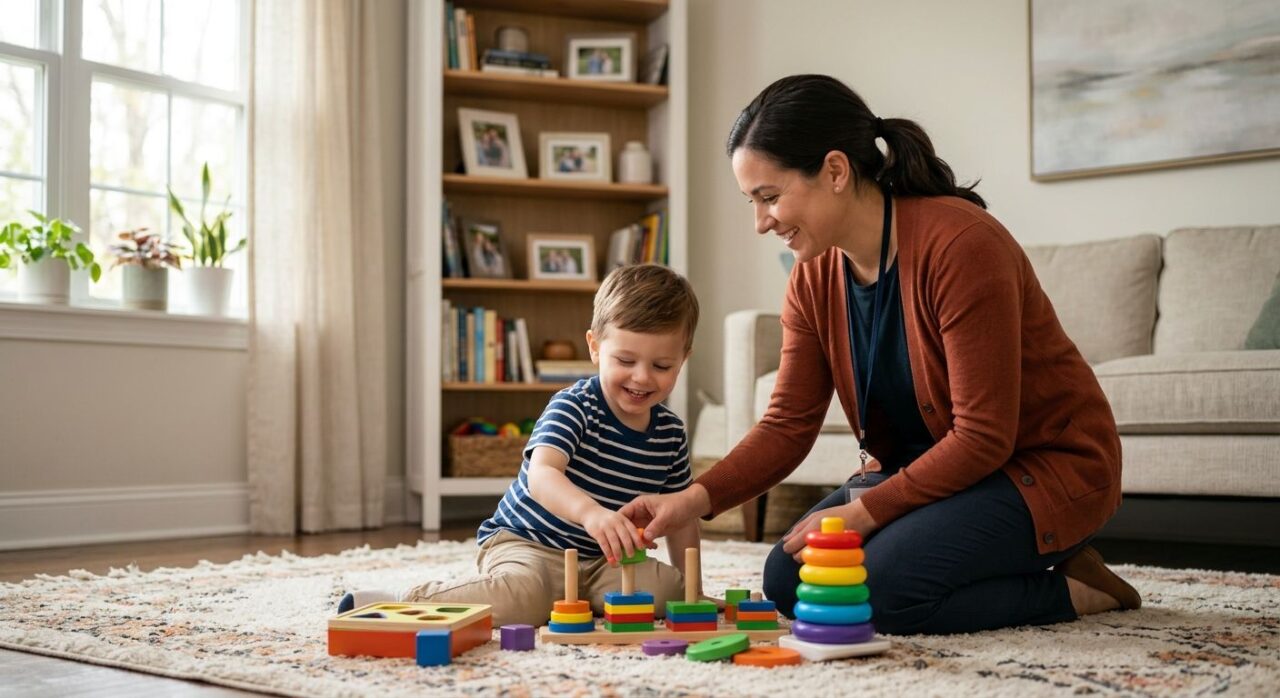
In naturalistic teaching, we embed skill-building into your child’s favorite routines. For example, during snack time our therapist might place a preferred snack slightly out of reach to prompt a request—“I want goldfish”—and immediately reinforce the attempt. This child-led approach extends to play, dressing, and even school circle time, always following the child’s interests. By teaching within moments that matter, we make therapy enjoyable and effective. Parents learn to use these same techniques at home, turning everyday activities into opportunities for communication, turn-taking, and daily living skills. This helps generalize skills to preschool and classroom activities when teachers join planning.
Data Collection and Progress Monitoring
Data collection is the backbone of our evidence-based approach. During every session, RBTs record trial-by-trial data on new skills, frequency counts of target behaviors, and duration when needed. Our BCBAs review graphed data weekly, comparing trends against treatment goals. If progress plateaus, we adjust the plan—perhaps by breaking a task into smaller steps, changing reinforcers, or introducing new targets. We also value parent reports, which add real-world context to the numbers. Our BCBAs integrate data with parent reports and school notes to guide weekly treatment adjustments. This continuous monitoring keeps therapy dynamic and responsive, helping your child succeed with ABA while celebrating every milestone along the way.
Maximizing Outcomes with Evidence Based ABA Strategies
When families look for evidence based aba techniques, they want more than theory—they want everyday practices that help children grow. At Brighter Care ABA, we believe meaningful progress comes from three key pillars: close collaboration between home, school, and therapy teams; rigorous professional standards and credentialing; and active parent training that makes skills stick. Each pillar is grounded in research, yet flexible enough to fit your child’s unique routine. By weaving these strategies together, we create a plan where communication, consistency, and compassion drive real results.
Collaborating Across Home, School, and Therapy Settings
Research consistently shows that skills learned during therapy sessions stick better when they’re practiced in everyday life. That’s why we make collaboration a core part of our evidence based aba techniques. Our BCBAs work with teachers and families through daily communication logs, shared digital behavior tracking tools, and monthly team meetings. These small, predictable touchpoints keep everyone aligned on goals like communication or social skills.
Naturalistic teaching strategies are one evidence-backed method that thrives in this kind of teamwork. For example, a teacher might use a prompt that our Board Certified Behavior Analyst (BCBA) modeled earlier, reinforcing a skill during circle time. We count on our parents just as much: a quick note in a digital log can turn a grocery-store trip into a chance to practice requesting.
Tip: Set up a three-way communication channel (parent–teacher–therapist) at the start of services to build trust and speed up progress.
Ensuring High-Quality Service Delivery and Credentialing
Quality ABA care depends on the professionals delivering it. Our team meets all BACB certification requirements, ensuring every therapist is qualified. According to the Behavior Analyst Certification Board (BACB), Board Certified Behavior Analysts (BCBAs) and Registered Behavior Technicians (RBTs) follow strict supervision ratios—typically one BCBA oversees a small number of RBTs weekly—and adhere to an ethics code that covers confidentiality and informed consent. This structure keeps treatment consistent and safe.
When you choose Brighter Care ABA, you’re choosing a team that stays current with ongoing professional development. We believe that staying aligned with BACB standards isn’t just a formality—it’s a promise of high-quality, evidence-based care.
Tip: Ask your provider how often a BCBA directly observes sessions; weekly or bi-weekly supervision is a strong sign of quality.
Parent Training and Consistent Strategy Use
Skills that are practiced only in therapy can fade. That’s why we equip families with straightforward, proven tools. In parent training sessions, we teach differential reinforcement—catching and praising desired behaviors, like when a child asks calmly for a break—and using visual schedules to bring predictability to daily routines. A functional behavior assessment may also guide us, uncovering why a behavior happens so we can teach a replacement skill.
Imagine a child who struggles with transitions. With our support, a parent can introduce a simple token board at home: three checkmarks earn a trip to the park. You’re not on your own in this process—your BCBA will coach you step by step until the strategy feels natural. Our approach is individualized and research-based—learn more by contacting our team.
Results may vary based on individual patient circumstances. Please consult with a healthcare professional for diagnosis or treatment advice.
A Bright Future with Evidence Based ABA Therapy
When you look ahead, a bright future with evidence based ABA techniques is within reach.
Our approach is grounded in methods that have been studied and validated over decades—in fact, a search of the NCBI biomedical research database reveals a vast body of studies confirming how these evidence based ABA techniques support real-world progress. As detailed in our parent guide, we begin with a functional behavior assessment to tailor every intervention to your child’s unique strengths and developmental goals. We then weave naturalistic teaching strategies into everyday routines, so your child practices communication, social, and self-care skills in the moments they naturally occur. Research consistently shows that child-led, play-based learning leads to stronger generalization and greater independence. At Brighter Care ABA, we are committed to providing compassionate, home-based care that evolves with your child, so progress is never static.
We know that lasting growth depends on a strong partnership with families, so we walk alongside you every step of the way. You’re not on your own—our supportive team, including BCBAs and behavior technicians, helps maintain consistency across home and community settings and celebrates each milestone with you. Together, we build the confidence and skills that create real, lasting change.
If you’re ready to begin this journey, we’re here to help—reach out to our team today and take the first step toward a bright future for your child.
