

Table of Contents
- Early Intervention ABA Therapy for Your Child
- What Is Autism Early Intervention ABA?
- Why Start Early? Key Benefits of ABA Therapy
- How Early Intervention ABA Therapy Works
- Best Practices for Early Intervention ABA Therapy
- Taking the Next Steps with Early Intervention ABA
Early Intervention ABA Therapy for Your Child
Early signs of autism call for early action, and research consistently shows that autism early intervention ABA is most effective when started before age 5. The U.S. Department of Education recognizes the critical importance of early services for children with developmental delays, supporting programs under the Individuals with Disabilities Education Act that help young children build essential skills during their most formative years.
Brighter Care ABA is a trusted autism ABA therapy provider offering personalized early intervention programs designed around each child’s unique strengths and family goals. Our approach brings therapy into your home, where children feel most comfortable, and involves parents every step of the way. A Board Certified Behavior Analyst oversees every treatment plan, ensuring your child receives high-quality, evidence-based care.
We incorporate natural environment teaching techniques that turn everyday moments into learning opportunities, along with pivotal response treatment strategies that build motivation and social communication skills. We count on our parents to help reinforce these skills between sessions, creating consistent progress across all settings. A Bright Future is Waiting for Your Child, and early intervention is the first step toward meaningful, lasting growth.
What Is Autism Early Intervention ABA?
Autism early intervention ABA is a specialized form of Applied Behavior Analysis (ABA) designed specifically for young children, typically from birth to age six. Unlike more general behavioral therapies, this approach zeroes in on the critical developmental window when a child’s brain is most adaptable and responsive to learning. The focus is on building foundational skills—communication, social interaction, and daily living—through a blend of structured teaching and playful, natural interactions.
Defining Early Intervention ABA
At its heart, early intervention ABA takes the principles of behavior science and applies them in a way that respects the unique needs of a very young child. A Board Certified Behavior Analyst (BCBA) will design a custom plan that uses positive reinforcement to boost helpful behaviors and gently reduce those that might hinder learning. A core component is the use of natural environment teaching, where a child learns skills right where they would use them—like learning to request a snack in the kitchen or putting on a coat by the front door. Our early intervention autism services are designed to meet children where they are, incorporating play and family routines to make learning effective and fun. The goal is to empower your child with the skills they need to navigate their world confidently.
The Science Behind Early Intervention
The push for early action isn’t just a best practice—it’s backed by science. Research on autism early intervention ABA shows that the brain’s neuroplasticity, or its ability to change and form new connections, is at its peak in the first few years of life. According to National Center for Biotechnology Information (NCBI) research, this period represents a powerful opportunity to influence a child’s developmental path. Studies have found that children who receive early intensive behavioral intervention often show substantial improvements in IQ, language, and adaptive behavior. This global understanding is mirrored in the standards set by professional bodies like the Association for Behavior Analysis International (ABAI), which provides ethical guidelines for these evidence-based practices. The takeaway is clear: starting supportive therapy early can make a lifelong difference. Results may vary based on individual patient circumstances—please consult with a healthcare professional for diagnosis or treatment advice.
Early Intervention vs. Standard ABA: Key Differences
This scientific evidence explains why early intervention is not just standard ABA for younger kids—it’s a different therapeutic experience built around the specific needs of early childhood. A key distinction is intensity; early intervention programs often involve 20 to 40 hours of therapy per week, whereas standard ABA for older children or adults might involve fewer, more targeted hours. The setting also differs significantly. To maximize a child’s comfort and the generalization of skills, early intervention is frequently home-based, allowing our team to integrate seamlessly into your family’s natural routines. Standard ABA can take place in a variety of settings, including clinics or schools. The goals and methods also diverge. Early intervention heavily utilizes play-based and child-led methods like pivotal response treatment to target foundational developmental milestones, such as initiating communication and joint attention. This is often a departure from the more structured, discrete-trial formats that may be more common in standard ABA. Understanding these differences helps parents know what to expect from a dedicated early intervention program, and that’s why we focus on early, evidence-based support for every child—because we believe a bright future is waiting for your child and that you’re not on your own as you take these steps. We count on our parents, and together, Succeed with ABA.
Why Start Early? Key Benefits of ABA Therapy
Once you understand what ABA therapy involves, the next question is when to begin. Starting early unlocks lasting benefits: research shows improvements in communication, social skills, and independence. For families exploring autism early intervention ABA, the toddler years are a critical window. At Brighter Care ABA, we bring these strategies into your home, making learning natural and secure. We are here to guide you every step of the way.
Optimal Age to Start ABA Therapy
According to U.S. Department of Education guidelines, early intervention services like ABA are most effective when initiated before age five, often as early as 18 to 24 months. During this critical window, the brain is highly receptive to learning new skills. At Brighter Care ABA, we design personalized ABA therapy services to match your child’s unique stage, incorporating evidence-based methods such as natural environment teaching. Our home-based sessions allow your child to practice communication and social skills in everyday settings — from the living room to the playground. We partner with you to reinforce these skills outside therapy, ensuring continuous progress. By beginning early, you maximize the opportunity for meaningful gains. A Bright Future is Waiting for Your Child.
School Readiness Through Early Intervention
Early ABA therapy does more than teach words; it prepares toddlers for preschool and kindergarten. We target school readiness by building turn-taking, joint attention, and cooperative play skills — often using pivotal response treatment to boost motivation and self-initiation. Our RBTs practice these skills during natural routines, so your child learns to share during a game or wait for a turn at snack time. Adaptive skills like toilet training, handwashing, and following instructions are woven into sessions, reducing anxiety when starting school. Through home-based therapy, we help your child generalize these abilities to the classroom, easing the transition and building confidence. Parent training ensures you have strategies to support readiness at home, creating a consistent bridge between therapy and daily life.
Long-Term Developmental Gains
The long-term benefits of autism early intervention ABA extend beyond single milestones. As your child builds communication and adaptive skills, daily life becomes less stressful and more joyful for the whole family. Many children show reduced challenging behaviors because they can express needs more effectively. With consistent early support, they often achieve greater independence in daily living and gain confidence to explore new environments. We empower parents through training so you feel equipped to support growth at home. Succeed with ABA means celebrating every step — from dressing independently to forming a first friendship. In communities across Illinois and Virginia, we see these gains strengthen family bonds. You’re not on your own; our team adjusts goals as your child develops, ensuring progress continues. The positive impact of early ABA sets the stage for a personalized therapy plan that evolves with your child’s needs.
How Early Intervention ABA Therapy Works
Now let’s walk through how our early intervention ABA program actually works. At Brighter Care ABA, we believe that autism early intervention ABA can help children build essential skills during their most formative years. Our process is designed to be simple, supportive, and centered entirely on your child’s unique needs.
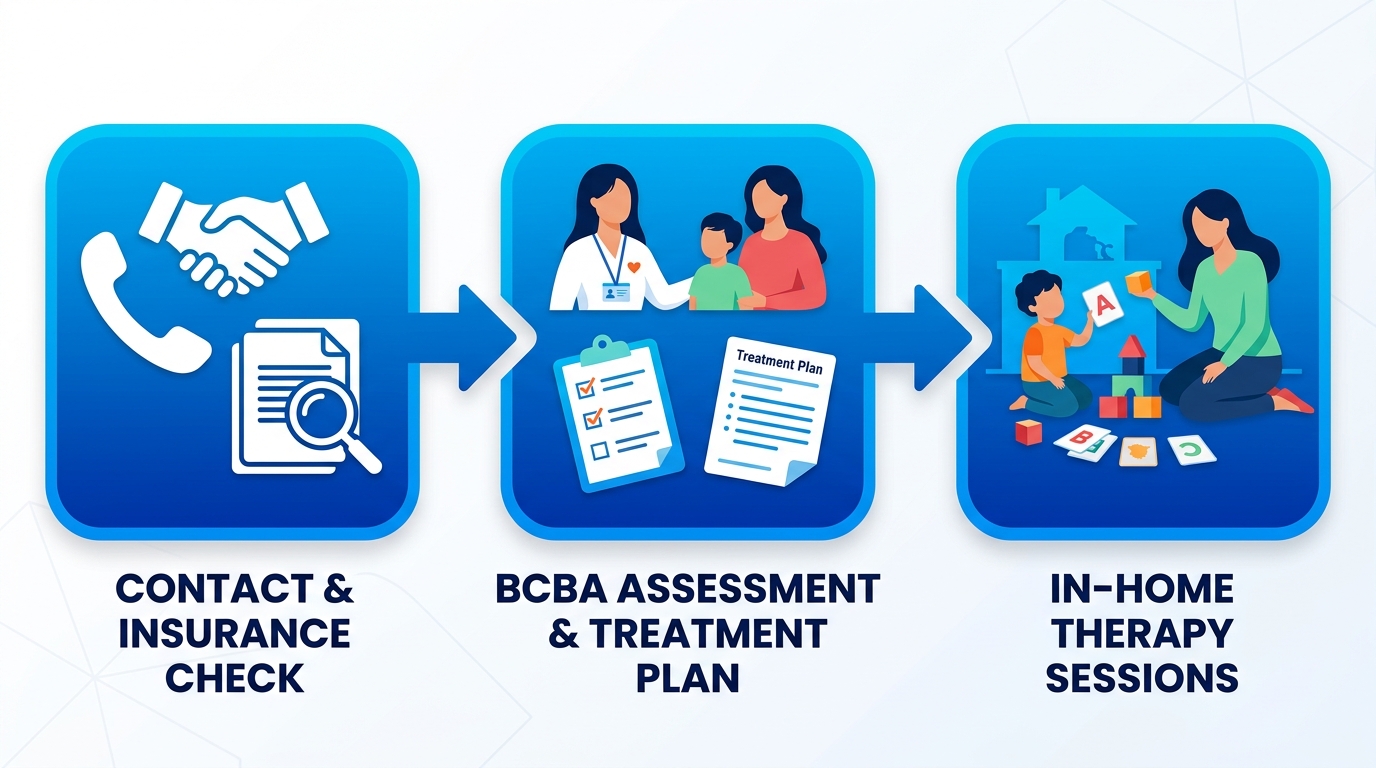
Three-step early intervention ABA therapy process at Brighter Care ABA.
Our approach unfolds in three simple steps.
The Initial Assessment and BCBA Evaluation
- Observing your child during play and daily routines to capture natural skills.
- Interviewing you and other caregivers to understand family priorities and what motivates your child.
- Collecting data on communication, social interaction, and behavior patterns.
The evaluation is designed to be comfortable and low-pressure, so your child can be themselves. Using this information, the BCBA creates a tailored treatment plan with specific, measurable goals for communication, social skills, and daily routines. This plan is not a medical diagnosis—it’s a strengths-based roadmap. We share the plan with you in detail and update it regularly as your child progresses, ensuring therapy always matches their evolving needs. You play a key role in shaping these goals, and we listen closely to your insights.
In-Home Therapy Sessions
Once the treatment plan is approved, your child begins one-on-one sessions with a kind, trained Registered Behavior Technician (RBT) right in the comfort of your home. Every session is play-based and child-led, building learning into the moments your child naturally enjoys. We use natural environment teaching (NET) to weave skill practice into everyday activities—like communication during snack time or turn-taking with a favorite toy. We also integrate pivotal response treatment (PRT), which targets critical areas such as motivation and self-initiation, helping your child become more engaged and independent.
Throughout each session, the RBT is closely supervised by your BCBA, who monitors progress and adjusts strategies based on real-time data. We count on our parents, and you are a vital part of the team. You are invited to join parts of the session to learn techniques you can use during daily routines, from mealtimes to play. This partnership helps your child generalize new skills across all the environments that matter most.
Accessing Services in Virginia and Illinois
If you are searching for “ABA therapy for preschoolers near me,” Brighter Care ABA provides home-based services in both Virginia and Illinois. Starting is simple:
- Free Consultation: Call us for a no-obligation conversation about your child’s needs.
- Insurance Benefits Check: Our team reviews your coverage and handles prior authorizations so you don’t have to.
- Assessment Scheduling: We arrange a BCBA evaluation at a convenient time, often right in your home.
- Plan Development: After the assessment, we create the treatment plan; therapy can begin as soon as insurance approves.
You’re not on your own. From your first call through every therapy session, we are by your side, answering questions and smoothing the way. Families across Illinois and Virginia rely on our local teams to bring compassionate care to their doorsteps. We can’t wait to meet your child and help them build a bright future. Whether you’re in Chicago, Richmond, or anywhere else in our service areas, our team is ready to help. Reach out today.
Best Practices for Early Intervention ABA Therapy
To maximize the benefits of early intervention, we follow several best practices. For young children, autism early intervention ABA is most effective when the therapy model emphasizes collaboration, data-driven refinement, and a consistent approach across all settings of a child’s life. Our team integrates these best practices into every personalized plan to ensure that each child receives the support they need to build critical skills.
Involving Parents and Caregivers
We believe that WE COUNT ON OUR PARENTS. Active parent and caregiver involvement is the foundation of successful autism early intervention ABA. When families are trained to implement strategies at home, skills learned during sessions are more likely to generalize to natural environments. We collaborate with families to set meaningful goals and provide daily strategies that fit into their routines.
We teach parents how to use evidence-based techniques like natural environment teaching, which embeds learning opportunities within play and daily activities. This approach, along with strategies like pivotal response treatment, empowers caregivers to reinforce communication, social, and adaptive skills outside of formal therapy hours. You’re not on your own—our BCBAs are there to guide you every step of the way, celebrating progress and adjusting strategies as your child grows. Our commitment to quality means that parent training is not an add-on but a core component of our program.
Data-Driven Adjustments and Progress Monitoring
Data is the compass that guides our therapy. Our Board Certified Behavior Analysts (BCBAs) rely on their credentialed expertise and adherence to strict BACB certification requirements to make informed, data-driven decisions. Throughout every session, our Registered Behavior Technicians (RBTs) collect detailed data on skill acquisition and behavior. This ongoing measurement allows our BCBAs to track progress, identify when a method isn’t working, and adjust goals quarterly or as a child’s needs change.
Regular BCBA supervision is central to maintaining therapy quality. Consistent oversight, which includes direct observation and fidelity checks for RBTs, ensures that every session is as effective as possible. For example, if the data shows a child is struggling to engage at a table, our team might pivot to a more play-based method like natural environment teaching, using a child’s motivations to teach new skills. This individualized, flexible approach ensures that therapy is always evolving to meet the child where they are, making every session count toward meaningful progress.
Coordinating with Schools and Other Professionals
We believe that a child’s success depends on a coordinated team. While our home-based therapy builds the foundation, collaboration with schools and other professionals is the expansion of that care. We work to align our behavior intervention plans with a child’s educational goals, ensuring consistency across all learning environments.
Our best practices for school collaboration include sharing effective ABA strategies with teachers and staff, helping to develop communication protocols, and participating in Individualized Education Program (IEP) meetings. This might involve demonstrating a pivotal response treatment technique that can be used in the classroom to increase a child’s motivation to engage. By partnering with speech therapists, occupational therapists, and educators, we create a unified support system. This team-based approach ensures that skills are reinforced whether a child is at home, in the clinic, or at school, keeping everyone focused on shared, measurable outcomes.
Succeed with ABA when best practices are put into action daily. At Brighter Care ABA, we are dedicated to providing personalized, collaborative support that empowers children and families. We walk with you through every stage of the journey, from the first assessment to school coordination, because A Bright Future is Waiting for Your Child.
Results may vary based on individual patient circumstances.
Taking the Next Steps with Early Intervention ABA
Now that you understand the profound benefits of autism early intervention ABA, it’s time to take the next step. At Brighter Care ABA, we make getting started straightforward and supportive because a bright future is waiting for your child.
The journey begins with a complimentary initial consultation. A dedicated Board Certified Behavior Analyst (BCBA) will work closely with your family to conduct a thorough evaluation, identifying your child’s unique strengths and areas for growth. From this assessment, we design a personalized, home-based treatment plan. Your child’s sessions, led by compassionate Registered Behavior Technicians (RBTs), incorporate proven methods like natural environment teaching and pivotal response treatment. This ensures skills are learned in familiar settings, making them easier to generalize. Throughout the process, you’re not on your own; we prioritize parent training so you feel confident supporting your child’s progress at every turn.
Our entire approach is grounded in science. We develop treatment plans informed by biomedical data resources to ensure our methods reflect the latest research. We also handle insurance management, so you can focus on what matters most: your child. We count on our parents as partners in this journey.
If you’re ready to help your child Succeed with ABA, contact us today. Learn more about our personalized process on our services page or visit our homepage.
Results may vary based on individual patient circumstances. Please consult with a healthcare professional for diagnosis or treatment advice.
