


Table of Contents
- Understanding BCBA vs RBT Roles in ABA Therapy
- BCBA and RBT: Core Definitions and Qualifications
- Supervision, Data Analysis, and Treatment Planning Responsibilities
- Questions to Ask When Evaluating Your ABA Team
- Building a Collaborative ABA Team for Lasting Progress
- Frequently Asked Questions About BCBA and RBT Roles
- Partnering with Brighter Care ABA for Expert Guidance
Understanding BCBA vs RBT Roles in ABA Therapy
When your child begins ABA therapy, you’ll quickly meet two important professionals: the Board Certified Behavior Analyst (BCBA) and the Registered Behavior Technician (RBT). Understanding the BCBA vs RBT roles in ABA therapy helps families see how their child’s team works together. Both roles are essential, but their responsibilities and training differ in important ways.
The BCBA’s Role
The BCBA is the clinical leader of your child’s team. According to the Behavior Analyst Certification Board (BACB), BCBAs hold a master’s degree and the BACB behavior analyst certification, which requires supervised fieldwork and a rigorous exam. At Brighter Care ABA, our BCBAs design your child’s entire treatment program—conducting behavioral assessments, writing individualized plans, supervising RBTs, providing parent training, and ensuring ethical compliance. Think of the BCBA as the architect who draws the blueprint for your child’s success.
The RBT’s Role
The RBT is the professional who spends the most hands-on time with your child, delivering the face-to-face therapy that makes progress possible. RBTs hold at least a high school diploma plus 40 hours of training and must pass a competency assessment. They implement the BCBA’s treatment plan through 1:1 direct therapy, collect data on target behaviors, and report progress back to the BCBA. If the BCBA is the architect, the RBT is the skilled builder who follows the blueprint every day.
Both roles work together under a collaborative model that ensures high-quality care. The RBT always operates under the BCBA’s supervision, and the BCBA retains clinical and legal responsibility for the entire program. We pair each child with a dedicated BCBA and RBT so families feel supported, informed, and confident. Now let’s look at how your child’s team puts the plan into action.
How BCBA and RBT Collaboration Drives Progress
Collaboration between the BCBA and RBT isn’t just a best practice—it’s the engine that drives your child’s ABA therapy forward. While each professional has distinct BCBA and RBT responsibilities, their ongoing communication ensures that every session builds on the last.
Brighter Care ABA explains that BCBAs provide supervision for at least 5% of the total monthly service hours for each client. This means the BCBA regularly observes sessions, reviews data, and refines the treatment plan based on what’s working. The RBT, in turn, brings daily observations and real-time data to these supervision meetings, giving the BCBA the detailed information needed to make smart, responsive adjustments.
For parents, understanding how the BCBA and RBT collaborate can be deeply reassuring. You’re not placing your trust in a single individual but in a dedicated team that checks and balances each other’s work. The BCBA ensures the program stays clinically sound, ethical, and customized to your child’s developmental needs. The RBT ensures that plan comes to life with warmth, consistency, and attention to detail during every session. Together, they create a feedback loop that continuously improves outcomes.
You’re not on your own. With both a BCBA and RBT on your child’s team, you have two professionals who see your child’s progress from complementary angles and work together to help them thrive in home, school, and community settings.
BCBA and RBT: Core Definitions and Qualifications
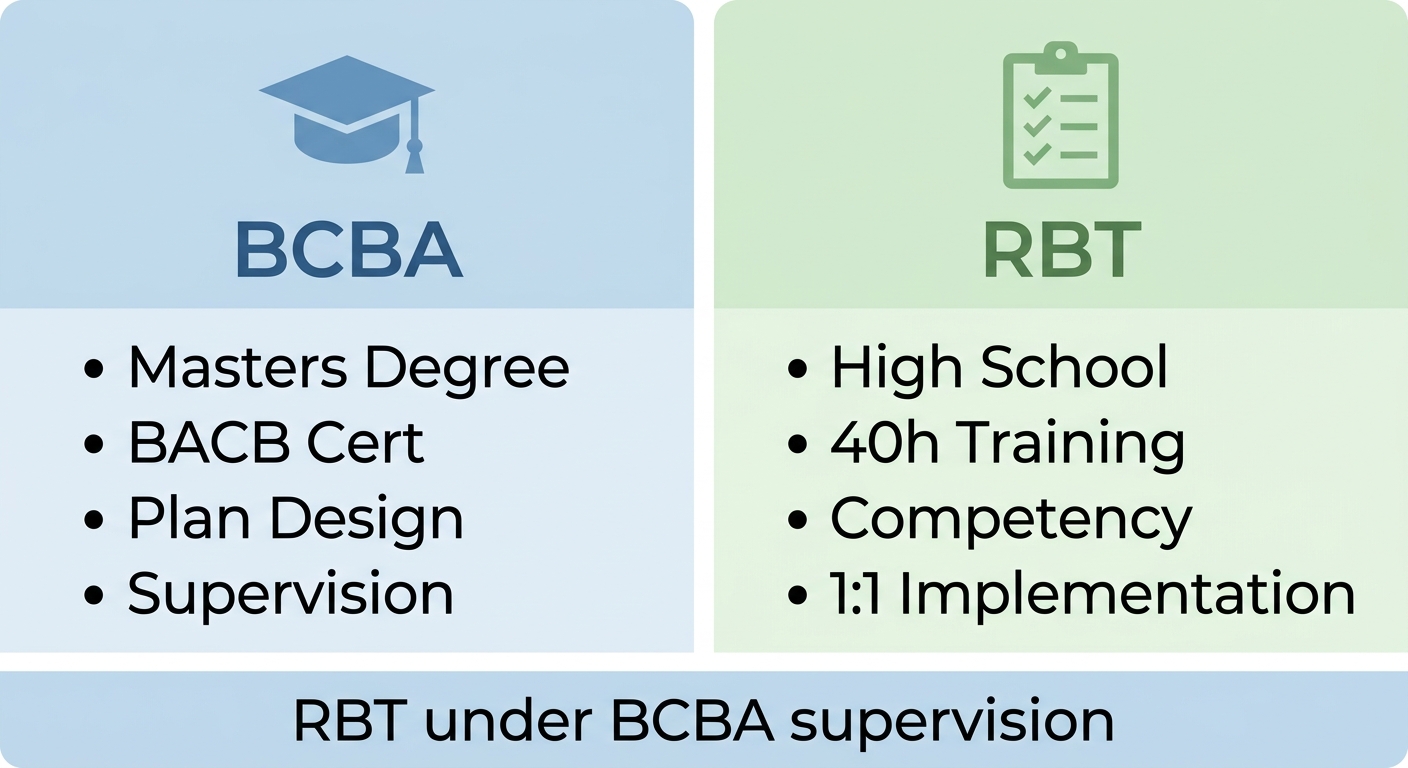
A successful ABA therapy program relies on two dedicated professionals working seamlessly together: the Board Certified Behavior Analyst (BCBA) and the Registered Behavior Technician (RBT). Understanding bcba vs rbt roles in aba therapy helps families see how our team collaborates to deliver personalized, effective care right in your home. While both roles are essential, their qualifications, responsibilities, and scope of practice differ significantly. The table below outlines the key differences between a BCBA and an RBT.
| Aspect | BCBA | RBT |
|---|---|---|
| Education | Master’s degree in behavior analysis or related field | High school diploma (or higher) plus 40-hour training |
| Certification | Board Certified Behavior Analyst (BACB exam) | Registered Behavior Technician (BACB exam and competency) |
| Typical duties | Assessments, treatment plan design, data analysis, supervision | Direct 1:1 implementation of plans, data collection |
| Supervision role | Provides supervision to RBTs (5% of service hours minimum) | Receives supervision from BCBA |
| Can design treatment plans? | Yes | No |
The comparison reveals a clear hierarchy designed to maximize the quality and consistency of your child’s therapy. The BCBA serves as the clinical expert, while the RBT brings that expertise to life through daily, hands-on interaction. Together, they create a dynamic partnership that ensures every session is both evidence-based and responsive to your child’s progress.
The Critical Divide in Scope of Practice
The most important distinction between the two roles lies in who designs the treatment plan and who implements it. A BCBA holds a Master’s degree in behavior analysis or a related field and has passed the rigorous BACB certification exam. According to the Behavior Analyst Certification Board (BACB), BCBAs are responsible for conducting comprehensive assessments, analyzing behavioral data, and designing individualized treatment plans that target the specific skills your child needs to develop. They also carry a critical supervisory responsibility: BCBA supervision requirements include a minimum of 5% of total service hours spent directly overseeing the RBT’s work. This supervision ensures treatment fidelity—meaning the plan is being followed correctly—and provides ongoing opportunities to adjust strategies based on real-time data.
An RBT, by contrast, works under the close, ongoing direction of the BCBA. To become certified, an RBT must hold at least a high school diploma, complete a 40-hour training program, and pass both a competency assessment and a BACB examination. As detailed in our guide on the RBT test content outline, this training focuses on four core domains: measurement, assessment, behavior intervention, and documentation. During each home-based session, our RBTs implement the BCBA’s plan through direct one-on-one activities with your child. They collect objective data on every response—how often a skill is demonstrated, how long a behavior lasts—without modifying the core plan itself. If an RBT observes something unexpected or believes an adjustment could help, they bring that insight to their supervising BCBA, who then decides whether and how to refine the approach.
BCBA vs RBT: qualifications and roles overview
This structured collaboration is what makes home-based ABA therapy so powerful. Our BCBAs and RBTs work together in your home, weaving therapeutic goals into your family’s natural routines. The BCBA’s expertise guides the strategy, while the RBT’s consistent presence builds trust and momentum with your child. Understanding these roles sets the stage for how our BCBAs and RBTs work together in your child’s ABA program.
Supervision, Data Analysis, and Treatment Planning Responsibilities
Building on the general roles, this section dives into the specific supervision and planning responsibilities that set BCBAs and RBTs apart. Understanding BCBA vs RBT roles in ABA therapy is essential for choosing the right support for your child. We ensure that every program we design is overseen by a dedicated Board Certified Behavior Analyst who guides the team, analyzes data, and refines your child’s plan as they learn and grow. You’re not on your own — our clinical leadership team provides the structure and expertise that help your family succeed.
BCBA Supervision Requirements and Frequency
Our BCBAs provide direct, ongoing oversight of your child’s therapy team to ensure treatment is delivered with the highest quality and integrity. According to BCBA supervision requirements, BCBAs must provide at least 5% of the total service hours delivered by an RBT as supervision each month. This means that for every 20 hours of direct therapy, your child’s BCBA will spend at least one hour observing sessions, modeling techniques, and providing feedback. Supervision can take place in person or through secure remote modalities, and every session is documented with signed records from both the BCBA and the RBT to maintain compliance and transparency.
This consistent oversight allows us to catch subtle changes in your child’s progress early and adjust programming before small challenges become larger obstacles. The skilled professional overseeing your child’s care may be a BCBA, a BCBA-D, or a Board Certified Assistant Behavior Analyst (BCaBA) who has completed the required supervision training. Regardless of which qualified clinician leads your team, you can expect regular check-ins and the reassurance of knowing an expert is actively guiding every session.
The following table illustrates how supervision, data analysis, and treatment planning responsibilities are divided between BCBAs and RBTs:
| Responsibility | BCBA | RBT |
|---|---|---|
| Initial assessment of child | Conducts functional assessments and establishes baselines | May assist with data collection during assessment |
| Treatment plan design | Sole responsibility – individualizes goals and interventions | Implements plan as written |
| Data analysis and progress monitoring | Analyzes graphed data, adjusts goals, writes progress reports | Collects trial-by-trial or session data |
| Supervision of RBT | Provides minimum 5% of service hours as supervision; observes sessions, gives feedback | Receives supervision, asks clarifying questions |
| Parent/caregiver training | Delivers parent training sessions, models strategies | Reinforces strategies during sessions |
This clear separation of duties ensures that the person designing and adjusting your child’s treatment has the advanced training and experience to make sound clinical decisions, while your child benefits from consistent, caring direct therapy delivered by a well-supported RBT.
Who Analyzes Progress Data?
Only the BCBA is responsible for analyzing your child’s progress data. While your RBT carefully records trial-by-trial responses, prompt levels, and session notes, these data points are handed off to the BCBA for interpretation. Our BCBAs review graphed data regularly — visual analysis of trend, level, and variability is a foundational skill in ABA — and use those insights to determine whether a skill has been mastered, whether a goal needs more intensive teaching, or whether a new target should be introduced. As an internal Brighter Care ABA FAQ explains, the BCBA serves as the primary clinical architect, designing and refining interventions based on data-driven decision-making.
RBTs play a vital role in this process by collecting accurate, real-time data, but they do not make programming decisions. The Behavior Analyst Certification Board’s RBT Task List confirms that the RBT’s role is limited to data collection and implementing the treatment plan as written. This structure protects your child by ensuring that every programming change is made by a master’s- or doctoral-level clinician who has demonstrated competency in behavior analytic assessment and intervention.
Can an RBT Design a Treatment Plan?
An RBT cannot design or modify a treatment plan under any circumstances. This question is at the heart of the BCBA vs RBT roles in ABA therapy distinction: treatment plan design is the sole responsibility of the BCBA. The BCBA conducts the initial functional assessment, selects evidence-based interventions, writes measurable goals, and individualizes every aspect of the program to your child’s unique strengths and needs. Using the RBT test content outline as a guide, we can confirm that the RBT’s scope of practice is focused on implementation — carrying out skill-acquisition and behavior-reduction protocols exactly as written — not on creating or changing those protocols.
When questions or challenges arise during a session, our RBTs consult with the supervising BCBA rather than making independent adjustments. This chain of accountability keeps your child’s program safe, consistent, and aligned with the latest clinical research. Understanding these responsibilities sets the stage for how BCBAs and RBTs work together day-to-day to deliver compassionate, coordinated care.
Results may vary based on individual patient circumstances.
Questions to Ask When Evaluating Your ABA Team
Now that you understand who makes up your ABA therapy team, here are the key questions to ask when evaluating them. Understanding the BCBA vs RBT roles in ABA therapy will help you advocate effectively for your child’s care and ensure you have the right professionals supporting your family’s journey.
We believe that empowered parents are essential partners in the therapeutic process. When you know what to look for in a qualified team, you can feel confident that your child is receiving evidence-based, high-quality services. We’ll walk you through the most important questions to ask about each professional on your team, from their training background to how they involve you in your child’s progress.
What Qualifications Should a Behavior Technician Have?
Registered Behavior Technicians, or RBTs, are the professionals who work directly with your child during most therapy sessions. Under the close supervision of a BCBA, they implement the individualized treatment plan and collect essential data that guides clinical decision-making. We want you to know exactly what to look for when evaluating an RBT’s qualifications.
Every RBT must complete a minimum of 40 hours of formal training covering the core principles of applied behavior analysis and ethical practice. After completing this training, they must pass a competency assessment conducted by a qualified BCBA and then sit for the official BACB examination. We recommend asking for the RBT’s BACB certification number directly so you can verify their active status on the BACB registry. This step ensures the professional working with your child maintains current, valid certification.
We also advise asking about the supervision structure that supports their RBT. A well-supported RBT receives regular direct observation and feedback from the supervising BCBA, which improves treatment fidelity and your child’s outcomes. You’re not on your own in navigating this process; our team is always available to discuss any team member’s credentials and supervision arrangements openly.
How to Evaluate a BCBA’s Experience and Credentials
The Board Certified Behavior Analyst, or BCBA, is the clinical leader who designs your child’s entire treatment program, oversees implementation, and makes data-based adjustments to goals and strategies. Evaluating a BCBA’s background involves more than checking a certification number—though that remains an essential first step.
BCBAs must hold a master’s degree in behavior analysis or a closely related field, pass the comprehensive BACB certification examination, and complete ongoing continuing education units (CEUs) to maintain their certification. Where state licensure applies, they must also hold an active LBA license. We encourage you to ask prospective BCBAs how many years they have worked with children who have similar diagnoses and needs—including your child’s age, communication level, and specific challenges. Experience with similar cases often translates into more nuanced, effective programming.
Understanding the differences between BCBA and RBT responsibilities will help you direct your questions appropriately. While the RBT focuses on daily implementation and data collection, the BCBA analyzes that data, modifies treatment plans, and leads parent training and goal-setting meetings. We believe transparency about these roles builds trust and leads to better collaboration.
The following table provides a quick-reference guide to help you ask the right questions to the right professional:
| Question | Best for BCBA | Best for RBT |
|---|---|---|
| What is your supervision schedule? | Yes – BCBA sets and communicates supervision. | No – RBT may not know the detailed schedule. |
| How do you collect and record data? | Partial – BCBA explains the system. | Yes – RBT is the primary data collector. |
| What training and certification do you hold? | Yes – BCBA holds master’s and BACB cert. | Yes – RBT has 40-hour training and BACB cert. |
| How will you involve me in my child’s progress? | Yes – BCBA leads parent training and meetings. | Partial – RBT shares session notes but does not lead training. |
These questions highlight how BCBAs and RBTs work together, each contributing distinct but complementary expertise to your child’s program. When you ask about supervision, for example, the BCBA can explain the structure and frequency of oversight, while the RBT can describe how feedback from supervision shapes their day-to-day sessions. The question about data collection reveals another key difference: the BCBA designs the measurement system and interprets trends, while the RBT faithfully records every trial and behavior during each session.
Understanding the Role of Caregiver Consultation
Caregiver consultation is one of the most valuable components of a comprehensive ABA program, yet families sometimes overlook its importance when evaluating a therapy team. These sessions are dedicated times when you work directly with your BCBA to learn strategies for reinforcing your child’s skills outside of formal therapy hours.
According to Brighter Care ABA’s caregiver consultation resources, autism caregiver consultation sessions typically occur weekly or biweekly and focus on reviewing progress, setting collaborative goals, and equipping you with practical techniques to use at home and in the community. The BCBA will help you understand how to respond consistently to behaviors, use positive reinforcement effectively, and incorporate learning opportunities into everyday routines. We count on our parents as essential partners, and these sessions ensure you have the training and confidence to support your child’s growth.
We also encourage you to ask about the format of these consultations—some families prefer in-person meetings, while others benefit from remote check-ins when schedules are tight. Clarifying expectations early helps you build a strong working relationship with your BCBA and ensures you receive the guidance you need. Our team manages the details of scheduling and coordination so that you can focus on what matters most: learning how to help your child thrive.
Once you’ve asked these questions, you’ll be ready to move forward with a team that fits your child’s needs. A bright future is waiting for your child, and we’re here to support you through every step of that journey.
Results may vary based on individual patient circumstances. Please consult with a healthcare professional for diagnosis or treatment advice.
Building a Collaborative ABA Team for Lasting Progress
Now, let’s look at how we build a collaborative ABA team that works together for your child’s lasting progress. Understanding the distinct roles of BCBA vs RBT in ABA therapy is the first step. At Brighter Care ABA, we believe that a coordinated team—which includes Board Certified Behavior Analysts, Registered Behavior Technicians, and you—creates the consistency needed for meaningful growth.
A Board Certified Behavior Analyst (BCBA) evaluates your child, designs a personalized intervention plan, and provides ongoing supervision. Registered Behavior Technicians (RBTs) deliver one-on-one therapy sessions, implementing the plan and collecting data on every response. According to our supervision guidelines, RBTs receive at least 5% of their service hours in direct observation and review, with a minimum of one hour per client per month—this ensures fidelity and allows the BCBA to make real-time adjustments. We also hold regular team meetings and data reviews to make individualized adjustments to the plan. When BCBA and RBT responsibilities are combined with clear communication, your child benefits from a seamless, data-driven approach that adapts to their progress.
Parents are an integral part of our team. Through training and ongoing communication, you help us understand your child’s strengths and priorities. When we work together to reinforce communication, self-care, and social skills across home, school, and community settings, your child learns to use new abilities wherever they go. Our functional skills guide shows that active caregiver involvement is key to generalizing skills. We count on our parents, and you’re not on your own—our team provides the coaching and support you need.
With a strong team in place, we can track progress and adjust strategies to keep moving forward. That’s how we help your child Succeed with ABA—because we believe a Bright Future is Waiting for Your Child. Results may vary based on individual patient circumstances.
Frequently Asked Questions About BCBA and RBT Roles
One of the most common questions we hear is about the bcba vs rbt roles in aba therapy – here we break down the differences.
What is the difference between a BCBA and an RBT?
Our Board Certified Behavior Analysts (BCBAs) design and oversee treatment plans. Registered Behavior Technicians (RBTs) implement therapy one-on-one with children under BCBA supervision.
How many supervision hours does an RBT need from a BCBA?
Per our guidelines, RBTs must have at least 5% of their service hours supervised by a BCBA, with a minimum of one hour per client monthly.
What is the role of a BCBA in a child’s ABA program?
BCBAs conduct assessments, modify plans based on progress data, and provide parent training so skills can be practiced at home.
If you have more questions, please reach out to our team—we’re happy to help.
Partnering with Brighter Care ABA for Expert Guidance
At Brighter Care ABA, our Board Certified Behavior Analysts (BCBAs) are at the center of every child’s program—they create a tailored treatment plan after a detailed assessment and continuously monitor progress. They supervise our Registered Behavior Technicians (RBTs) to ensure therapy is delivered with fidelity, offer parent training to support skill generalization at home, and manage insurance paperwork so you experience less stress. We believe in true partnership: we count on our parents as essential members of the team, and we’re here to guide families in Illinois and Virginia every step of the way. You’re not on your own—together, we’ll work toward your child’s bright future. Results may vary based on individual patient circumstances.
